Dusting off the Olympus Stylus Epic

I bought my first Olympus Stylus Epic in 2004 and fell in love. I’ve owned one ever since. That original copy was replaced in 2012 for $10, in the box, from a guy on Craigslist. Those days are gone. These little fellas have grown quite a following and fetch upwards of $300 on eBay. I’m not going to be paying that much once this one dies.

Mine has been collecting dust in a drawer for a year or two, which is a shame, so took it out today and loaded it with a roll of HP5+. No sense trying to preserve it, right?

Permalink #

Pilot Custom 823 Fountain Pen

It’s been a while since I bought a new fountain pen. This is about the Pilot Custom 823.

Literally every review I’ve read says the same things: “It’s not a looker, but what a great writer!” I can only resist that kind of consensus for so long, so I bought one. I have the “smoke” color with a fine nib. I ordered it from JetPens for $270. I’d say this puts it well into significant purchase territory, so I was very excited when it arrived. I’ve been journaling quite a lot recently and was looking forward to spending time with what reviewers call one of the best every day writers.

I’d like to tell you that it was love at first write, but that wasn’t the case. The pen looks fine, if a little boring. I didn’t get it for its looks, so I don’t mind. The pen feels very good in hand, too. This is important. It’s not too heavy or unbalanced, either with the cap posted or not.

It’s a vacuum filler, which is apparently unusual but I’m not sure why, as it’s super easy to fill. It holds a lot of ink, too. This does make it more difficult to switch inks, but I don’t switch often so this isn’t a problem.

So what’s not to love, then? Well, I didn’t love how it wrote. I bought the pen to write with and not look at, so this was a problem. It felt somewhat scratchy and skipped more often than I’m used to. At first I thought of it simply as “feedback” but it was worse than just feedback. It felt dry. I’m left-handed, so any scratchiness in a pen is amplified. This was disappointing.

I thought maybe I had received a bum copy, but I’m loathe to ship things back and wait so I’d try a few things before giving up.

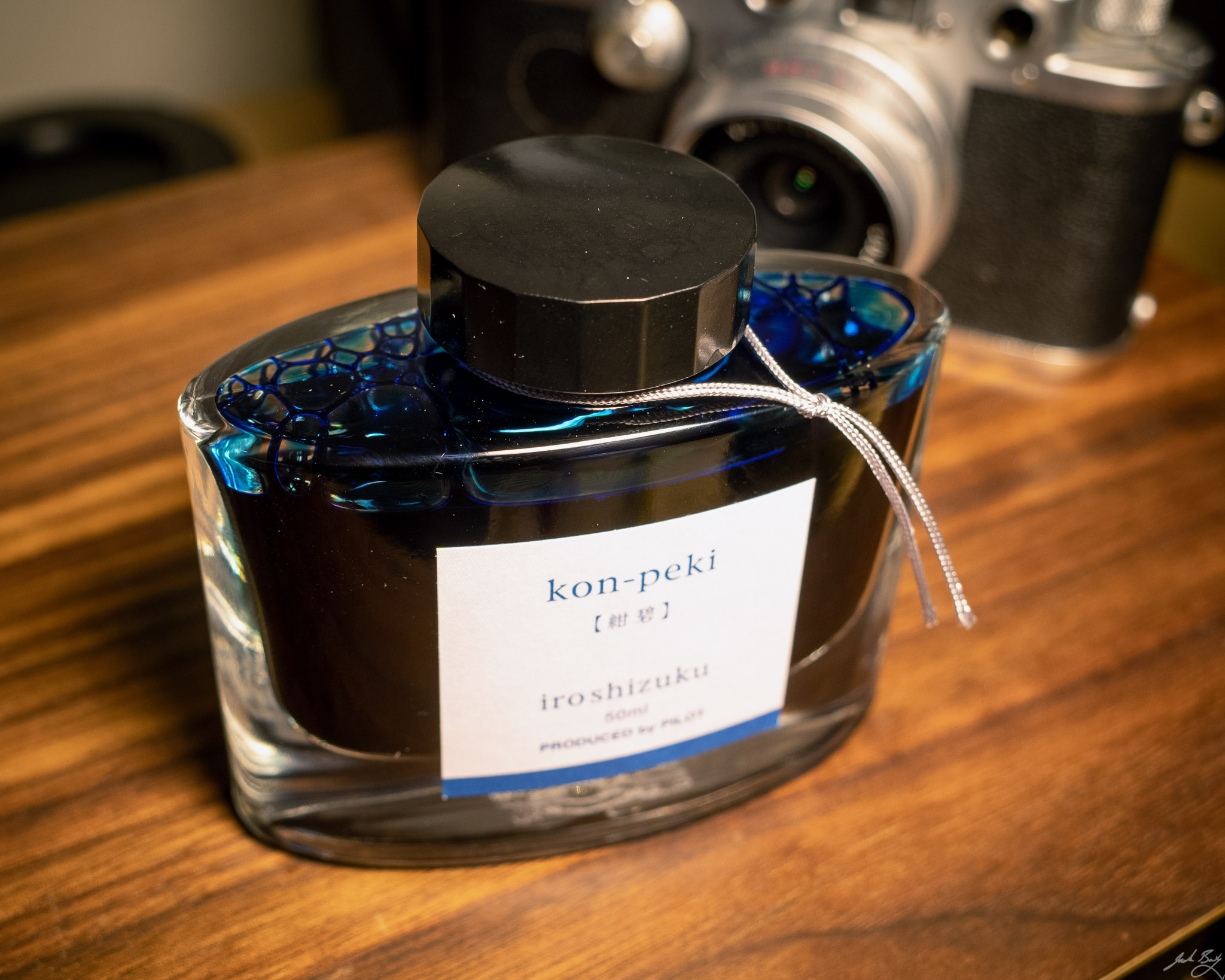
First, I ran it with wetter ink. I typically use one of the quick-drying Nooder inks like Bernanke Blue, but thought something wetter might fare better. I ordered Pilot iroshizuku kon-pecki ink and it was an immediate improvement. Also, what a great ink!

Pilot iroshizuku “kon-peki”

Then, I spent some time writing in a Midori notebook. Maybe I got an off copy of the Leuchtturm notebook I have been using, but writing in the Midori made a huge improvement.

So the problem wasn’t with the pen, necessarily. It was just a combination of the fine nib, dry ink, mediocre paper, and being left-handed.

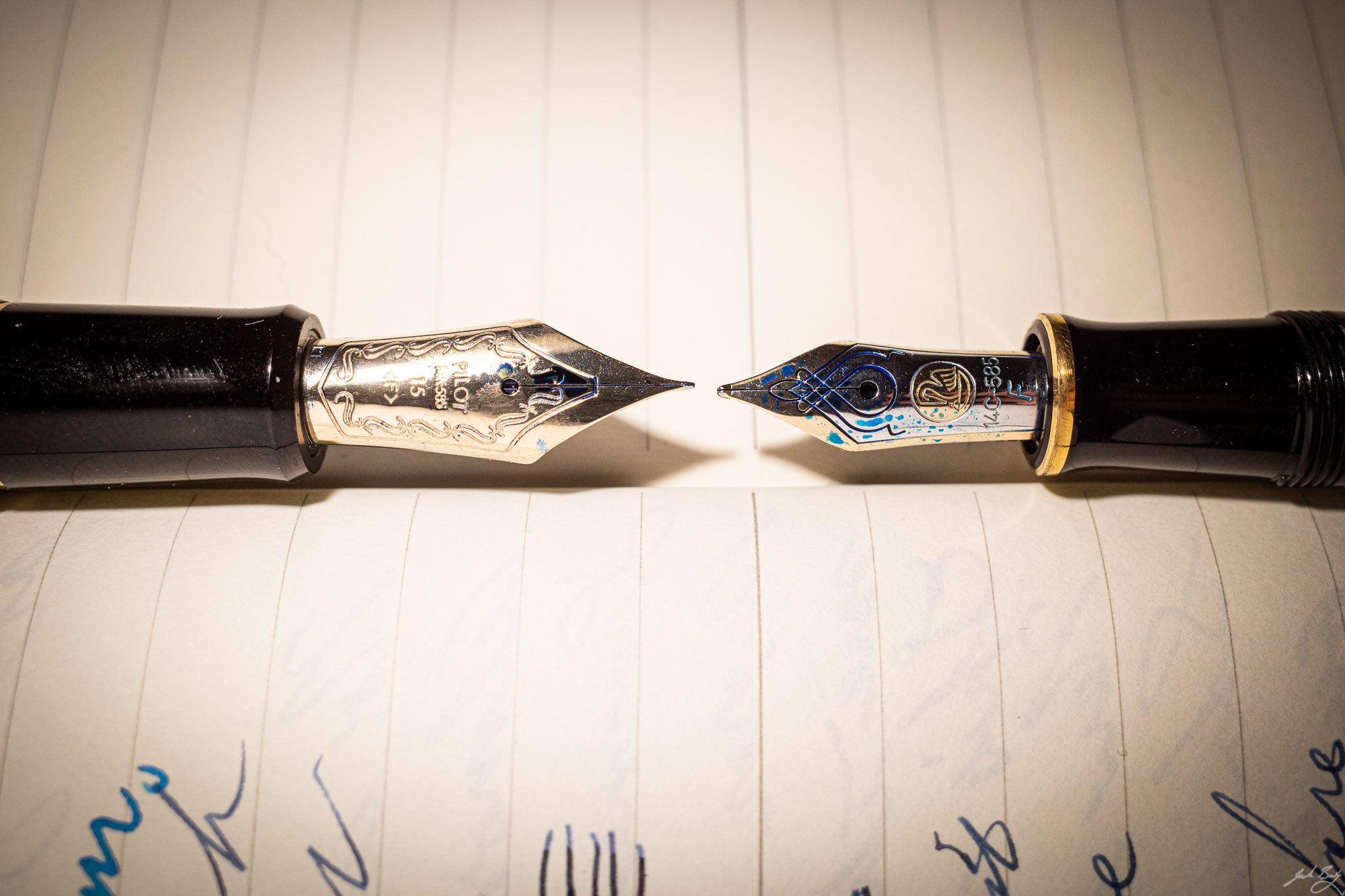
Things were much better, but I still wasn’t thrilled with how it wrote. I wondered if maybe the nib was simply too fine. Japanese pen makers’ idea of “fine” is different than that of the German pen makers. Here’s a comparison between the fine nib on the Pilot and that on the Pelikan M400.

Left: Pilot Custom 823 Fine. Right: Pelikan Souverine M400 Fine.

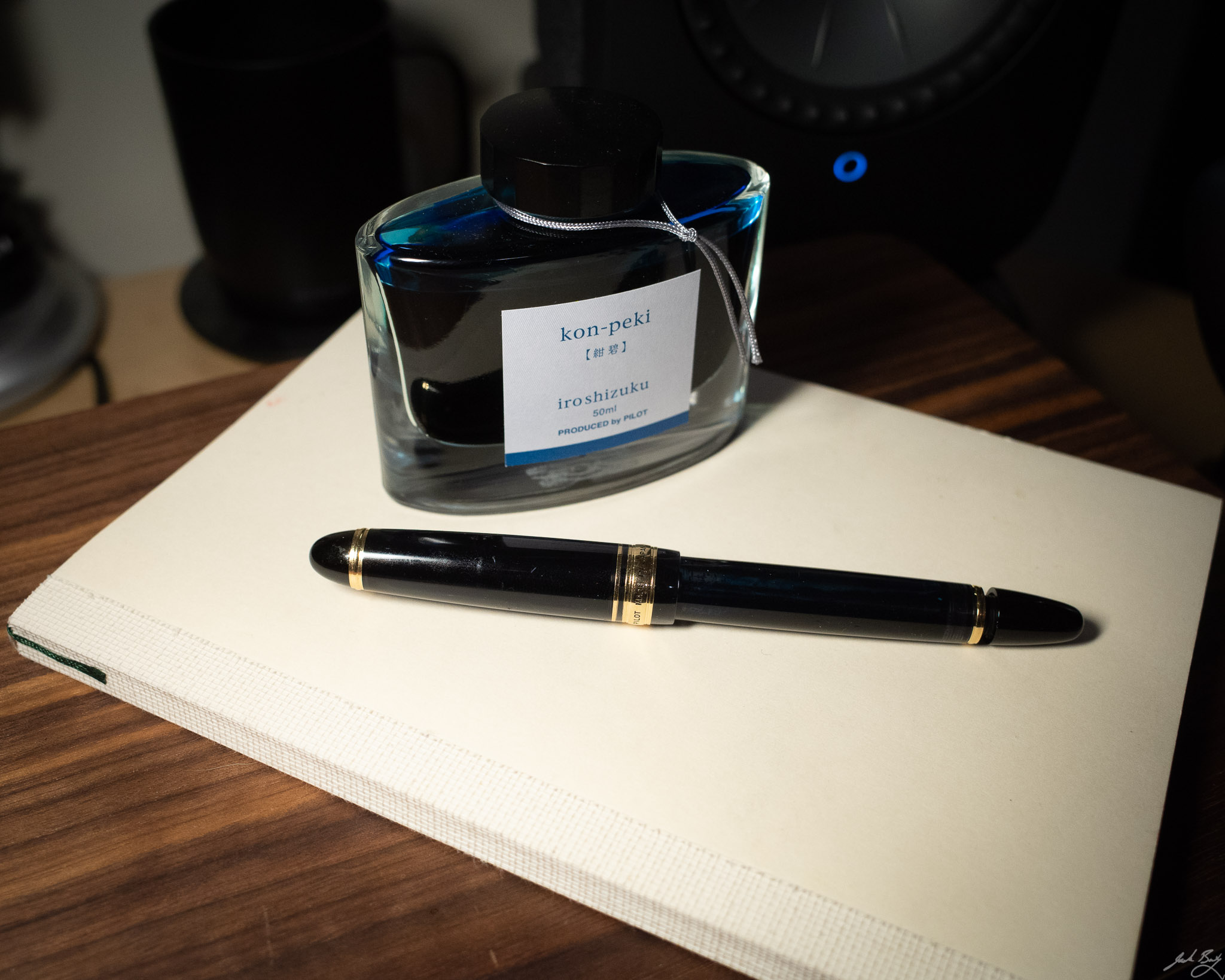
I had to find out, so I ordered another Custom 823, but with a medium nib. After a day with the new pen, I’ve concluded that it’s perfect. The combination of better paper, wetter ink, and broader nib is wonderful. This is my new favorite crew.

Pilot Custom 823, Pilot “kon-peki” ink, and Midori MD notebook.
Permalink #

Remote workers and their diapered managers

My feelings about remote work are evolving, and I’m working through them, but social media makes it difficult because social media almost forces us to pick a side and run hard with it. Nuance is left at the curb, along with rational discussions.

The above tweet demonstrates the kind of thing I see from people who’ve never had an employee who wanted to work remotely, but was incapable of being productive that way. That is a situation that exists. What should be done? My first reaction is termination. Problem solved!. How’s that for adult pants? But seriously, I don’t have a good answer. I don’t think the answer is automatically, “just give every employee the choice.”

I could have chosen any number of tweets along these lines as example, but Bell is someone I enjoy following and this tweet in particular triggered me with the “adult pants” phrase. Managers, even good ones, sometimes struggle making difficult decisions (which I assume he means by “putting on adult pants”). So? Who doesn’t?

I’ve been managing a handful of people for 25 years. In most cases, I’m entirely OK with them working remotely. Basically, I’m a fan of remote work, and prefer it for all the reasons made by its proponents.

However, I don’t agree that remote work is automatically the best option for every person and for every company. Maybe you work for one of those companies. You might even be one of those people for whom remote work is counterproductive (and you probably don’t even know it.)

So at least maybe don’t assume that every example of “I’d like you in the office” is a case of a bad manager just wanting to watch over the shoulder of a “body in a seat.” It could be that, but it also might not be.

Nuance, is all I’m saying.

Permalink #

Selling cameras is usually a mistake

I've owned a lot of cameras and lenses.

More than average, I’d say. I’ve of course sold more than I currently own. With few exceptions, I regret selling any of them.

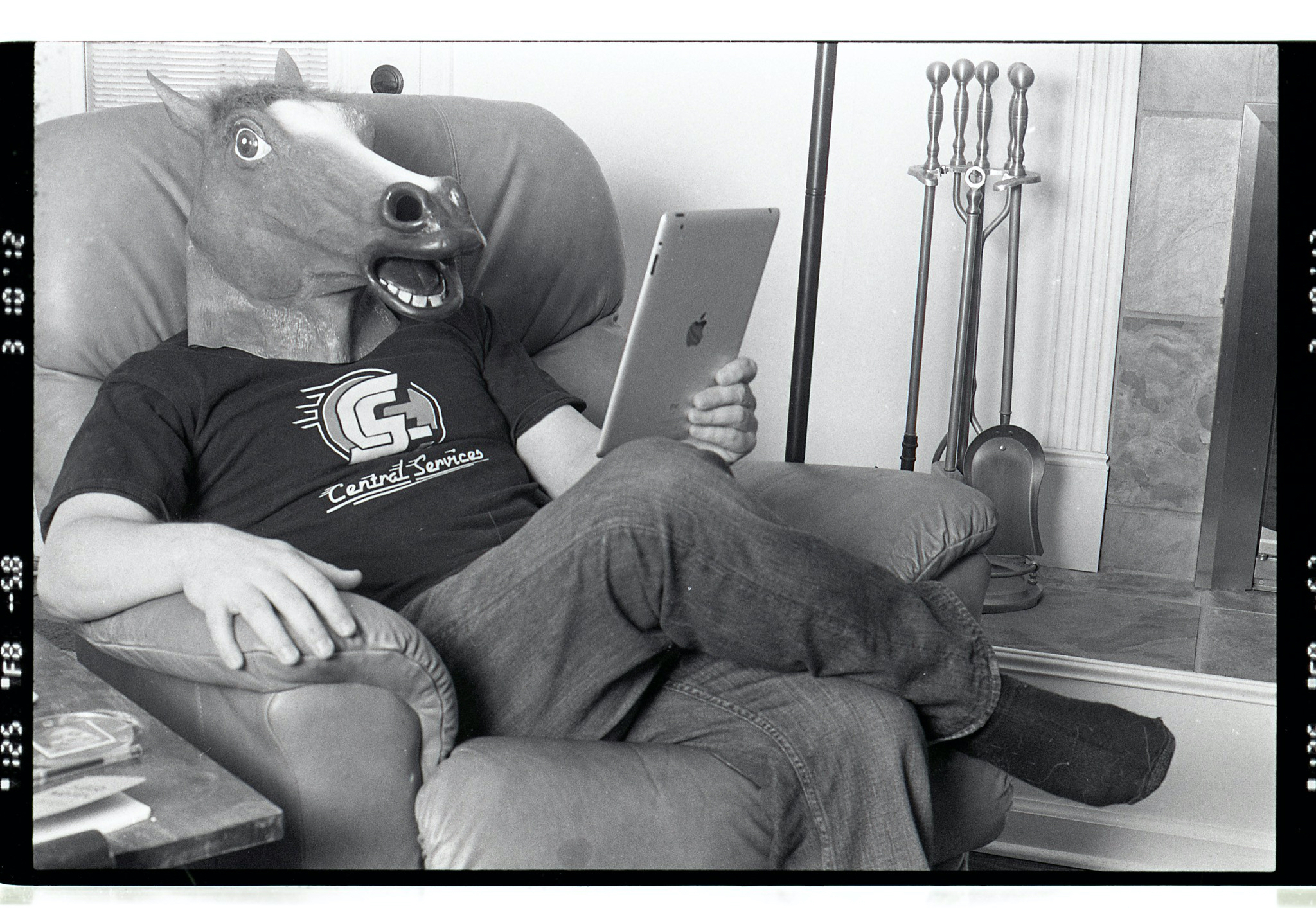
Remember how the Nikon F6 printed exposure data between frames?

Self-portrait with horse head. Nikon F6.

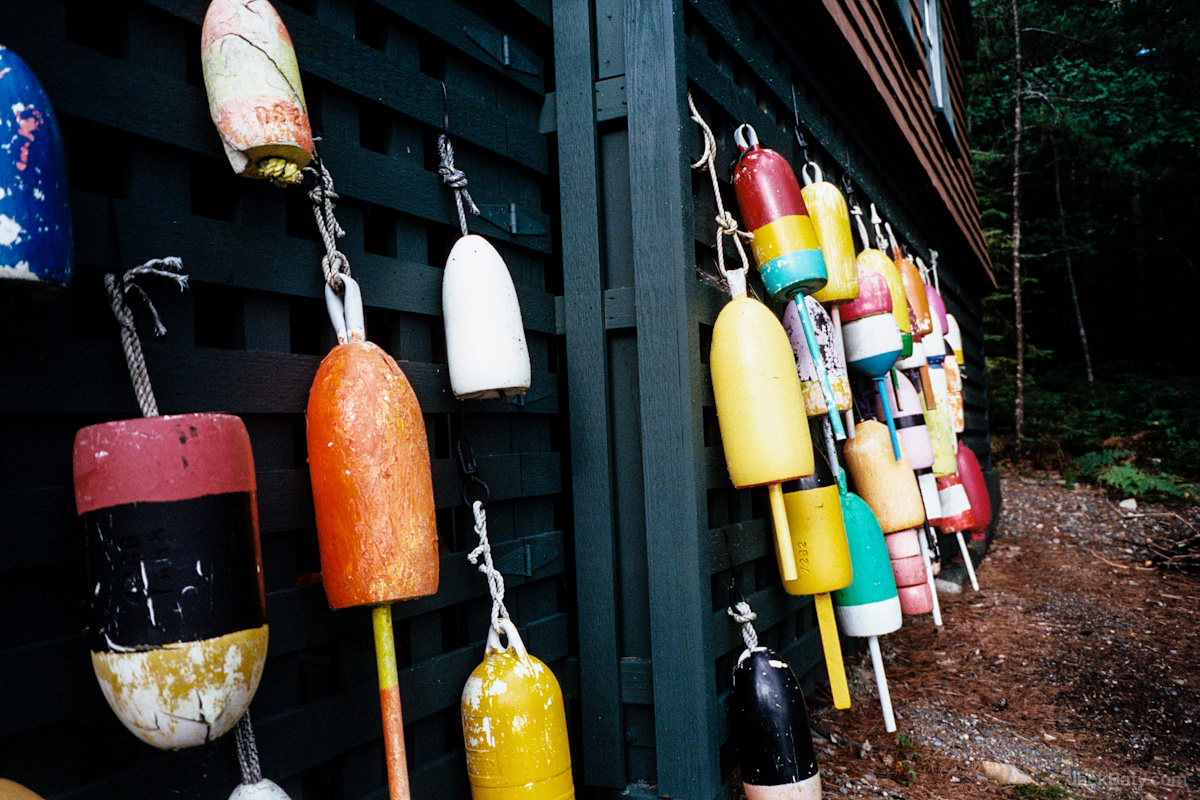
Or how nice it was having aperture-priority auto-exposure on the Leica M7?

Lobster Buoys. Mount Desert, Maine.

Or the Mamiya 6 with its giant square negatives in an easy-to-shoot package?

Self-portrait with eggs. Mamiya 6.

I’ve been thinking about this lately while pondering all of the money I have tied up in various cameras and how infrequently I use some of them. My head tells me to sell everything I’m not using often, but my heart won’t let me. I always, always regret selling camera gear, so I think I’ll hang onto all of it for now. At least until circumstances dictate that I cannot.

Permalink #

A reluctant Lightroom user

I've never loved editing photos in Adobe's Lightroom (Classic). It does the job fine, and it has all the tools one might need, but it's no fun. I prefer editing with Capture One Pro.

As much as I enjoy the editing process in Capture One, it otherwise feels like working on an island. C1 has no way to sync photos, the plugin/extension options are very limited, and while it works with other editors, it doesn’t do it as seamlessly as Lightroom. And so on.

Lightroom’s ecosystem is hard to beat. It works with nearly everything. I can sync with the mobile Lightroom CC library. It works with every plugin one could possibly want (most notably, Jeffrey Friedl’s and Negative Lab Pro.) There’s no end to the presets and styles available. If I want to do something with a photo, Lightroom is more likely to be able to handle it.

Lightroom’s cataloging is more capable than Capture One’s. Or at least it feels easier to use. I’d prefer not having to rely on a specific vendor’s tool for managing my lifetime of photos, but it’s better than only having them scattered in folders. Believe me, I’ve tried it that way numerous times. It’s liberating, but only for a moment, then it quickly becomes frustrating.

And of course I don’t like having to pay a monthly subscription to Adobe. That said, for $20 a month I get Lightroom Classic, Photoshop, Lightroom CC on all my devices, and 1TB of cloud storage. It’s a pretty good deal.

While I’m still looking for excuses to go back to Capture One, I am, reluctantly, back in Lightroom Classic for the majority of my photo management. For now.

Permalink #

Joys of well-engineered mechanical devices – Macfilos

Keith James, Macfilos:

Perhaps because life in the third decade of the twenty-first century, for those of us in technologically developed countries, seems to involve almost total submersion in an ocean of digital devices, I suspect I am not the only one who enjoys occasionally being cast away on an island of mechanical wonder, where devices involve moving parts more than moving electrons.

Mmmm, mechanical memories.

Permalink #

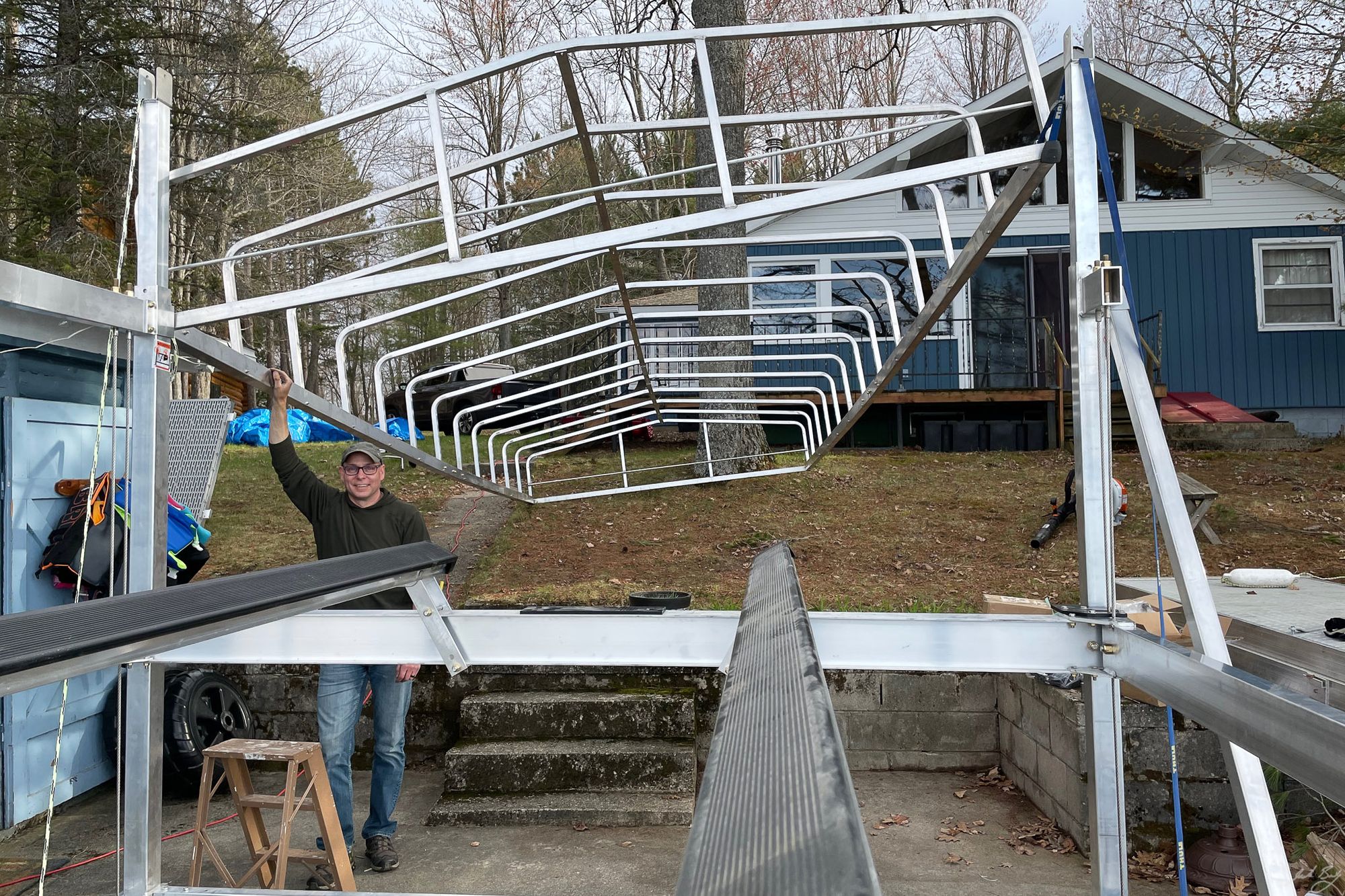
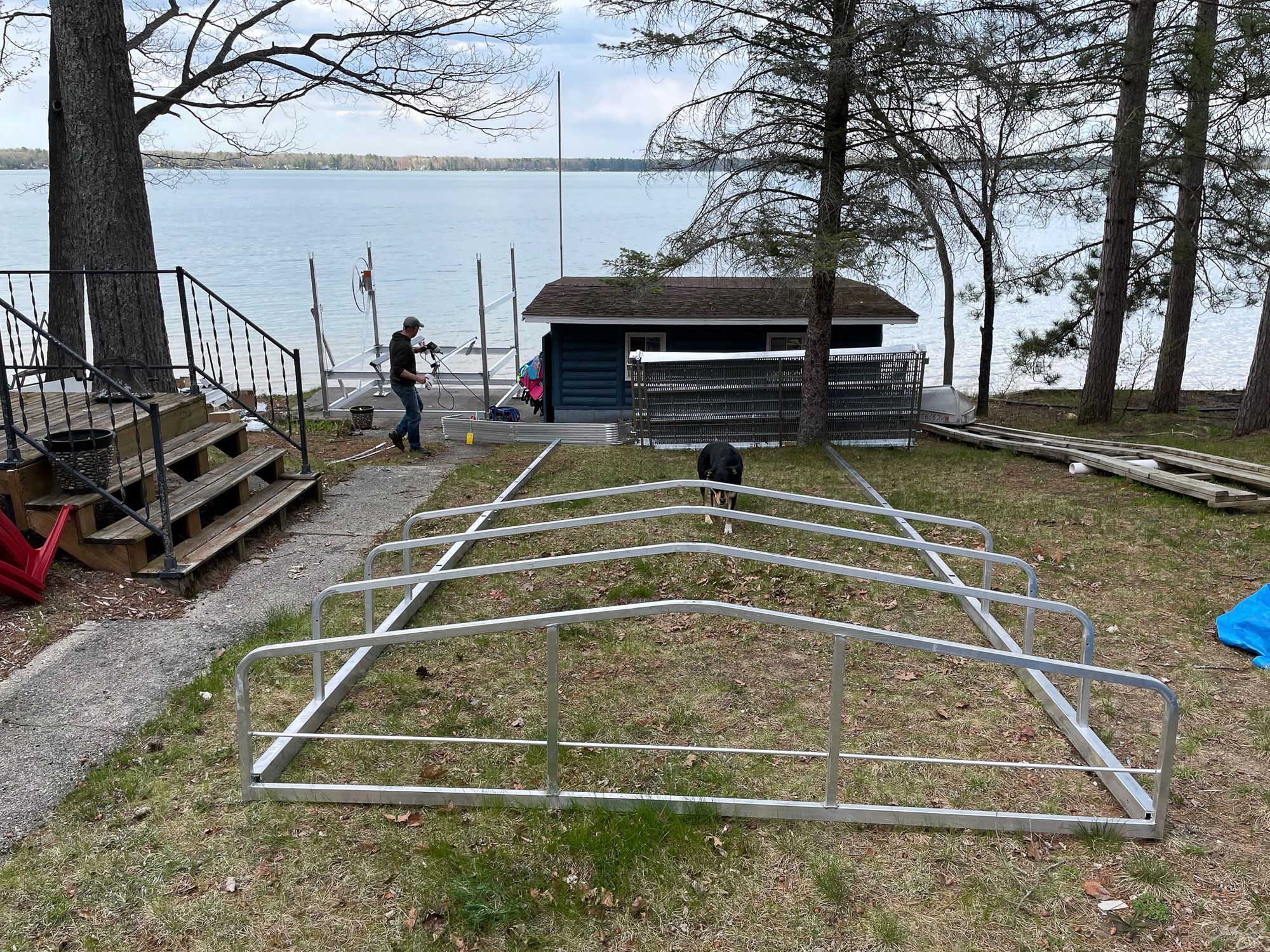
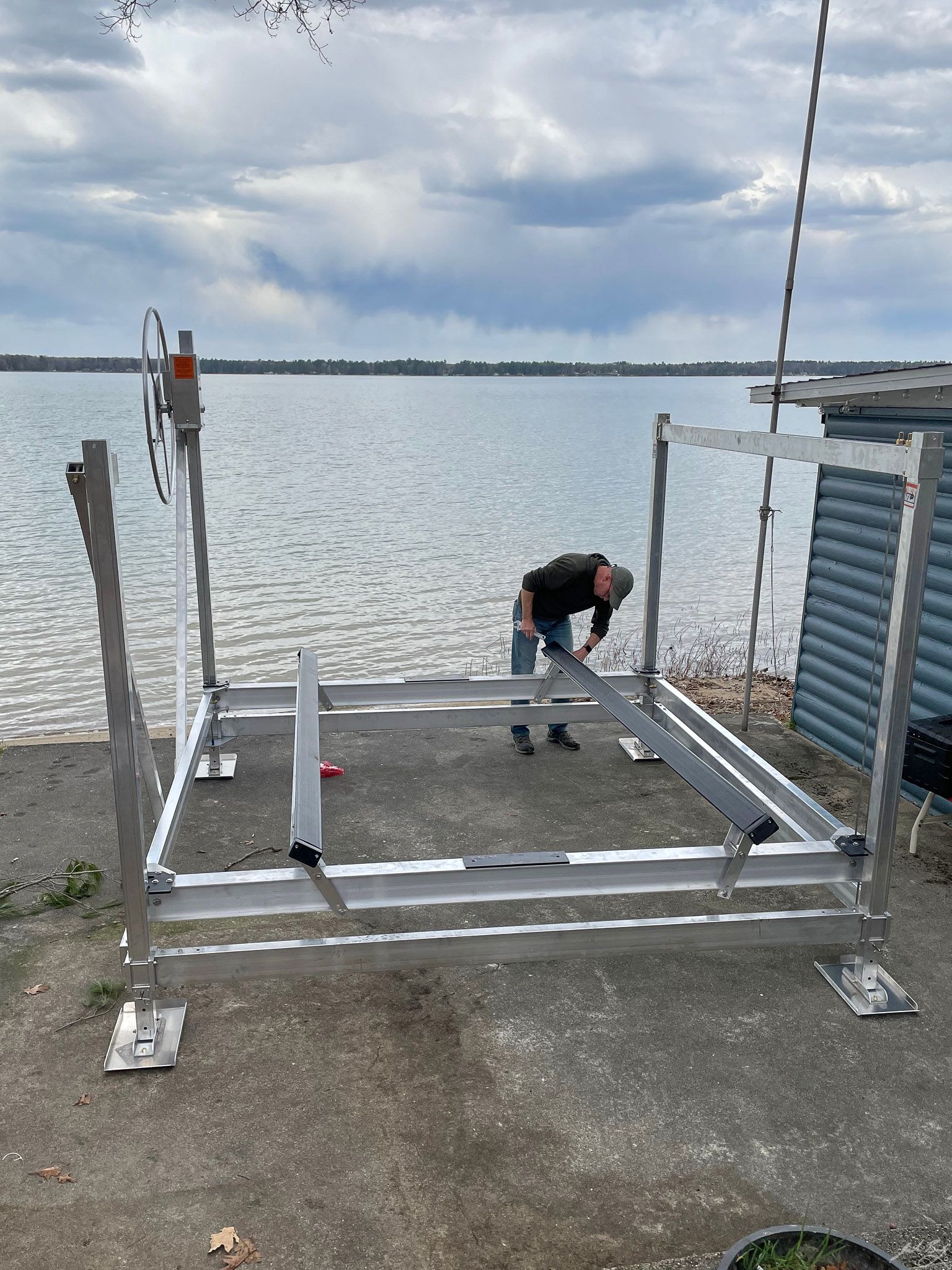
Assembling Bryan's boat lift

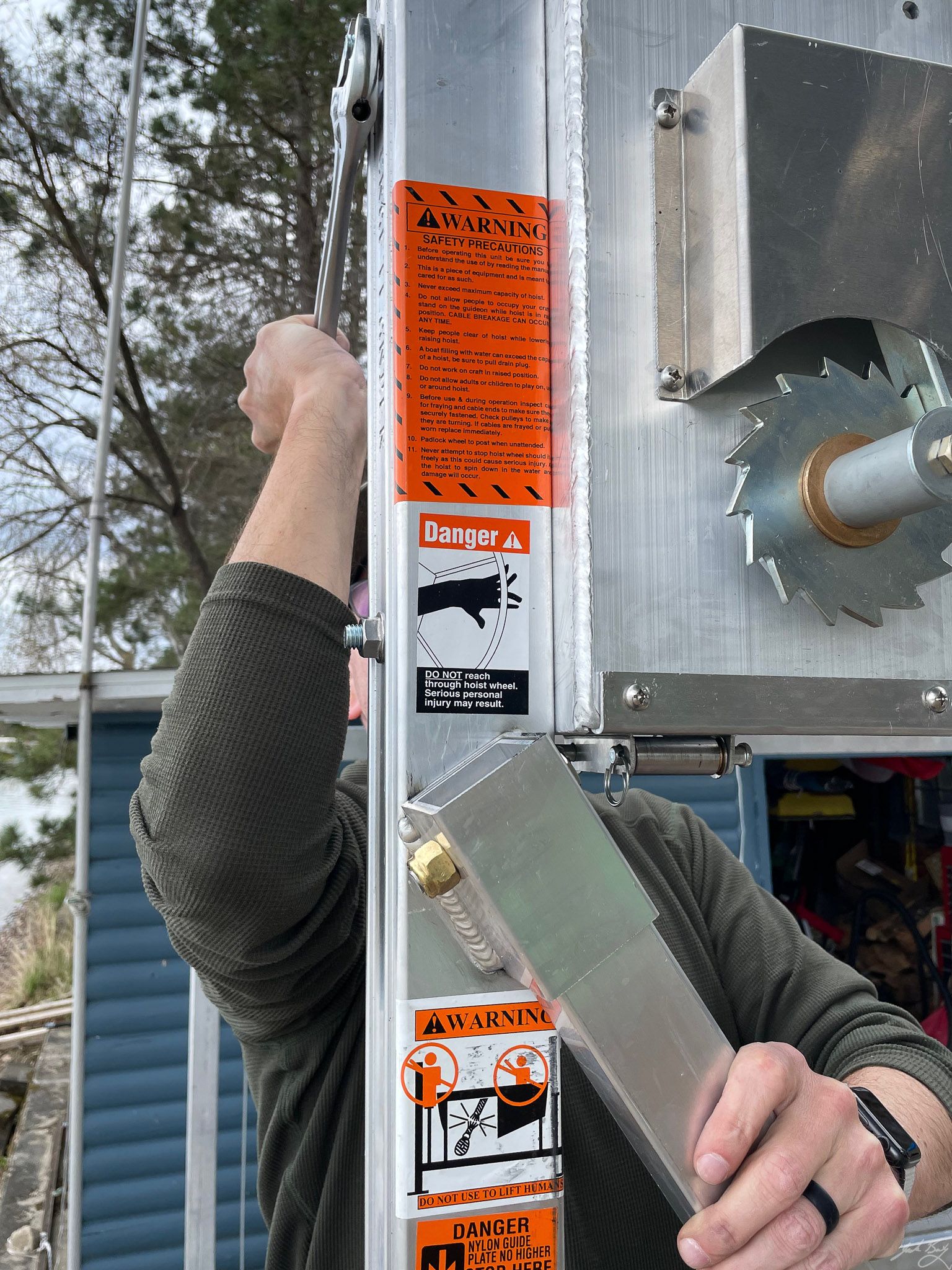
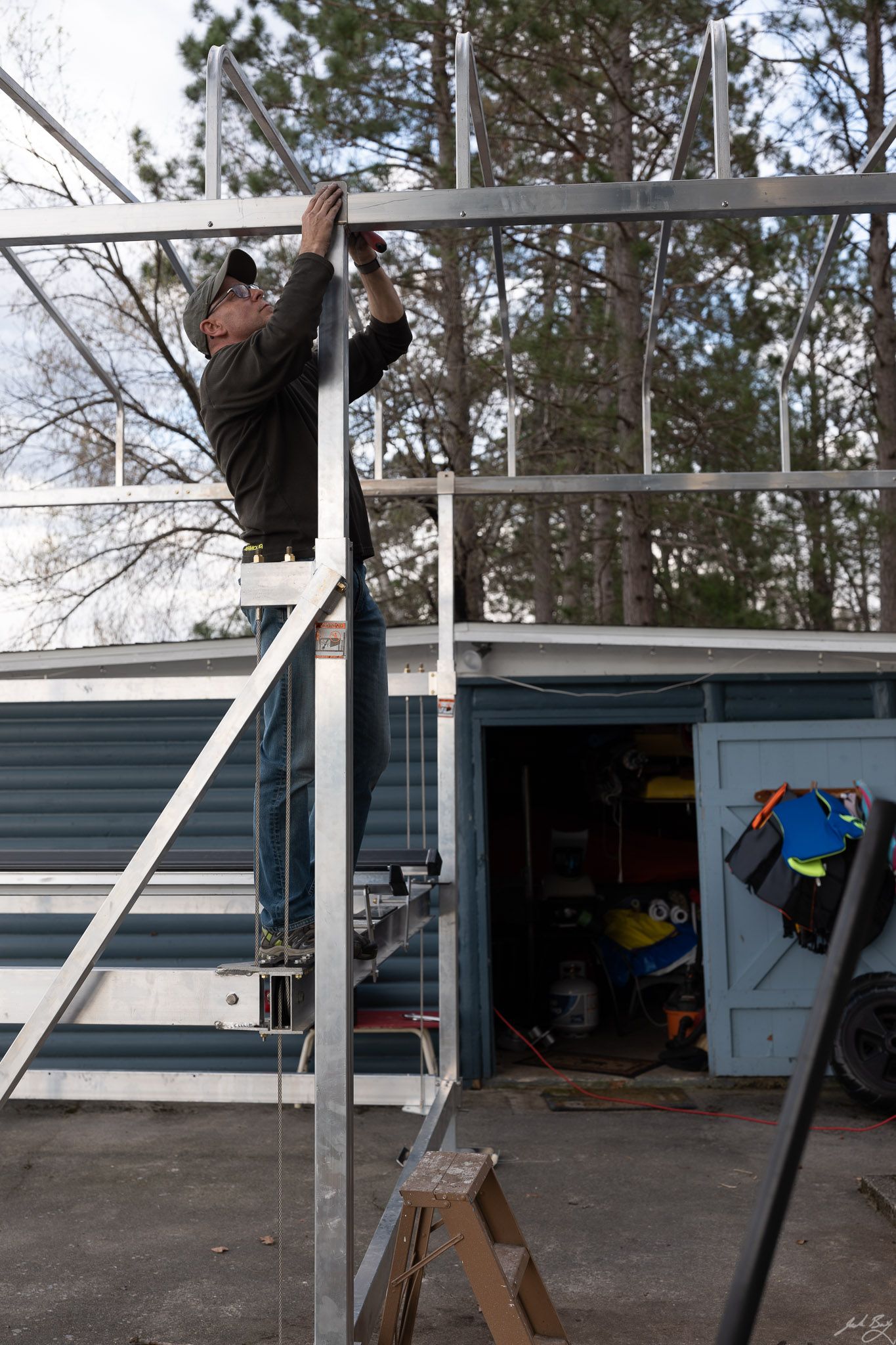
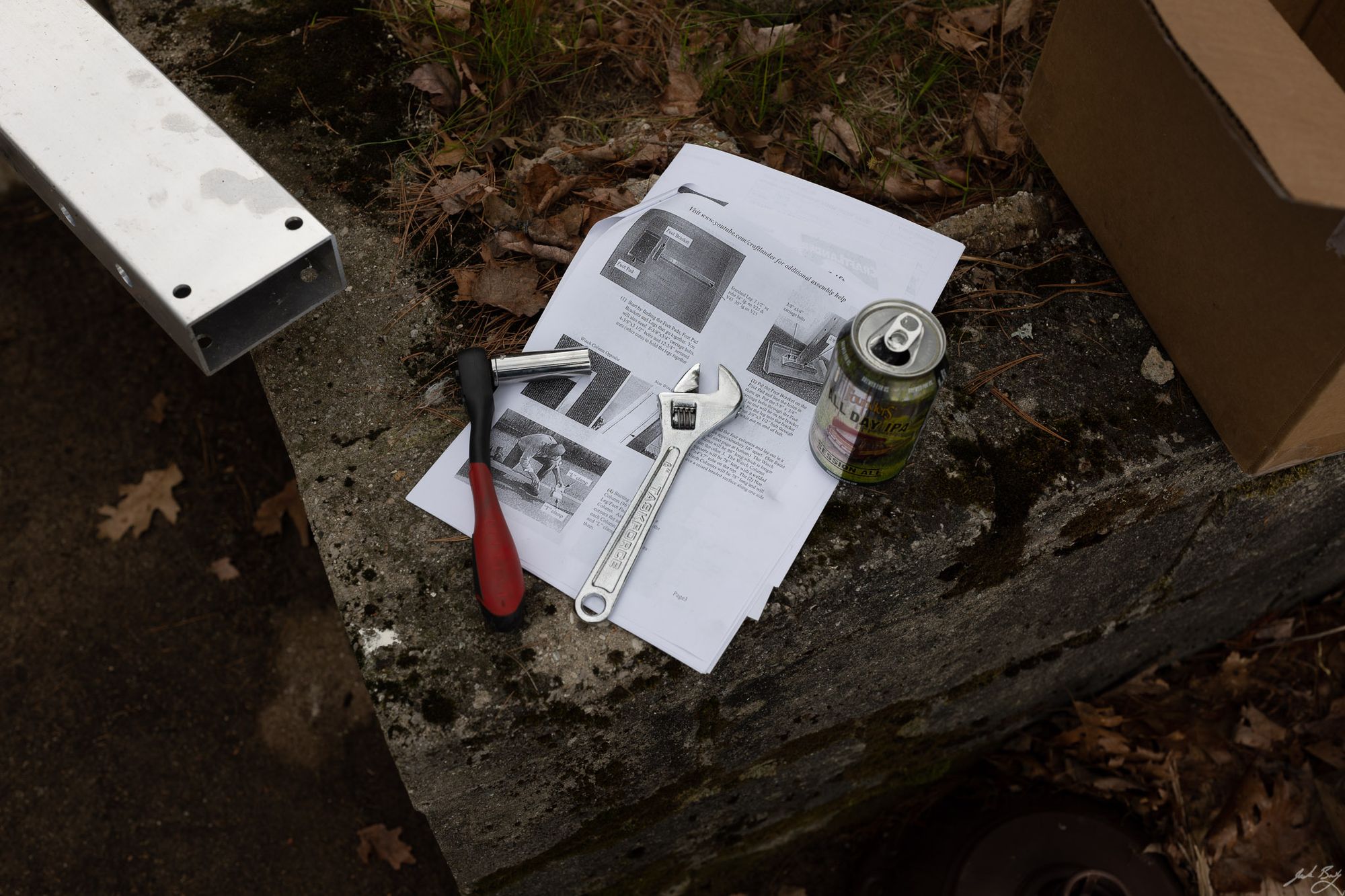
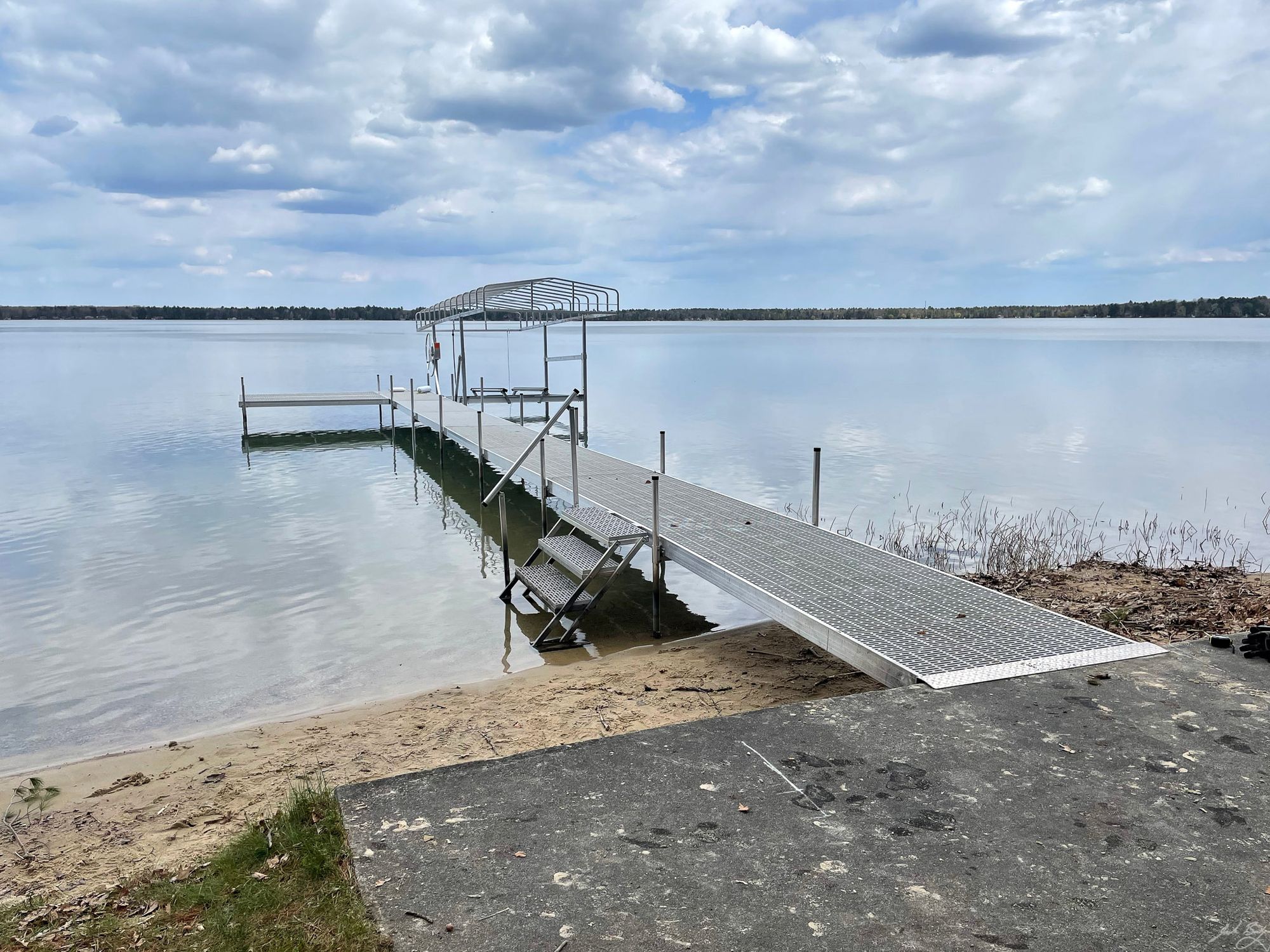
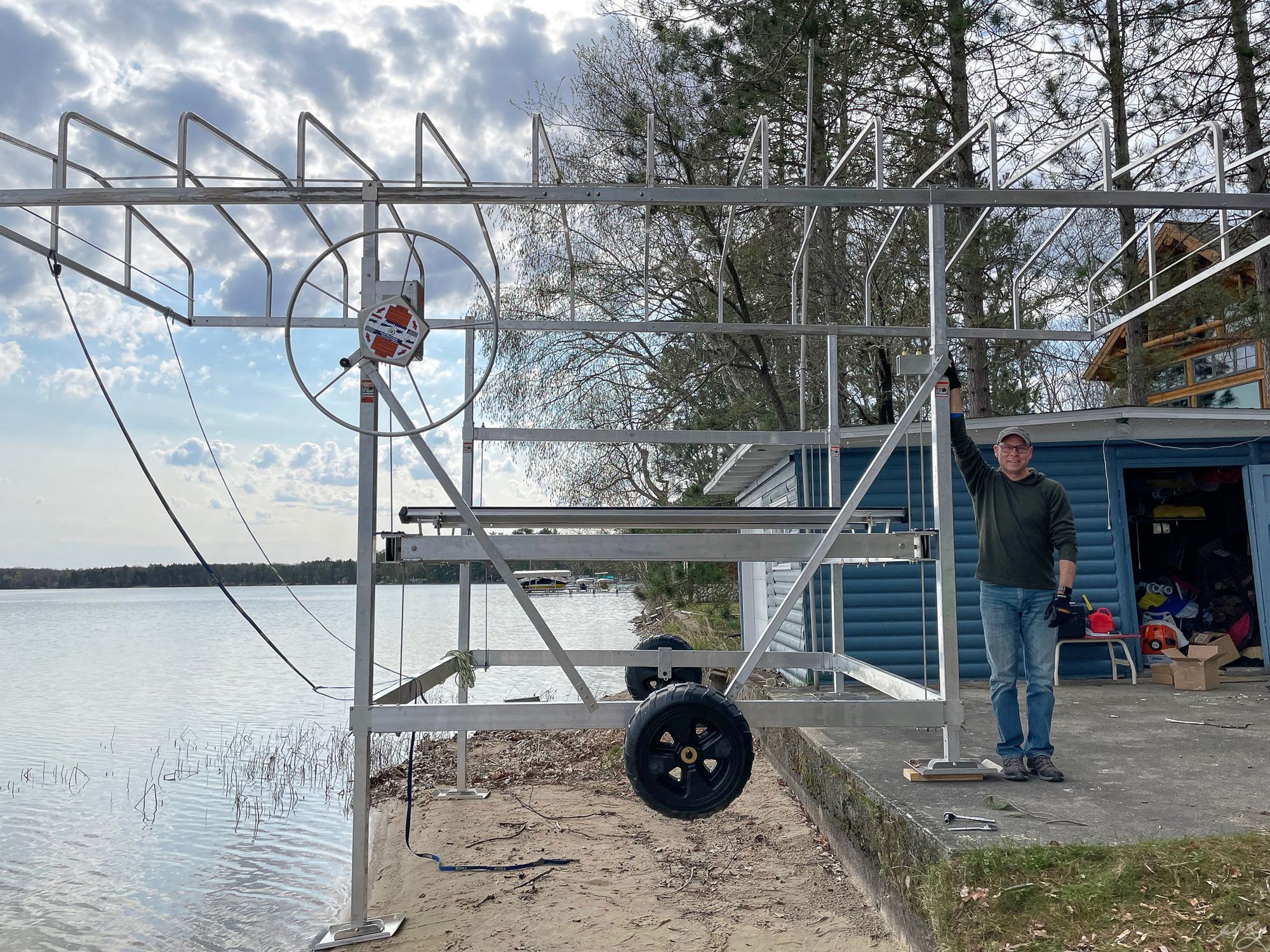
I spent the weekend helping a friend assemble and place a lift for his speedboat. It was a job for four people, but we only had two. This meant some extra planning and heavy lifting. Eventually, we succeeded. It was a fun challenge.

Permalink #

Idle or floor it?

Things have been stagnating around here. I haven’t felt like doing any capital-B Blogging. Rather, I’ve been pouring stuff into

rudimentarylathe.wiki. It’s just easier to have the daily notes tiddler open and type as I go. No need to come up with titles or worry about whether I have enough words put together to justify a new post. Writing blog posts is a Whole Thing™.

This blog started out as a place for me to share photos and their supporting processes and gear. Later, I combined it with my other blog(s) in an effort to consolidate my “presence”. Instead of writing more, which is what I expected to happen, I write almost never.

I love my wiki, but I’ve always been a blogger, and the wiki isn’t a blog no matter how much I treat it like one. Rather than letting it just sit here and idle while I figure out what’s wrong with me, I may experiment with different types of posts and a higher frequency. Maybe I’ll summarize the daily wiki content as a way to clean it up and make it available via RSS, since the wiki doesn’t have a feed. Or maybe I’ll just post links with tiny blurbs about them, like the good old days. Or maybe I’ll post a random photo from my archives every day.

Or, maybe I’ll let it languish, but I hope that doesn’t happen.

Permalink #

Back to the barn with nothing – Mike Johnston

But just because we always come back to the barn with “results” doesn’t mean we got anything. When we get nothing, we have to have the discipline to know we got nothing, and not try to force it to be “something”

Mike Johnston

So much of the photography I see on the internet is made of snapshots that don’t work. Most of the stuff I post fails in the same way. One thing I’m doing to improve my self-evaluation is to immediately delete photos that don’t show me something first thing. This is riskly, but I’m betting that 99% of the time I’m right. This way I don’t spend hours trying to make something from nothing.

Permalink #

Writing everything in TiddlyWiki and publishing just the public parts

I take all my notes in

TiddlyWiki now, and publish most of them to rudimentarylathe.wiki.

For the past few years, I’ve published my wiki using TiddlyWiki. I write daily, publicly sharable notes there. Private stuff goes elsewhere…or did, until yesterday.

It’s the “elsewhere” part that drove me nuts. I have a private Roam database in which I would track things I don’t want to share. Or maybe I should write it in Org mode. Or Obsidian, or Craft, or or or. The difficult part for me has been that I want to take a note about, say, a new camera purchase. There are two components to it, the information about the camera itself, and information about the purchase. The former is public, the latter is private. This means I create one note in TiddlyWiki and one in, let’s say, Roam. There are dozens of examples like this, and it’s crazy-making. I thought I could manage this using links or copy/paste but it sucks trying to do that. I could also make everything public or private. Neither of these are feasible.

If only I could keep everything in one place, but only publish things I wanted public. Then, a few days ago, Soren Bjornstad came to the rescue with his video, A Tour Through My Zettelkasten.

Wow, other than building an amazing Zettelkasten, Soren has implemented nearly everything I needed in order to go all-in with TiddlyWiki for my own wiki.

A few highlights:

  • Public and Private tiddlers
  • Sensible tagging and organization
  • Override the “copy permalink” feature to substitute public URL when on localhost
  • Scripted rendering and publishing of public wiki
  • Specific behavior when viewing public vs private editions
  • A number of other nice touches

I borrowed some of these and integrated them into Rudimentary Lathe. Now, I’m taking all my notes in TiddyWiki. I’ll describe the process a little.

Editing the wiki locally.

I use TiddlyWiki as a local Node.js app. While one of TiddlyWiki’s great features is that can be just a single HTML file, running it locally as a single-page web app via node.js makes things a bit more flexible. Also, it’s the easiest way to allow for saving changes in Safari. The file structure looks like this:

├── files/
├── plugins/
├── tiddlers/
└── tiddlywiki.info

All tiddlers are kept as separate “.tld” files in the tiddlers folder. Here’s an example:

created: 20201220181044760
creator: jack
modified: 20210505182021507
modifier: jack
revision: 0
tags: Public
title: Leica APO-Summicron-SL 35mm ASPH
type: text/vnd.tiddlywiki

[img[files/2020/leica-apo-summicron-sl-35mm.jpg]]

I prefer primes, so this is the one I've chosen for the [[Leica SL2-S]]. Watching Peter Karbe admit it's is desert-island lens and suggesting it's the best lens Leica has ever produced made the decision a little easier.

I have over 2300 of them currently. Another nice side effect is that git diffs are much more usable on individual text files than on a giant HTML file.

Public vs Private content.

Any tiddler I want to be public gets a “Public” tag. That’s it. The export script is smart enough to automatically include all system tiddlers, etc so that everything works.

As a useful helper, each tiddler displays a “Publish this tiddler” checkbox to make adding the tag easier, as well as serving as a handy indicator of private vs public status. The export script updates one of the configuration tiddlers so that the published version doesn’t show this checkbox.

I can’t tell you how huge this is. Not having to choose the tool or app for new notes is so liberating. I can now write and link freely with everything and can still share most of it publicly.

Hosting

I’ve never used Github Pages for hosting any content, so thought this would be a good opportunity to try it. Basically, I keep a separate repo of the public version and pushing to that repo automatically publishes it. Super easy to set up.

Publishing workflow.

Soren was kind enough to share a version of the script for publishing his wiki (publish.sh), which I’ve modified slightly. Here are the highlights.

PRIV_FOLDER="rl-wiki"
PUB_FOLDER="public-wiki"

FILT='[is[system]] [tag[Public]] -[[$:/plugins/tiddlywiki/tiddlyweb]] -[[$:/plugins/tiddlywiki/filesystem]] -[prefix[$:/temp]] -[prefix[$:/state]] -[prefix[$:/sib/StorySaver/saved]] +[!field:title[$:/sib/WriteSideBar]]'

WIKI_NAME="index.html"ext_image_folder="extimage"

“FILT” is the tiddlywiki filter for determining which tiddlers to include (and exclude). The [tag[Public]] bit is the key to the public/private thing.

Then we export tiddlers based on the filter and settings above.

"$(npm bin)/tiddlywiki" "$PRIV_FOLDER" --savewikifolder "$pub_wiki" "$FILT"

Next, generate a single HTML version of the wiki and copy over the separate image files..

"$(npm bin)/tiddlywiki" "$pub_wiki" \
    --render "$:/core/save/all" "$WIKI_NAME" text/plaincp -r "$pub_wiki/output"/* "$pub_ghpages"cp -R "$PRIV_FOLDER/files" "$pub_ghpages"

Isn’t TiddlyWiki amazing!?

Finally, we commit and push the public wiki to Github…

if [ "$1" = "--push" ];
then
echo "Pushing compiled wiki to GitHub..."    
cd "$pub_ghpages" || exit 1    
git add .    
git commit -m "publish checkpoint"    
git push
else    
echo "Not pushing the wiki to GitHub because the --push switch was not provided."
fi

And voilà!

A few nice odds and ends.

Soren’s “Reference Explorer”, seen at the bottom of individual tiddlers, replaces my handmade backlinks display. His is much fancier. I removed a few tabs I don’t use, and may exclude the tags at some point. I conditionally exclude the explorer from my Daily Notes pages. (anything tagged “DailyNote” hides the explorer.) Another nice tweak is that if I add a “refexplorer-hide” field to any tiddler and set it to “true”, the explorer is not shown on that tiddler. Nifty.

TiddlyWiki comes with a button for copying a permalink to each tiddler. The problem with that for me is that when I’m running the wiki locally, permalinks look like this

http://localhost:8080/CommandLineInterface, which obviously won’t work. Soren’s version of the button replaces localhost:8080 with the live hostname, e.g. https://rudimentarylathe.wiki/CommandLineInterface. This saves me a ton of copy/paste/edit hassles.

Putting it all together.

When I’m ready to publish, I open a terminal and type prl (for “publish rudimentary lathe”)

prl is a script…

#!/bin/shcd ~/Sync/rudimentarylathe./scripts/publish.sh --push

That’s it.

I wish more people would spend time getting to know TiddlyWiki. It’s amazing. It’s a Quine, which makes it ridiculously flexible and powerful. And yet it’s very simple. It’s also a free, local-first, easily-distributable, storable, backup-able single HTML file.

TiddlyWiki is fun, fancy, and
future-proof. I live there now.

Permalink #

A headroom so high you’ll never see it again – Riccardo Mori

Software-wise, this incredibly powerful iPad is as capable as a 2014 iPad Air 2 (the oldest iPad model that can run iPadOS 14). There is still, in my opinion, a substantial software design gap preventing iPads from being as flexible as they are powerful. Software-wise, iPadOS still lacks flow. Don’t wave Shortcuts in my face as a way of objecting. Shortcuts are a crutch. A good one, no doubt, but a crutch nonetheless. Software automation can do great things for an operating system, but if an operating system comes to depend on it to become usable, then maybe you have to rethink a thing or two.

“iPadOS still lacks flow”. Indeed, and that’s not all it lacks. I wish it were better.

Permalink #

May is "Easy Mode" month

I’m exhausted. I think it’s because I haven’t been working in more than a month and my brain has had too much free time to “figure stuff out.” (Yes, I know how it sounds to complain about exhaustion while not having a job!)

As an experiment, I’m going to live the month of May in “Easy Mode”. This means I’m going to solve problems with quick, obvious, easy solutions. I’m going to use the easy-to-use tools. And I’m going to make various processes as easy as possible.

Examples? Sure!

  • Roam not Emacs
  • Lightroom CC not Photo Mechanic and Capture One
  • Things not Org mode
  • Day One not Org Journal
  • WordPress not Hugo
  • Streaming music not FLAC/MP3 files
  • Netflix not Plex
  • Books not Kindle
  • Walks not Workouts
  • Mac not Linux

It could be argued that some of these are backwards, but this is where I’m starting, and the gist is: nothing fancy for a while.

Permalink #

reMarkable is sleeping

I’ve been using the

reMarkable 2 tablet for almost three months now. I’m often asked what I think of it. The short answer is this:

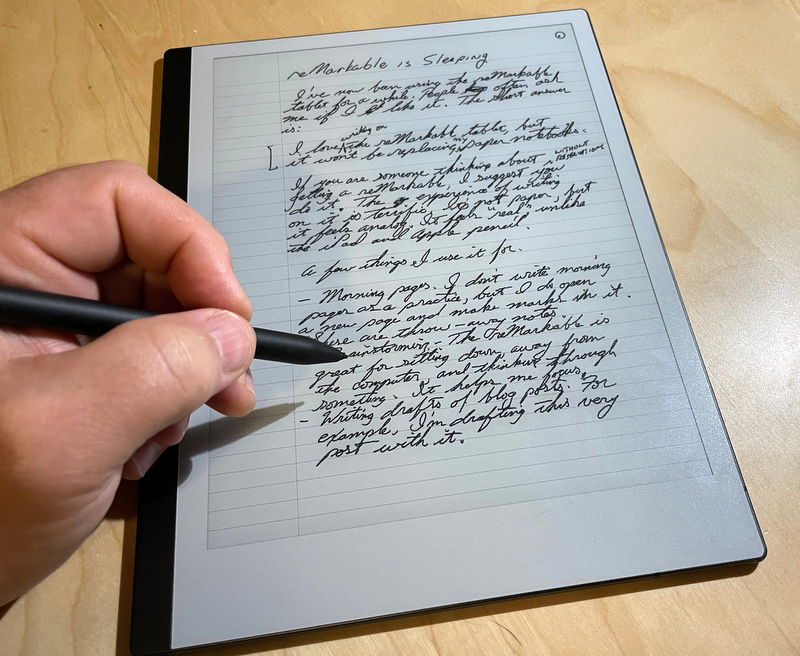
I use the reMarkable tablet every day. I love writing on it, but it won’t be replacing my paper notebooks.

If you are thinking about getting one, I have no reservations recommending that you do. The hardware is very nice and the experience of writing on it is terrific. It’s not exactly like paper, but it does feel analog. It feels “real”, unlike using the iPad and Apple Pencil, which feels like writing on a computer screen.

Here are what I’ve been using it for:

  • Morning pages. I don’t write morning pages as a practice, but I often open a new page first thing in the morning and make marks on it.
  • Brainstorming. The reMarkable is great for sitting down, away from the computer, and thinking something through. Sketches, scribbles, and a few notes are a perfect use for the tablet.
  • Drafting blog posts. I’m drafting this very post using it.

A common thread here is that they’re all throw-away notes. I have not been using the reMarkable for things I’ll want to reference later. It’s great for raw materials to be used later in some other format, but less so for long-term notes. I find that it’s still too much trouble to quickly jump between notes on the reMarkable. Swiping from page to page is slow, and getting to an overview of a notebook’s pages requires tap, wait, tap, wait, tap, and wait. This makes paging around in a notebook rather cumbersome for certain things.

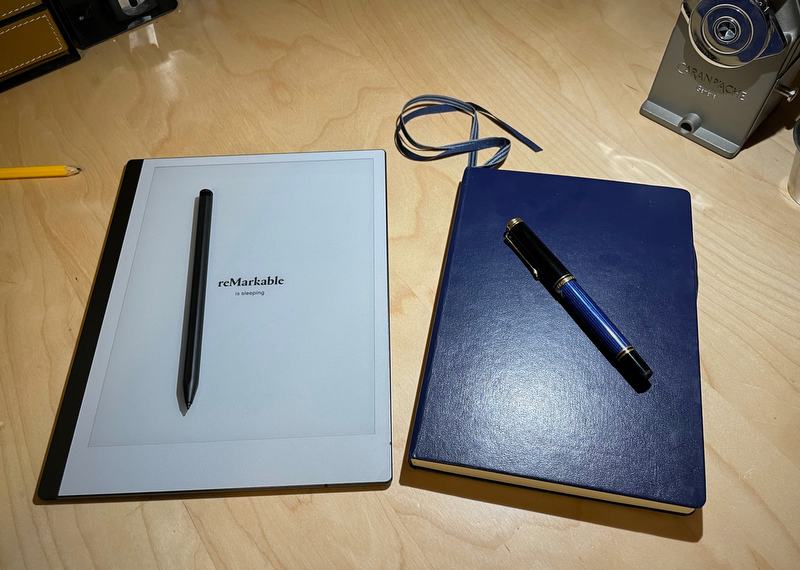
I use the reMarkable nearly every day, but only a little. It spends most of its time sleeping.

I keep a paper notebook open on my desk, not the reMarkable. The reMarkable wakes quickly at the touch of a button, but a paper notebook never sleeps.

I use paper for:

  • Personal journaling. Nothing beats paper and a nice fountain pen.
  • Tasks and quick notes. This is my lightweight version of bullet journaling.
  • Jotting things down. Phone numbers, names, anything I need to remember.

As great and convenient as digital tools like the reMarkable are, there is one thing about paper notebooks that I never want to live without, and that is the artifact itself. There is no substitute for a shelf lined with full notebooks. I can pick one up today, or in twenty years, and easily skim around in it. No digital format, as convenient as they may be, can replace that.

Permalink #