I have never regretted taking a photo, but I always always regret not taking one.
I've been planning to do a series of environmental (large format film) portraits of my close and extended families. The idea is to travel to their homes and photograph them using natural light, if feasible, in their favorite spaces. I would then make two archival silver gelatin fiber prints, one for them and one for me.
I've not done this even once.
Wherever I go, there is a camera with me. It often remains in the bag, unused.
I was walking yesterday and passed a man on the sidewalk wearing a hard hat and face shield which was tipped up so it didn't hit the cigarette hanging from his mouth. He had a great face and I thought it could make a fun photo. But, I was afraid to ask him if I could photograph him and only nodded as I walked by.
I'm ashamed of myself and it makes me want to sell everything and find another hobby.
When I first learned of RSS Club I thought, "Cool! How fun!"
The website says:
Congratulations on joining a secret society! RSS Club is a collection of blogs (personal and otherwise) committed to providing RSS-only content. It’s like a newsletter delivered to your feed reader in order to celebrate the medium of RSS and breakaway from social media.
Something has been bugging me about it, though.
I love RSS. I spend a crazy amount of time in a feed reader. I want everyone to use RSS and I want every website to publish an RSS feed or three.
So what's the problem with having some content only available via RSS?
Fair question. For me it's because it feels exclusionary with a touch of Insiderism. Mostly, though, it's that blogging itself has enough problems with adoption. I'm not sure it's a great idea to be "hiding" blog posts. Good blogs are hard enough to find these days. Why limit your writing to only those people who've already discovered you?
I totally get, and agree with, the concept of getting our stuff out of social networks, but aren't blogs already doing that?
My current thinking is that our little blogging society doesn't need secrecy, it needs visibility.
RSS Club is a fun idea and I do like the "it's like a newsletter delivered to your feed reader..." bit. What I don't love is it feels like it's advocating for RSS (a good thing) by limiting the visibility of cool content (not a good thing, IMO).
There's also some hypocrisy on my part here. I've created a way in my blog to publish things on the home page that never appear anywhere else, including the RSS feed. You need to actually visit my site in order to read it. Perhaps that's what the RSS-only content is meant to be, too.
Anyway, I love experiments like RSS Club. What I've written here are just my current feelings about it, and they are very much subject to change.
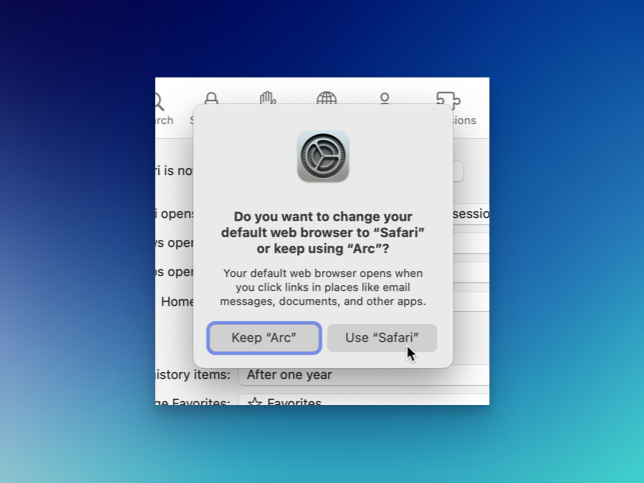
Switching from Safari to Arc as my default browser several months ago was a big deal for me. I've always been a Safari user. Arc, though, does innovative things that I find useful (such as Little Arc and Spaces).
Lately, however, I've noticed that I spend a lot of time "managing" things in Arc. I organize the sidebar. I pin and unpin tabs. I make spaces for no good reason. I "traffic control" sites so they open in specific ways. There are many things one can tweak Arc, and I've been tweaking all of them.
Yesterday I did this:
Making the switch
After using Safari all day, I remembered why I like it. It's tight, somehow, you know? It fits on macOS like nothing else does. It integrates with everything.
Arc's sidebar approach to tabs/bookmarks is awesome. What I found is that I don't like having the sidebar hidden, but when it's showing I tend to scan the list of tabs and click things at random, looking for things to do/read. This isn't Arc's fault, but still. Safari uses its UI to focus on the current page. This is better for my brain.
I'm going to keep using Safari for a spell and see how it goes. I've missed it, but it remains to be seen if I'm drawn back into Arc's orbit by all the neat stuff Arc does.
I mentioned that I should create a lisp function for sending my org-journal entries to Day One. Turns out I'd already done it. The only problem was that the original version assumed I was using a new org file every day. I'm now doing monthly files, so I needed to change how the text selection was made. Here's the new function.
(defun jab/dayone-add-note ()
  "Sends current subtree as Day One entry"
  (interactive)
  (org-mark-subtree)
  (shell-command-on-region
   (point)
   (mark)
  "/usr/local/bin/dayone2 -j=Journal new"
  nil))
It's not perfect, since it includes any PROPERTY drawers and leading stars, but it works and was easy to make.
Dave Winer's Fargo blogging tool worked exactly how I wanted my blog to work. It collected a bunch of individual posts into a single group for each day, with each post also linked to its own page. (Dave's site still does this at scripting.com). Fargo was great, but support waned and Dave's attention went elsewhere, so I felt it was best to move on.
When I began using Tinderbox to build my Daily Notes blog, I reimplemented most of my favorite features from Fargo. The big one was the daily container of notes. Another was the small icon shown on the right of individual posts. I now have both of these here at baty.net, using (link: https://getkirby.com/ text: Kirby).
Here's the (abridged version of) how I did it.
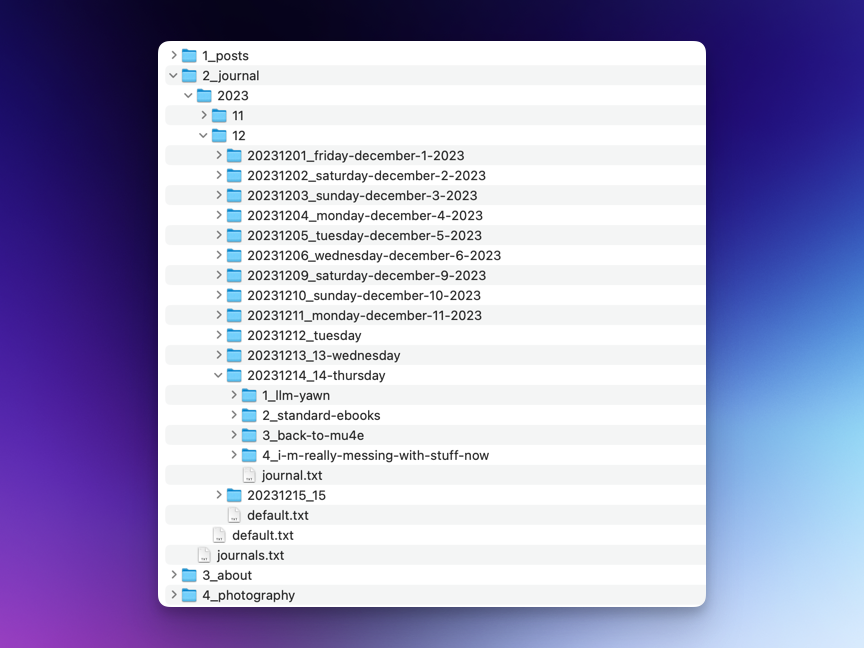
Since Kirby's static content model reflects the underlying folder structure, individual notes go right in the day's journal folder. That way, listing the notes on a day's journal page is simple as looping through $page->children().
Kirby
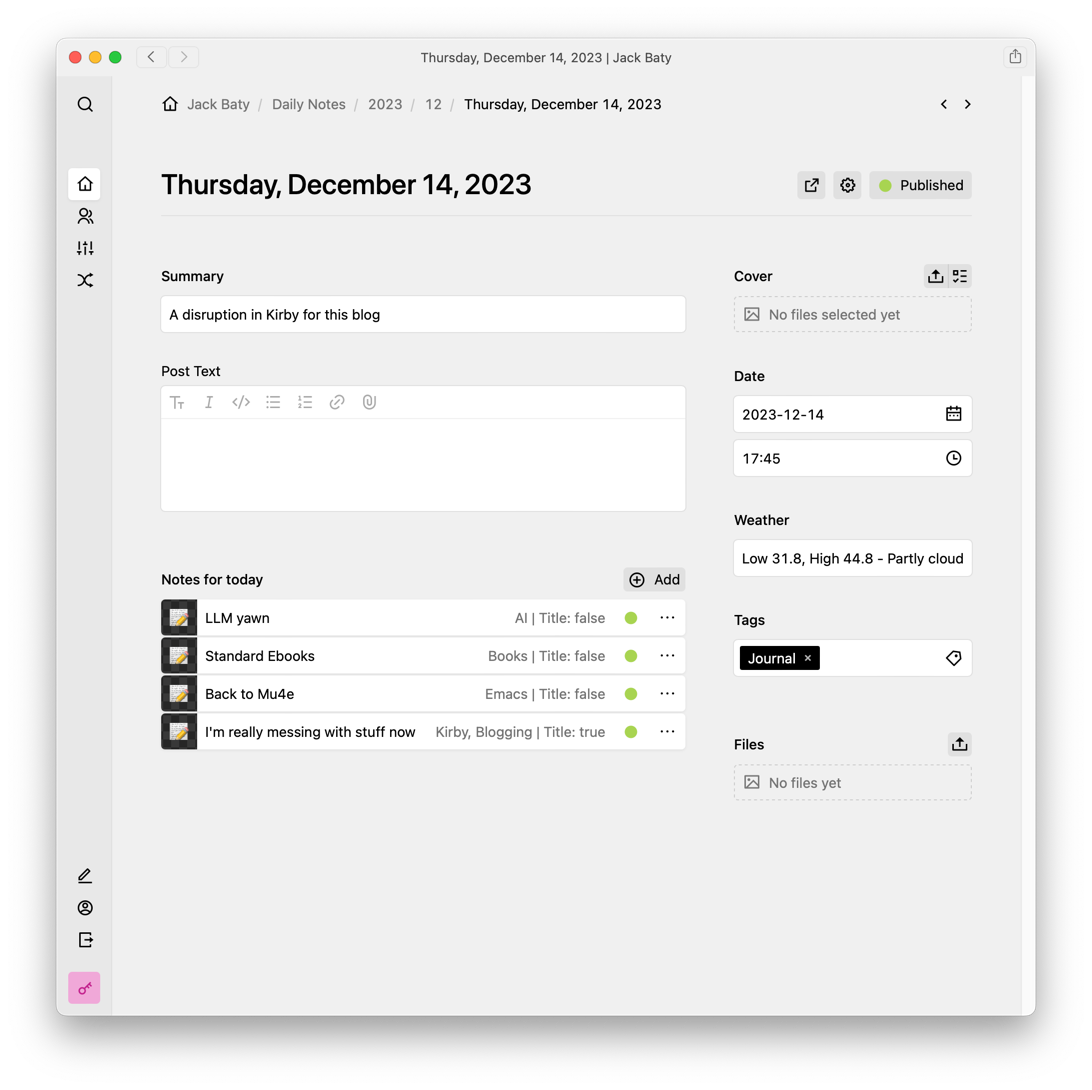
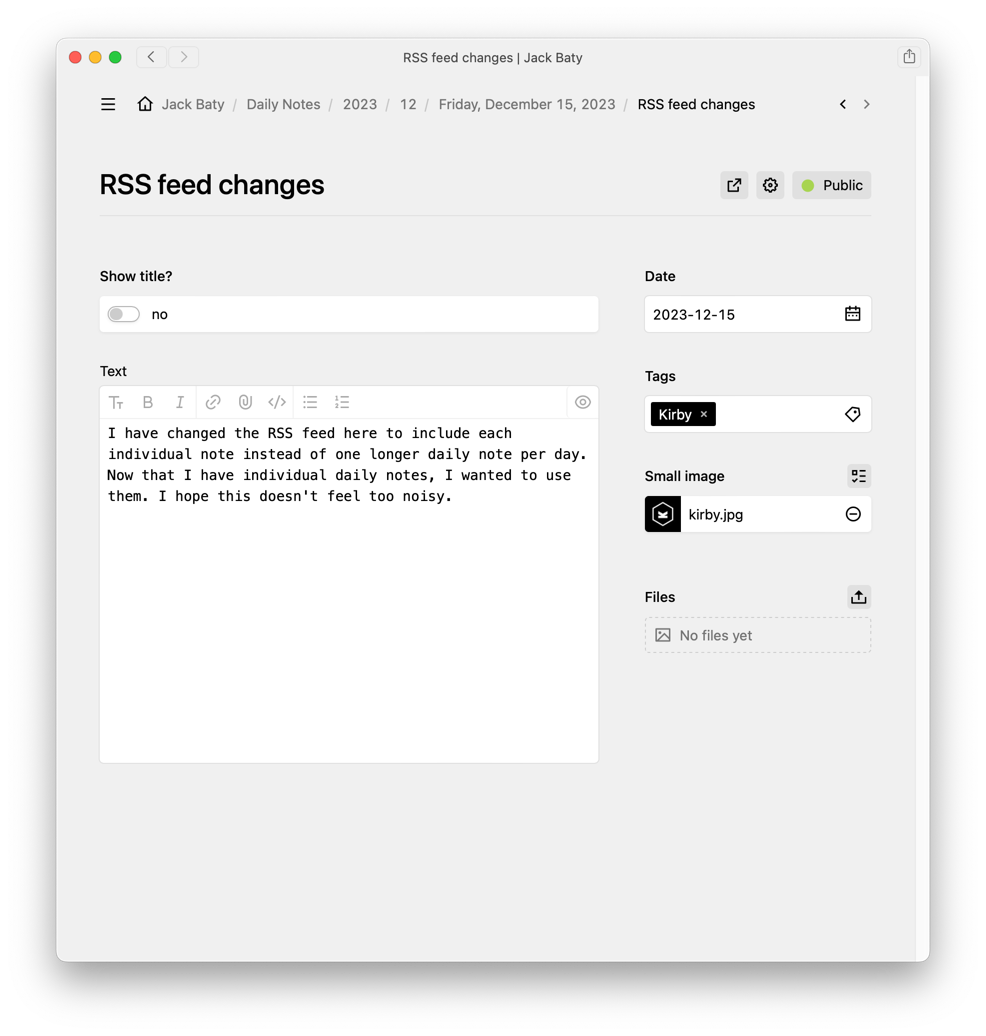
Of course getting the notes where they belong is best done via Kirby's panel, so this meant creating Blueprints. Kirby's Blueprints are pretty cool. They're YAML files that define the UI and properties for content in the panel. As simple as they are, I am still struggling to wrap my brain around how they work. There's a lot of trial and error before I get things right. Eventually, my Journal Blueprint worked, and the relevant bit looks like this:
Note that the text, files and cover fields are vestigial and will be removed eventually.
The showtitle field is a toggle that determines whether to show the note's title when rendering the note. I use this for longer, multi-paragraph notes so (I think) things are easier to scan.
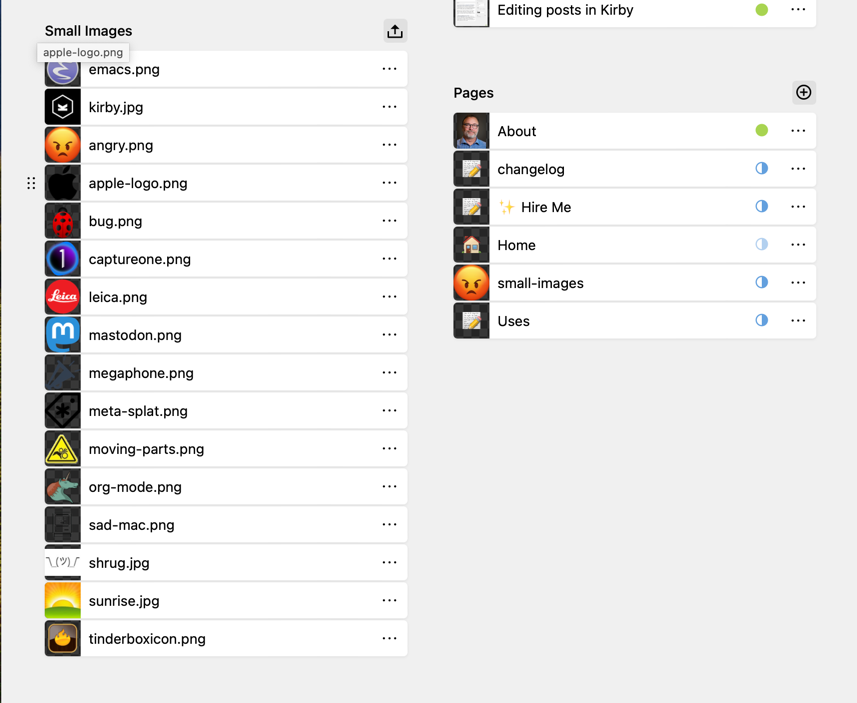
The "smallimage" field is fun. It's a Files field that lets me upload a small image to be floated at the right of the note's text. I don't know why, but I really like this. The trick here is that I don't want to upload the same image multiple times, so I created an area on the site.yml blueprint that allows me to upload them to a central location, then I can just pick one when adding a note.
This has been an over-simplified account of the process, but hopefully you get the gist. It took me the better part of a day to get this in place, but most of that time was me fumbling around because I'm new to Kirby. Overall, it was easy and working with Kirby is darn pleasant.
I'm sure I'll tweak this incessantly as I learn more, but so far I'm happy with what I was able to put together in short order.
Either way, the more boring personal websites I see the more I want to skip the boring corporate handshake at the beginning. Because you’re more than a list of accomplishments, more than a career, more than a Wordpress template, or SQL query, more than one subject for a narrow audience.
Same.
Thing is, I almost never worry about what goes here. It's just a stupid website. Who cares?
I'm currently looking for work, so I probably should keep things tidy and professional and LinkedIn-ey and talk about how "Super Excited I am for this new journey" (🤮), but I'm not going to do that. If a potential employer reads my blog, they'll either click with it or they won't. I hope they do hire me, but if they don't, it probably wasn't going to be a good fit anyway.
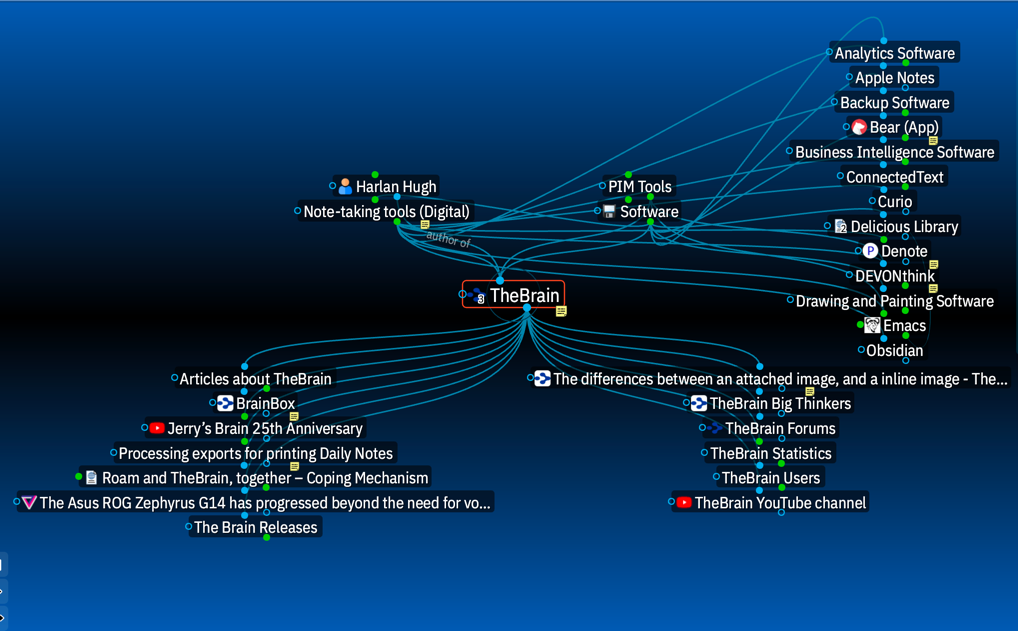
TheBrain might be the original "second brain". I mean, it's right there in the name. I started using it when it was still named "PersonalBrain", sometime before 2011.
At some point around the time Roam Research released Roam, I stopped using TheBrain, mostly because I didn't enjoy writing notes in it and adding new thoughts felt cumbersome compared to Roam. Roam was an outliner and made quick work of adding and linking notes. This was also a heyday of Notion, Obsidian, Craft, etc. TheBrain seemed a bit dated, so I moved on for a while. Of course throughout all this, I was living in Org-mode as well.
But here's what happens: I need to look up some old note or file, and when I launch TheBrain and search, if it's in there, I find what I'm looking for immediately. Not only that, but I get a good sense of context and can jump to nearby "thoughts" quickly and continue digging until I have what I need. Every time this happens, I dive back into using TheBrain. Eventually, I get distracted by newer, shinier tools, but TheBrain never goes away completely. I made the mistake of "starting over" with an empty brain at some point in early 2016, so I lost everything before then. I won't make that mistake again.
So why do I always come back to using TheBrain?
It handles everything: notes, links, backlinks, files, everything. File attachments are important to me, and TheBrain handles them well. As opposed to the janky way things like Obsidian deal with files.
I always find what I'm looking for and can get a sense for context right away. Isn't this what taking notes is for?
There are no limits to how much I put into it. I never need to worry about things getting too large or becoming too slow. See Jerry's Brain as an example with 500,000 thoughts.
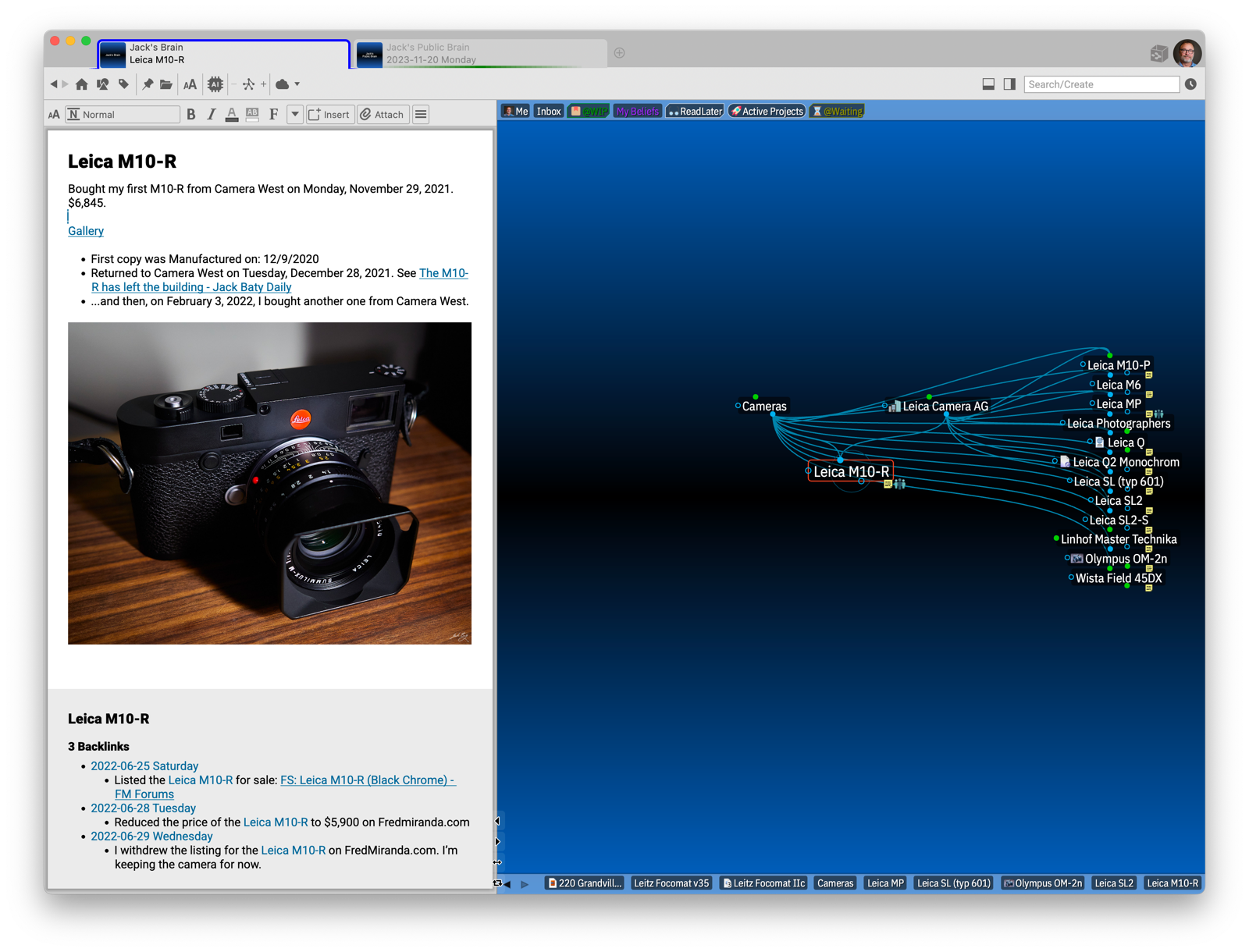
Each thought is just a folder on my Mac. Notes and attachments live on the filesystem. They're buried in UUID-named folders, but I can still find stuff outside of TheBrain. One thing I've done is to index the entire brain hierarchy in DEVONthink. I don't fear lock-in.
It's Markdown. The notes editor in TheBrain is a nicely-implemented WYSIWYG editor for Markdown. The actual note is just a Notes.md file in the thought's folder. I can edit it using BBEdit or Emacs if I want.
The Notes editor is pretty good. For a long time, adding notes in TheBrain was...unpleasant. Recent releases have turned this completely around.
There's a web and iOS versions. My brain is synced and available via both a web client and iOS apps. I don't need to worry about getting at my notes when I'm not sitting at a computer.
Are there drawbacks? Sure. Getting things into TheBrain takes some work. There is the BrainBox extension, but it's not great. (I understand they're working on a new one, though). Otherwise, getting things in is drag-and-drop or nothing. Some form of global quick-capture features would be nice. Perhaps with the newly-released API, someone will make one. And I need to put everything somewhere. I mean, that's kind of the point, but still. Another thing is that TheBrain is expensive and requires a subscription. I pay $159/year for the Pro edition and sync services. (That's actually cheaper than Obsidian with Sync and Publish subscriptions, but still.)
I'm a "notes first" person. I prefer to work with notes over files. But, I also manage a lot of files. TheBrain makes doing both of these things easy. It connects everything to everything. Some thoughts are nothing more than holders for other types of documents. For example, I have thoughts that are just a Tinderbox document. Others contain Org-mode files. Others contain links to Google docs. Thing is, TheBrain connects all of these things. It's powerful stuff.
My wiki, a single TiddlyWiki file, currently contains 3,594 tiddlers. I look up something in it at least once every day. The following offers a glimpse into why:
The purpose of recording and organising information is so that it can be used again. The value of recorded information is directly proportional to the ease with which it can be re-used.
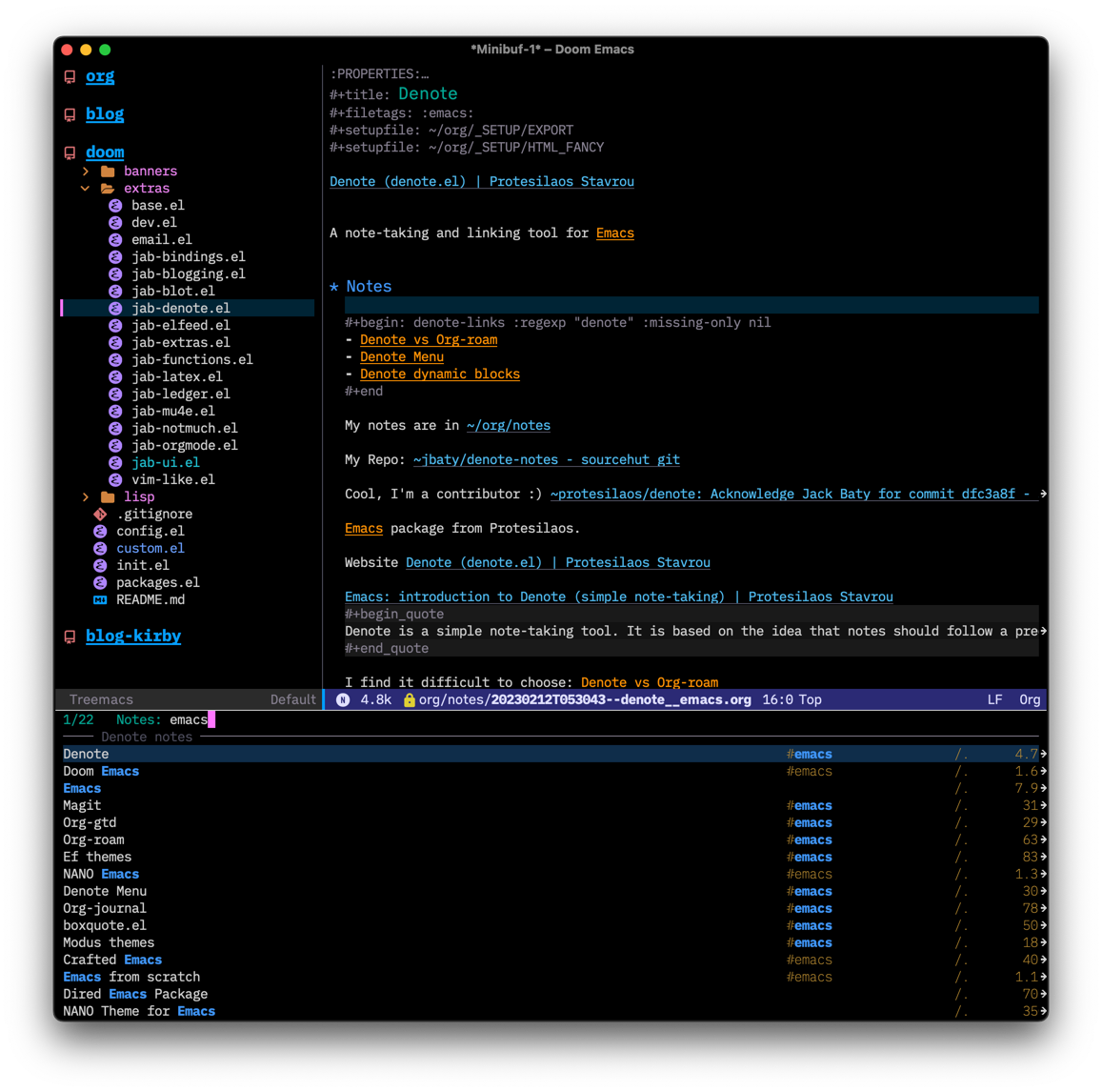
This morning I wanted to make a note about my Kobo eReader. I didn’t yet have a Denote note about it so I started a new one in Emacs and started typing. It occurred to me that maybe I’d already written about it. Of course I had. This happens a lot.
My dilemma is that I very much prefer writing and managing notes in Emacs, but to actually find, read, and reuse them, TiddlyWiki works better for me most of the time. (I once tried running TiddlyWiki via Node.js and editing individual tiddler files in Emacs, but that was awkward and ended up not worth the extra effort.)
Longevity is critical when it comes to my notes, so what about the future-proofness of plain text? TiddlyWiki is nothing more than a fancy, self-contained HTML document. One could argue, I suppose, that HTML is plain text, but that’s a stretch. One could also argue that Org-mode documents aren’t really just plain text either. Not if you’re doing anything remotely clever. They’re just easier to read when viewed as plain text than HTML[1].
It’s been surprising and confusing to me that I so often prefer making a quick note, linking it, finding and reading it later in TiddlyWiki than in Emacs. All of my notes are in one HTML document that I can simply double click, browse, and search right there in my web browser.
It’s the "ease with which it can be re-used" part that keeps me coming back to TiddlyWiki.
Protesilaos Stavrou updated his spacious-padding package. I’d ignored this earlier but installed it today and it’s a nice, subtle, quality-of-life improvement to Emacs.
It increases the padding or spacing of frames and windows on demand.
The idea with this package is to provide the means to easily toggle between terse and spacious views, depending on the user’s needs.
This morning, I had trouble finding something that I was certain I'd written yesterday. I was pretty sure I'd written it in one org-mode file or another, but it seemed to be missing.
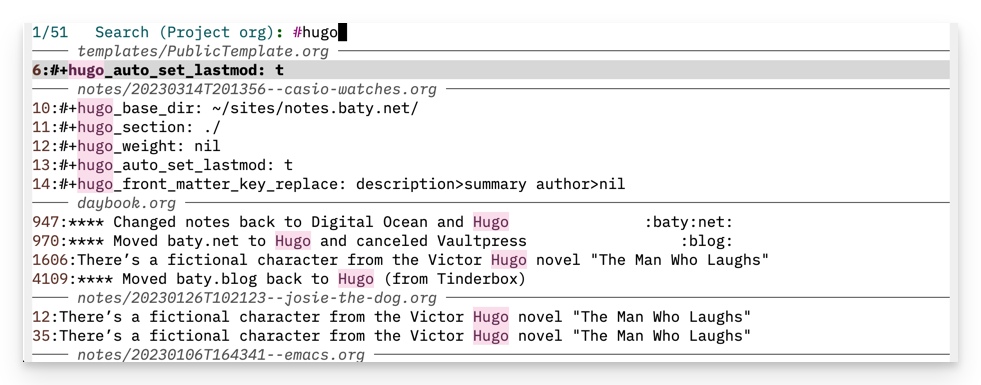
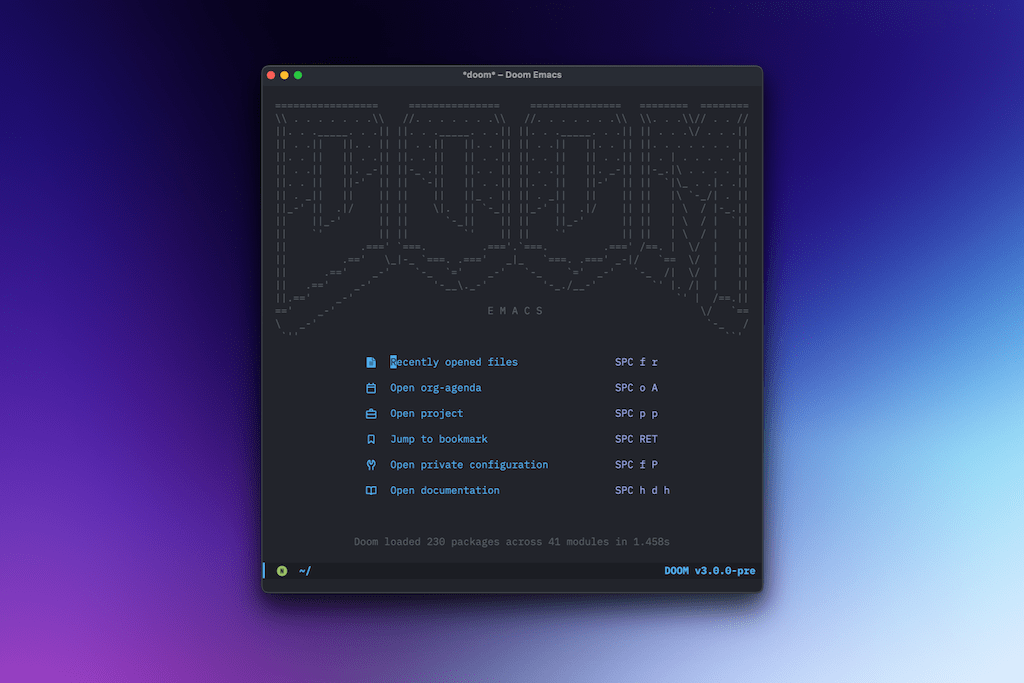
Turns out it wasn't missing. I just couldn't see it because of the way the results show up when searching for something in Emacs. The display of search results when running projectile-ripgrep is pretty awful, and I missed what I was searching for. Here's what it looks like in Doom Emacs by default.
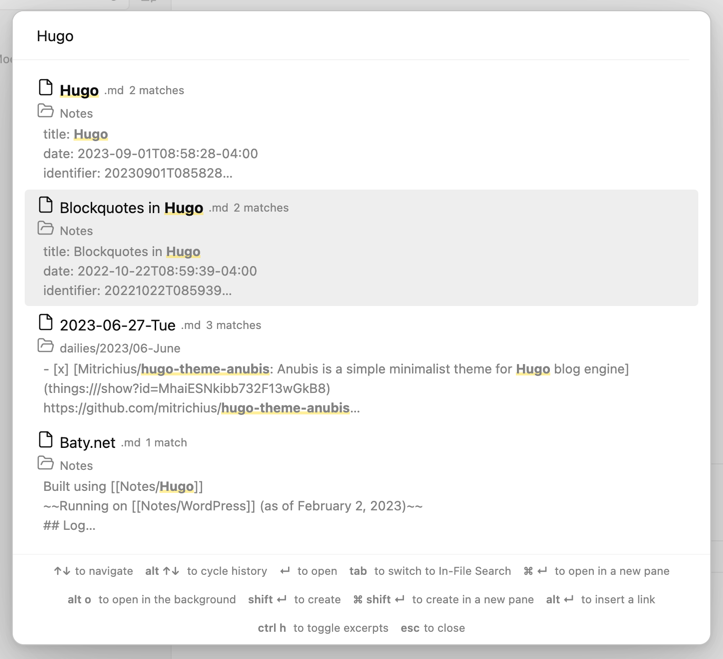
I don't know about you, but I find that difficult to scan. Here's the same search (although with different content) in Obsidian's "Omnisearch":
If I'd written my note using Obsidian, I'm convinced I would have found it straight away[1].
This bugged me so much that I fired up Obsidian and thought, "There, I'll just put my notes in Obsidian. Problem solved!"
Except you know what came next. I don't enjoy using Obsidian. Emacs is better at nearly everything. Once again I'd overreacted to a minor annoyance and was going to burn it all down and start over. That's a silly thing that I do. I avoided it this time, thankfully.
I understand that some people might feel the opposite. Not the case for me. ↩︎
I use org-attach a lot. There's no way to see which files are attached without calling "org-attach-open" or whatever. Apparently something changed in Org-mode years ago that removed the function that did what I want. Found the following on the mailing list...
(defun org-attach-save-file-list-to-property (dir)
    "Save list of attachments to ORG_ATTACH_FILES property."
    (when-let* ((files (org-attach-file-list dir)))
      (org-set-property "ORG_ATTACH_FILES" (mapconcat #'identity files ", "))))
  (add-hook 'org-attach-after-change-hook #'org-attach-save-file-list-to-property)
It's possible that no one will ever see this post. I'm writing a Hugo-formatted markdown file in Emacs. This means it will be published to a defunct copy of my blog[1]
Unless of course I decide to bring it back as baty.net. If that happens, then 👋! ↩︎
A few folks[1] have been posting about their current subscriptions. Here is a list of my subscriptions, in alphabetical order, because I didn’t want to try categorizing them.
1Password: $5 – Apple’s password manager needs to improve a lot before I’ll consider replacing this
Adobe: $10 – I’m trying the Lightroom 1TB plan. Seeing if I can live with just Lightroom Desktop.
Amazon AWS: $2 – I don’t even know where this charge is coming from
Amazon Prime: $9 – Indispensable
Apple One: $37 – I really only want Music, TV+, and 2TB of iCloud storage but they make it impossible to cherry-pick
Capture One: $15 – Raw photo editing. I keep trying to replace this with Adobe but can’t
Day One: $2 – On-and-off journaling app for over a decade. I’m currently On again.
DigitalOcean: $15 – My VPS
Fastmail: $5 – Great email service
Flickr: $6 – It’s sad to see the world slowly stop using Flickr. I’ve got thousands of photos over nearly 20 years stored there. No way I can quit now.
Glass: $3 – Modern social photo sharing. Glass is really nice and it’s all about the photos (as opposed to, say, Instagram)
Hulu: $12 – I’m surprised by how much stuff I watch on Hulu
Max (HBO): $18 – This can probably go
Neatnik (omg.lol): $2 – My Mastodon account. Also a ton of other nice services.
Netflix: $17 – This may go soon, too.
NYTimes: $25 – Paper of record, whether we like it or not.
Photomator: $3 – The only way I can deal with editing iPhone photos
Photoscan: $4 – If I ever get around to scanning my grandfathers 24 photo albums, I’ll need this
Put.io: $10 – Such a handy service for managing torrents
Qobuz: $11 – Music. It works seamlessly with Roon so I kind of need it.
SetApp: $10 – Like Netflix for apps. I use a dozen of them nearly every day. Easily worth the $10/month.
Sourcehut: $2 – Now that I’m using my own Gitea instance again, this can probably go.
Spotify: $15 – My kids prefer this to Apple Music. I may put my foot down and make them switch.
The Atlantic: $6 – A favorite
Tinylitics: $5 – A new, nice, privacy-focused analytics platform.
YouTube Premium: $18 – Don’t tell Google, but not seeing ads on YouTube is worth double this to me.
For a total of $256 per month. That seems like a lot, but I have another list of canceled subscriptions totaling around $125 so I'm improving!
Just a quick appreciation of a common Org-mode feature.
By default, archiving a TODO in Org-mode moves it to another file:
"The default archive location is a file in the same directory as the current file, with the name derived by appending ‘_archive’ to the current file name."
I never gave this much thought and sort of assumed that it was just how things worked. Of course this is Emacs, so yeah, it can work however I want it to work.
I use TODOs in a couple of ways. First, I keep fleeting, repeating, and future TODOs in a single, giant "todo.org" file. TODOs here are normally not related to specific projects. When I'm done with them I want them out of the way, so I archive them using org-archive-subtree, which behaves as described above, by default. I also keep an "inbox.org" file for newly-captured TODOs and notes. This means I have two separate _archive files. I prefer to keep things together, so I started looking for a better way to handle things.
Of course there's a better way to handle things. It looks like this:
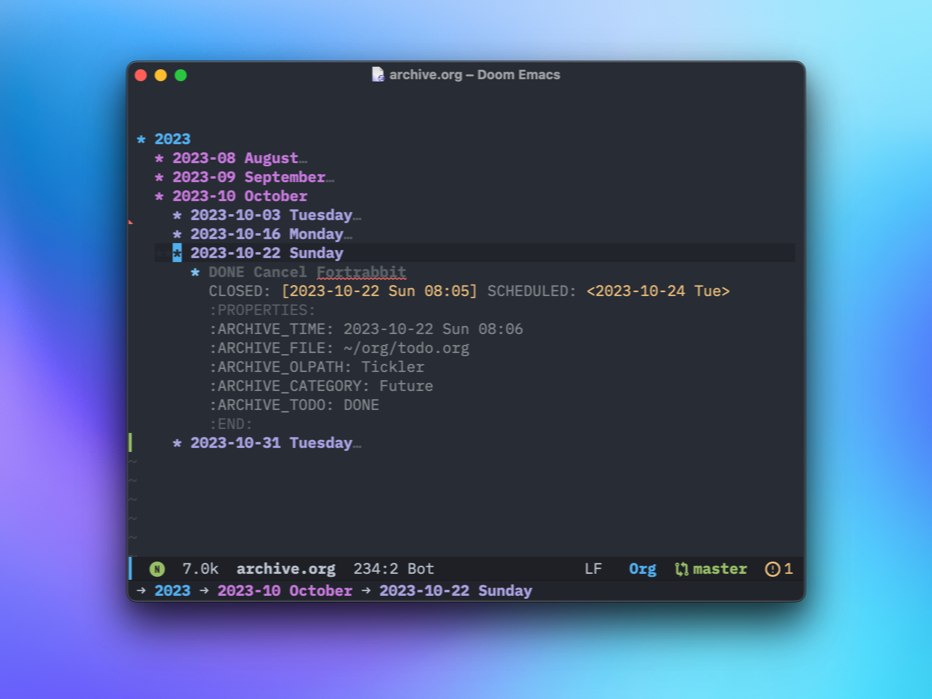
Now, everything I archive goes into a single Org file, organized by date within an Org date tree[1], like so:
Screen shot showing an org-mode datetree
For projects, I create a separate Org file and I keep all TODOs related to the project within that file. It's nice and tidy this way. What's not as tidy is when I archive things in project files, by default I end up with a bunch of matching _archive files. Or, using the above configuration, they end up mixed in with everything else in "archive.org"
I want project TODOs to remain in the original project file, but I also want to archive old ones, so, instead of calling org-archive-subtree I use org-toggle-archive-tag. This adds an :archive: tag to the TODO, which prevents it from showing in my agenda and excludes it from exports and sparse trees, etc. This effectively removes it from my normal routine, but the TODO remains right there in the project file. Neat!
Much of this is obvious and well-known to Emacs users, but I wanted to call it out as something that makes using Org-mode so much fun.
A date tree is an outline structure with years on the highest level, months or ISO weeks as sublevels and then dates on the lowest level. I love date trees so much. ↩︎
Why would anyone host their own Git repos when Github exists? Fair question!
For me, it's mostly because Github has become too much like a social network. It feels like LinkedIn for nerds.
I moved most of my repos to Sourcehut last year. Sourcehut has that fun, Craigslist sort of retro simplicity that I like. On the other hand, it's just kind of weird. I have a hard time finding my way around. I don't really understand the Projects hierarchy. I love the built-in mailing lists, but otherwise it's mostly too difficult for me.
A few years ago I moved my stuff to a self-hosted Gitea instance. Gitea is nice. It's familiarly Github-esque. It's fast, and it's a single Go binary. You know how much I love self-contained software.
Gitea and I drifted apart when I went through a "let someone else deal with hosting" phase. I'm less inclined to want to geek out with hosting still today, but between the ultra-nerdiness of Sourcehut and the increasingly showoffy nature of Github, I thought it might be time to revisit running my own repo server.
Installing Gitea was a breeze. I followed their own instructions to the letter and was up and running in less than 30 minutes. Here's a quick summary (I'm basically paraphrasing the installation guide):
Then I set it up as a service using their instructions and sample service file
By default, Gitea runs on port 3000. I wanted to run it on the standard web port so I needed to configure Caddy as reverse proxy, which is as simple as adding this to my Caddyfile:
git.baty.net {
        reverse_proxy localhost:3000
}
There are no default users configured, so I added myself as an admin via the Gitea CLI.
That was it. By the way, every self-hosted app should use SQLite by default. It's so great and simple.
This feels good. As long as things don't get weird on me, I'll try and stick with it for a while. One odd thing is that almost all of my repos are private, so I have no real need for a hosted git service. But I feel better having somewhere "out there" to commit changes to, and Gitea works well for that.
Emacs is less than friendly out of the box, so we customize things to suit our own personal tastes and preferences. When starting out, some people even enjoy that part. It's one of the best things about Emacs, but I hated it. I just wanted to do stuff, ya know?
I muddled through (this was in 2011), but eventually I tired of having to figure everything out on my own, so I tried a few "starter kits". That was much better! I could piggyback on someone who knew a lot more than me, then edit to suit. A few people scolded me for "cheating", but ¯_(ツ)_/¯.
Long story short, I went through a few of these kits before landing on Spacemacs. As a long-time Vim user, using Spacemacs was awesome. But man, that weird configuration scared me. Along came Doom Emacs, which claimed to prioritize speed and I found that to be true. Doom's configuration was much more reasonable, I thought, so I switched to Doom.
Since then, I've gotten the bug to roll my own config again, so I did that. Three or four times I did that. After many (many!) hours, I would eventually just end up with a shitty version of Doom anyway.
My most recent attempt at building my own config was actually pretty good. It was fast, simple, and reasonable. At first, anyway. Then I'd realize that I missed something so I'd add it. Then I'd add more things. Just a little tweak, is all! Eventually, my startup times were getting longer and things would break that I'd forgotten how I'd made work in the first place.
I get lazy and don't always feel like fixing things or figuring everything out on my own, so yesterday I ditched the whole thing and installed Doom from scratch. I copied over the best parts of my custom config and off I went. Doom is nicer than mine was. It's probably nice than mine would ever be, so why do I keep trying to do it myself?
I get caught up in other people's enthusiasm. It's often fair to describe my entire personality as an amalgam of the blog posts I read that morning.
When someone writes enthusiastically about something, I want to try that thing. It could be software, a camera, a process, or a habit. I tell myself that it's not FOMO, but rather curiosity and a desire to explore new things.
To some extent, this is healthy. Learning about and experiencing new things is fun and useful. To a point. Too much, and it becomes a distraction and counterproductive. I'd say I'm about two decades into the counterproductive-ness of it all.
I feel like I would have been better off had I picked a few things years ago and stuck with them.
People make fun of me for frequently changing the way I do things. This is not undeserved. I like to try things. That's me ¯_(ツ)_/¯.
But as a counterpoint, sometimes I stick with things for a long time. Today's example is shaving. I was so annoyed by the price of disposable blades for my razor that I started shopping for alternatives.
It costs a little extra up front, but everything after that is better, including costs. And no overpriced, plasticy blades. The last time I bought blades was in 2018 and I paid $8.00 for 100 blades. I have many left. It costs much less than $1.00/month for blades. And a jar of shaving cream lasts for many months.
Aside from saving money, using the kit simply feels better. I don't anticipate any of this changing, which is a nice...er...change of pace for me.
Note that brushes using badger fur are made from, well, real badgers. Those badgers are sometimes badly mistreated. I didn't know that at the time I bought mine. Today, I would recommend a synthetic brush instead. ↩︎
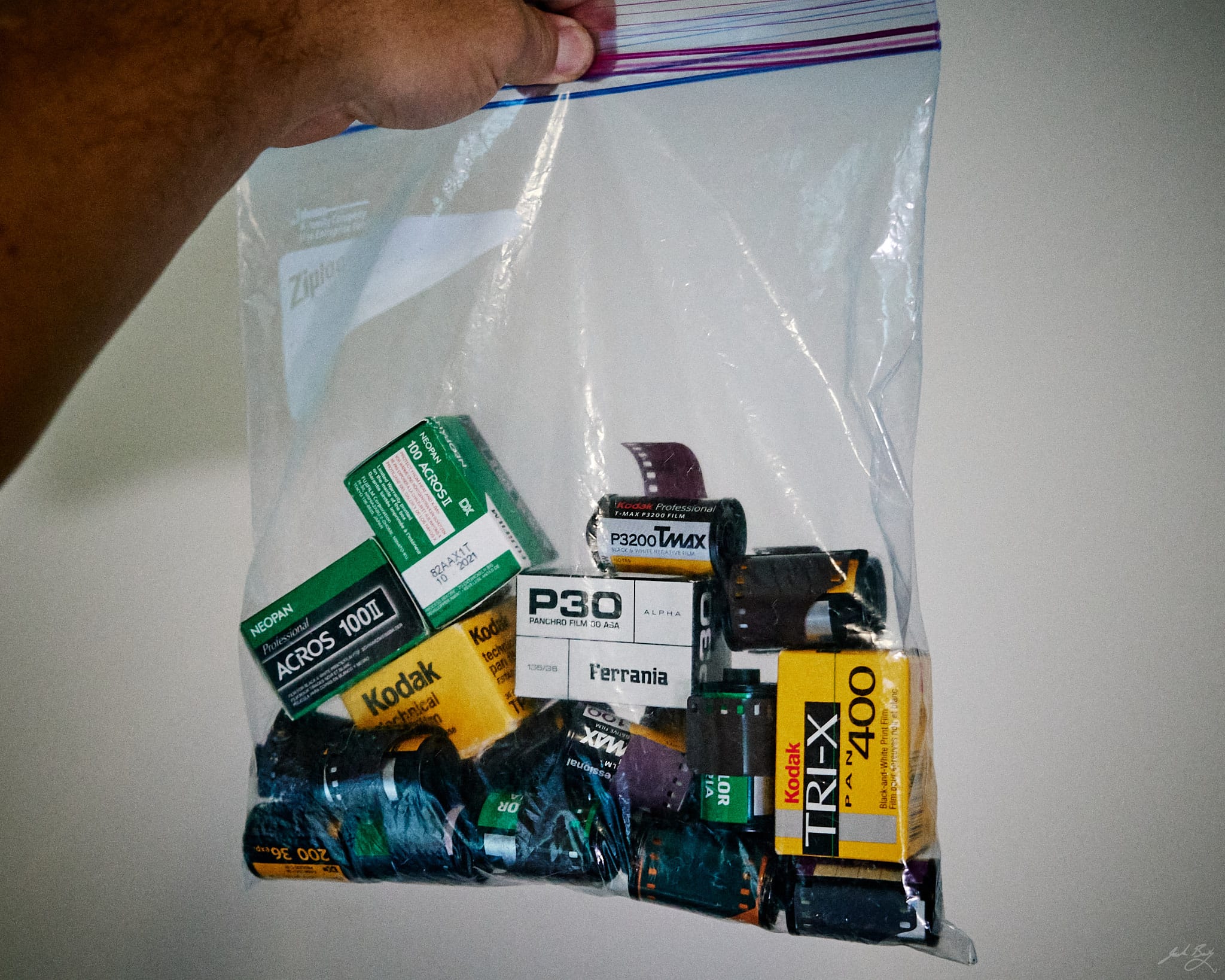
Whenever I review my recent photos, I am reminded that I prefer film. Film is fun, if sometimes frustrating, to shoot. Film cameras are cooler. And I love the results.
This morning I was tinkering with film emulation styles in Capture One, to see if I could get something close to HP5. The presets are pretty good, but even if they completely nail the look, they're still digital photos manipulated to resemble something they're not. This bugs me.
When I go out, I bring both film and digital cameras. You know, just in case. I tell myself this will ensure that I "get the shot", whatever that means. I'm not sure it works the way I think it does. I often spend so much time deciding which camera to use and then switching that I'm sure I'm missing lots of shots anyway.
Sometimes I'm disappointed with the results from film, sure. There are development issues, dust (OMG the dust!), low light challenges, etc. Thank goodness I have a digital version, right?
Having options is great, but always having to decide...isn't, so I'm thinking about going all-in with film for a while.
Film photography is slow, expensive, and untrustworthy. It's also fun, creative, interesting, and makes for, in my opinion, nicer images.
I have a new iPhone 15 Pro and that should cover any "must-have" documentation photos and selfies, but otherwise I will try shooting everything else with a film camera. For a while.
 baty.net