I can't be trusted with powerful software

It's happening again. My love of powerful, complex software has overrun my ability to avoid tinkering.

For example, I've spent several hours this week working on my Org-mode agenda display. Configuring org-super-agenda is tons of fun. It can make one's Agenda absolutely sing and dance, which is not ideal for me because I've spent way too much time trying to teach it to sing and dance. I could have finished all of the tasks on my todo list in the time I've spent getting them to display just right.

I did the same thing with tweaking Elfeed for my RSS feeds and Notmuch for email. They're just so cool and they can do so much. But they're not really better than, say, NetNewsWire or Apple's Mail.app. They're just cooler.

Basically, I've been feeling like the more powerful the tool, the less effective I become. This seems counterintuitive, but it's real. I get so deep into the weeds that I have a hard time finding my way back to wherever I started.

I'm not sure how to fix this. I've been down this road before so I just want to talk it through.

At times, I fall back to Apple Notes and Reminders and Mail and THAT's IT! But nope, that frustrates me almost immediately. The ideal solution would be to find tools that are just right. But what? Probably Things, BBEdit, DEVONthink, and TheBrain. As much as I love Tinderbox, it's second only to Emacs on the Powerful Software scale, so I'm backing away from that for now, too.

Stay tuned.

Permalink #

I'm weary of all social media

Twitter was the place I liked to be from 2006 until 2022. Or more accurately, it was the place I liked to be from 2006 until around 2015. After that, it was the place I felt I needed to be. Still, I managed to curate my Twitter feed well enough to avoid most of the awful bits. I'm a CIS white male, which made it easier of course.

Then Musk happened. I gave him the benefit of much doubt, hoping that just maybe he would "fix" things. The opposite has happened so far, so I'm out. I visit every few days to see if I've missed anything from my friends still there, but otherwise, it's no longer a place I want to spend time or contribute to. It's quite sad, honestly.

Mastodon to the rescue, right?! Sort of. Mastodon is a great idea. It's distributed and federated and built on top of an open protocol. All good things. But it's the culture that has put me off lately. There are a lot of people who feel it's their job to police how everyone else uses the platform. "You need to CW things like that!". "Hey, you didn't add alt text to that image, shame on you!" In some cases, the scolding is justified, but who gets to decide? Not you, that's for sure.

I signed up for Bluesky a few days ago. I don't know why, really. I guess it's because I try just about every new service, whether I need it or not. Also, I have been lamenting the loss of early Twitter. Those were heady days. The last couple of days on Bluesky have felt a little like that, which is nice. It's currently like a calm Twitter.

It's already changing. The Bluesky app is brand new and was really only meant as a way to test the API/Protocol they're building. And yet, people sign up (for the beta, remember) and start demanding better blocking, GIFs, and whatever other flavor of Twitter they feel is missing. It's a bit like Mastodon in that half of the conversation is dedicated to discussing the service itself. This is typical but gets old quickly.

The other Mastodon-like behavior is the non-stop snarky anti-Twitter smugness. That, too, gets old quickly. We get it, you're all so above social media in general and Twitter in particular. I kind of want to tell everyone to get over themselves and just go back to sharing fun things they're doing instead of pointing and yelling "That's BAD!" at everything else.

Anyhoo, I'm just venting after reading a heated discussion (on yet another social network) about whether using Bluesky is "approved" because Jack Dorsey is loosely involved in the project[1]. Remember, Jack did a Bad Thing that one time, so if he even walks by the project it's contaminated. I disagree, but I sure as hell don't feel like arguing about it.

In fact, I don't feel like arguing about anything online. I don't know how to avoid that and remain on any of the current social media platforms. This is why I write here on my blog that almost no one reads, and which requires some effort if you want to fight me. (But how hard is it to write an email, honestly?)


  1. Jack wrote: "All I made happen was get a team focused on the idea." He's one of 3 people on the board. Mostly, though, he's on Nostr now anyway. ↩︎

Permalink #

Installing a new sprinkler system controller

I replaced our flaky sprinkler system controller this weekend. All by myself.

The unit I chose was the Rachio 3 Smart Sprinkler Controller. They offer 4, 8, and 16-zone versions. My system has 9 zones because of course it does. The good news was that Costco sells a version with 12 zones for the same price as the standard 8-zone model. Yay me!

I'm not a handy person, so it was with some trepidation that I even started this project. I was careful to remember to take lots of "before" photos to use as a reference.

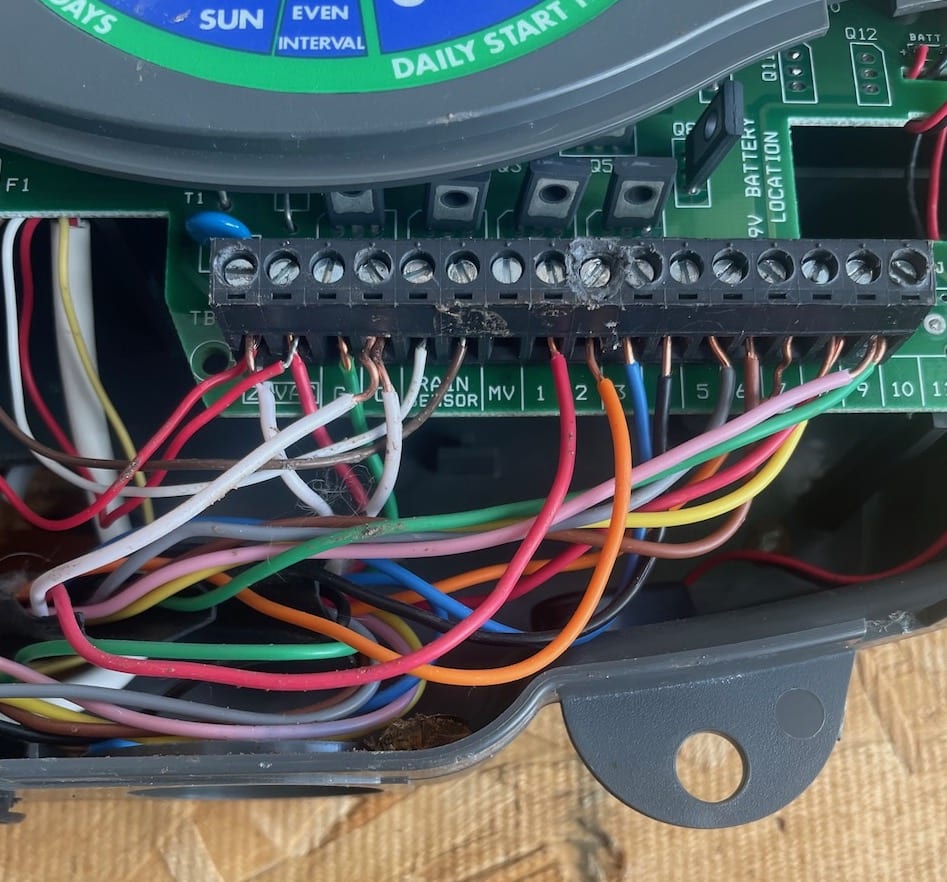
Wiring in the old controller

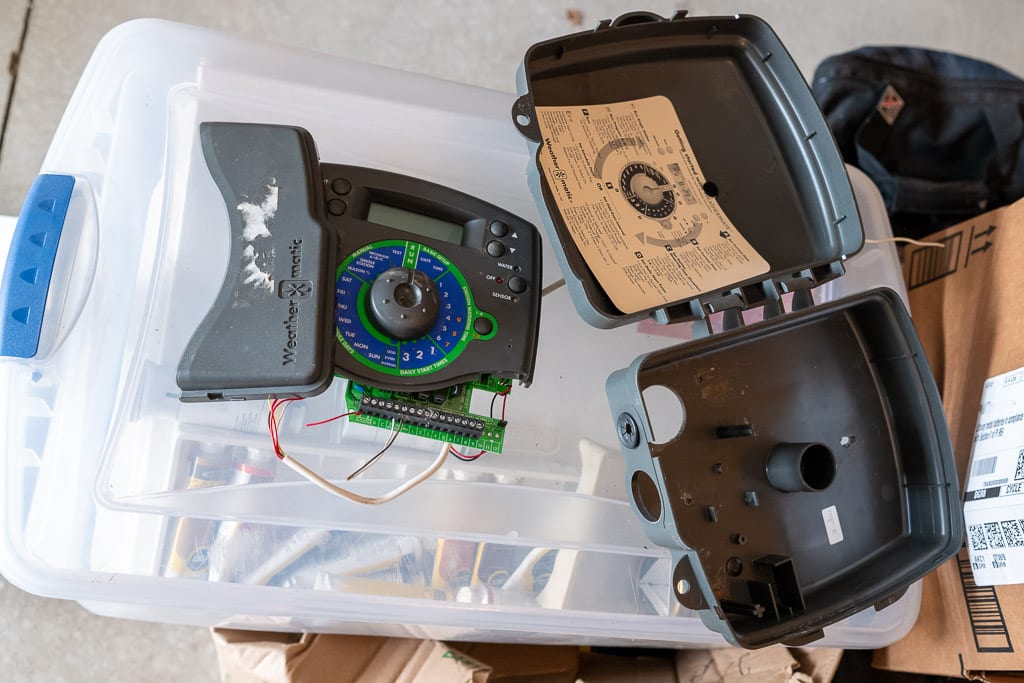
Removing the old housing was a little tricky because it was nailed to the backing board rather than screwed.

The old controller, not-so-carefully removed

Three screws later and the new controller was in place. I used the reference photos to connect the wiring and it was time to test everything.

New controller wiring

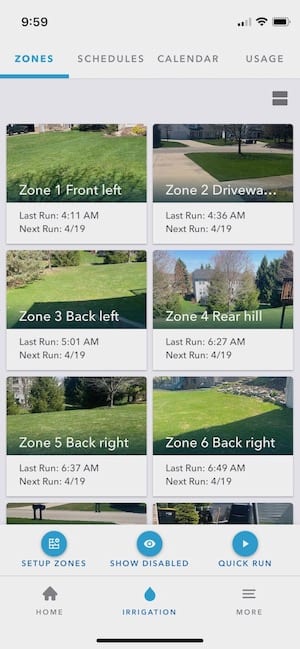
The Rachio app walked me through getting everything set up. Of course nothing worked. I had missed one common wire. Once that was in place, the system was working. The next step was to go through each zone and indicate grass type, soil type, amount of sun, grade, etc. This took me about thirty minutes, after which a default schedule was created for me, using the information for each zone.

The Rachio app

It's pretty cool. The app knows my local weather conditions, and skips runs based on wind, temperature, and rainfall. My wife has access so she can start and stop things any time, right from her phone. I was excited to add it to HomeKit until I read that they'd recently abandoned HomeKit support. Well, crap. That would have been nice.

The first run ran as scheduled this morning. I received a text letting me know it was about to start. The run is timed to start so that it "ends before sunrise". The next run has been automatically postponed until next Wednesday, as it's supposed to rain tomorrow and Monday. Pretty cool.

Once in a while, I get a DiY project right. Feels good when that happens.

The new Rachio 3 controller, installed

Permalink #

Another Mastodon move

I decided that a single-player Mastodon instance isn't ideal. It's overkill for one person, and it's lonely! The #local feed is just me shouting to myself. That's no fun. What's the point in having a giant Rails app with all sorts of moderation tools, user management, and monthy costs if it's just me? That's what I thought, so I've moved.

First, I considered heading back to fosstodon.org. The vibe there is kind of what it's like to be in my head, but it also ends up feeling a little narrow-scoped, if that makes sense, so I decided against it.

Another choice was to join the new Medium instance, but if I did that I'd probably end up posting nothing but listicles about productivity tools and we need zero more of those in the world. So Medium is out.

I've ended up at @jbaty@social.lol. I've had an omg.lol account for a long time, and I get a kick out of the vibe. All those hearts and happy stuff. It's nice, ya know? Follow me there if you like.

Permalink #

Blot is just right

You may have noticed that once again things have changed around here. This time, it's due to switching from WordPress to Blot. We've been around this block before, but lemme 'splain[1].

I've switched from Hugo to Eleventy to WordPress within just the past several months. This is not surprising to any of you who've been following along. Sometimes I switch blogging tools because I'm mad at whatever I'm using. Other times I switch because I'm bored. This time it's a bit of both.

Mostly, I switched because I don't enjoy using WordPress. WordPress is powerful and easy and everywhere, but the editor is unpleasant and everything just feels heavy and overwrought. I also tire of plugins nagging me to "Upgrade to Premium!" all the time. I tell myself I can live with it, but in the end I never can. On the other end of the spectrum, my usual static site generators (e.g. Hugo) feel like too much work. They require maintenance and sometimes break for no reason I can see. They also require some form of deployment mechanism as well as hosting, etc. It's too much.

The decision between super-easy-but-icky WordPress and more-work-but-pleasant Hugo always trips me up. While debating this with myself earlier, I remembered Blot. You see, Blot is like an SSG but without all the dependencies and fuss. Put some Markdown (or HTML or Text) files in a Dropbox folder and boom, a nice blog appears. There's a little more to it than that, but still. With Blot, I can use any of my favorite text editors to edit posts. And there's no deployment or "Send to blog" steps. I simply save the file and the rest is taken care of.

I gravitate toward software that "thinks" like I do. Blot thinks so much like me that it's creepy. If I were going to build my own blogging tool, it would work like Blot works.

Another great thing is that Blot's developer, David Merfield, is preternaturally helpful. He's gone so far above and beyond what's expected when helping me that I almost felt guilty. He's just nice. Reading his News page shows how he's continually making improvements. And also how helpful he is.

So I'm back to using Blot for Baty.net. It's easy, and I get to live happily in plain text files. Thanks for playing along.

UPDATE May 29, 2023: Aaaand, we're back on Hugo. I wanted everything on my server.


  1. Again, like it's 2018 ↩︎

Permalink #

Must we become what we're near?

I’ve seen a number of thoughts similar to this from Shane Parrish:

We unconsciously become what we’re near. If you work for a jerk, sooner or later, you’ll become one yourself. If your colleagues are selfish, sooner or later, you become selfish. If you hang around someone who’s unkind, you’ll slowly become unkind. Little by little, you adopt the thoughts and feelings, the attitudes and standards of the people around you.

Shane Parrish, Farnham Street

I wonder if anyone’s considered whether the opposite could happen. Let’s assume that I’m, say, a kind person working with someone who’s unkind. Maybe, just maybe, the person I’m near will become more kind rather than the other way around. Must things always trend toward the negative? I’d like to think not.

Permalink #

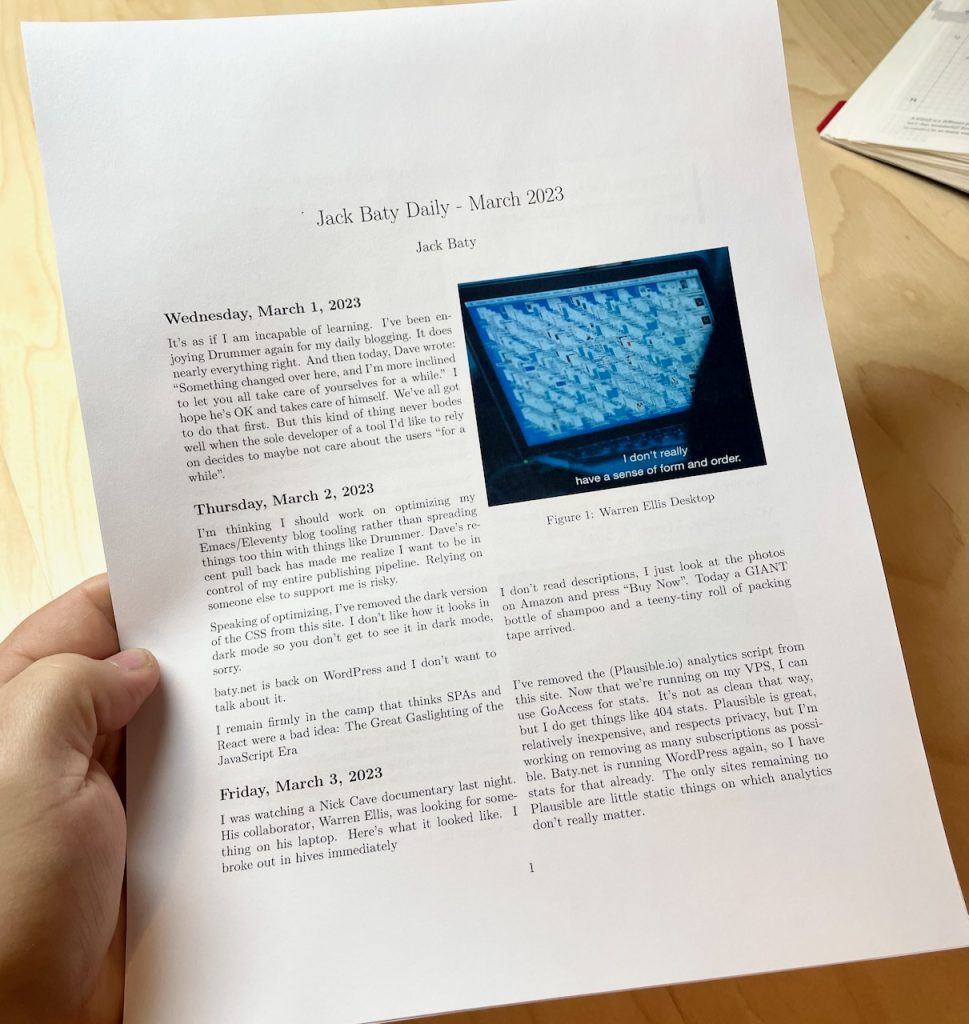
Printing daily.baty.net

At the end of each month, I convert my Org-journal entries into a nice PDF, print it, and put it into a binder.

It occurred to me that my daily.baty.net website content is just a bunch of markdown files that could be treated the same as my org-journal files and perhaps printed as well.

I started by concatenating March’s entries into a single Markdown file, like so:

cat 2023-03*.md >> ~/Desktop/202303-MarchBlog.md

The resulting file wasn’t in great shape for printing, so I had to clean it up. At minimum, I needed to do the following:

  • Convert the YAML titles into Markdown headings (e.g. “title: Saturday, March 4, 2023”)
  • Remove all YAML delimiters (“—“)
  • Remove all date lines (e.g. “date: 2023-03-31T05:59:55.10-4:00”)
  • Convert absolute image links to relative links

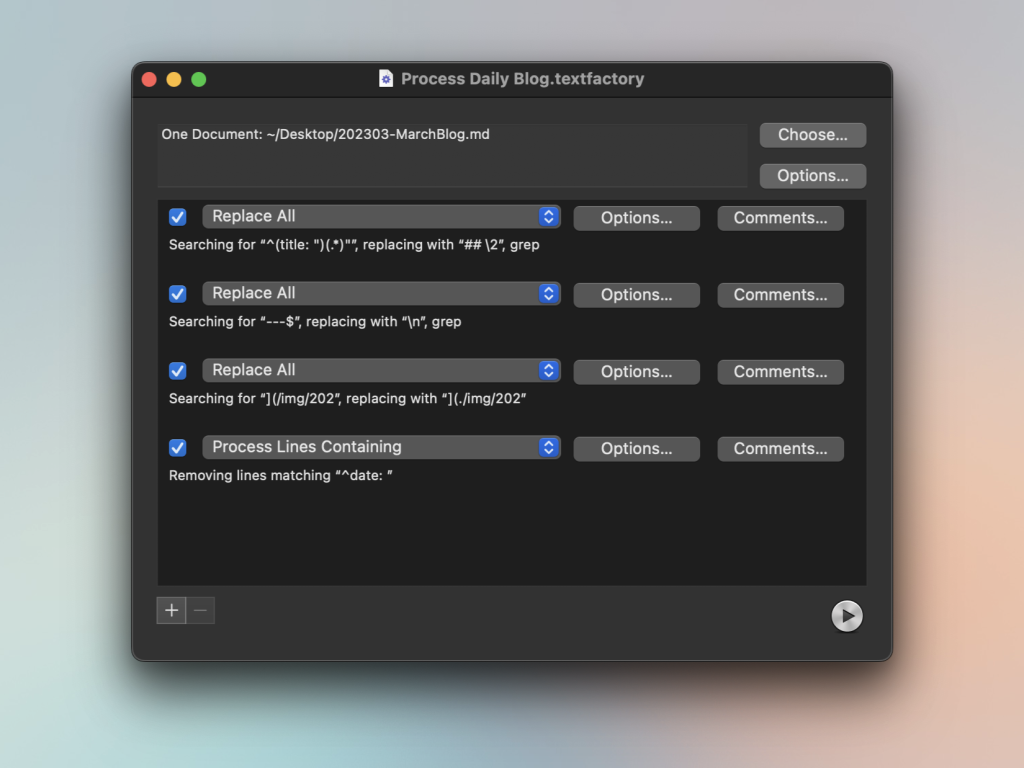
My first approach was to create a Text Factory in BBEdit. Text Factories are re-usable bundles of BBEdit’s text transformation commands constructed using a handy UI. Here’s what it looks like:

This worked fine, and I assumed I was finished, but I wondered if there might be an easy way to do the same thing in Emacs. I’m terrible at writing lisp, so I cheated and asked ChatGPT to write it for me. To create the prompt, I copied the descriptions out of the screenshot shown above and pasted them into my prompt. It was just a list of things like “Search and replace “](/img/202” with “](./img/202”

ChatGPT wrote the function, added comments, and summarized what it did. The code was wrong about a couple of things, but it got me maybe 75% of what I needed in a couple of minutes. Say what you will about AI, but it’s darn helpful, even though it’s flawed. After some tweaking, I ended up with the following emacs function:

(defun jab/process-daily-blog-export ()
  "Converts Markdown file of concatenated daily.baty.net entries"
  (interactive)
  (save-excursion
    ;; Replace title: lines with ## heading
    (goto-char (point-min))
    (while (re-search-forward "^title: \"\\(.*\\)\"$"  nil t)
      (replace-match "## \\1"))

    ;; Remove YAML delimiters "---"
    (goto-char (point-min))
    (while (re-search-forward "---$" nil t)
      (replace-match "\n"))

    ;; Make image paths relative
    (goto-char (point-min))
    (while (re-search-forward "](\/img\/202" nil t)
      (replace-match "](./img/202"))

    ;; Remove lines matching "^date: "
    (goto-char (point-min))
    (while (re-search-forward "^date: .*" nil t)
      (delete-region (line-beginning-position) (line-end-position)))))

Like I said, I’m terrible at writing Lisp, and there may be a dozen better ways of approaching this, but this worked fine and was easy to do (with AI’s help).

All that remained was to add my usual Pandoc headers and print using the same template I use for Printing web pages and the result is a nice, printed copy of my blog for the month. At some point I may try and automate the rest of the process, but this is good enough for now.

Permalink #

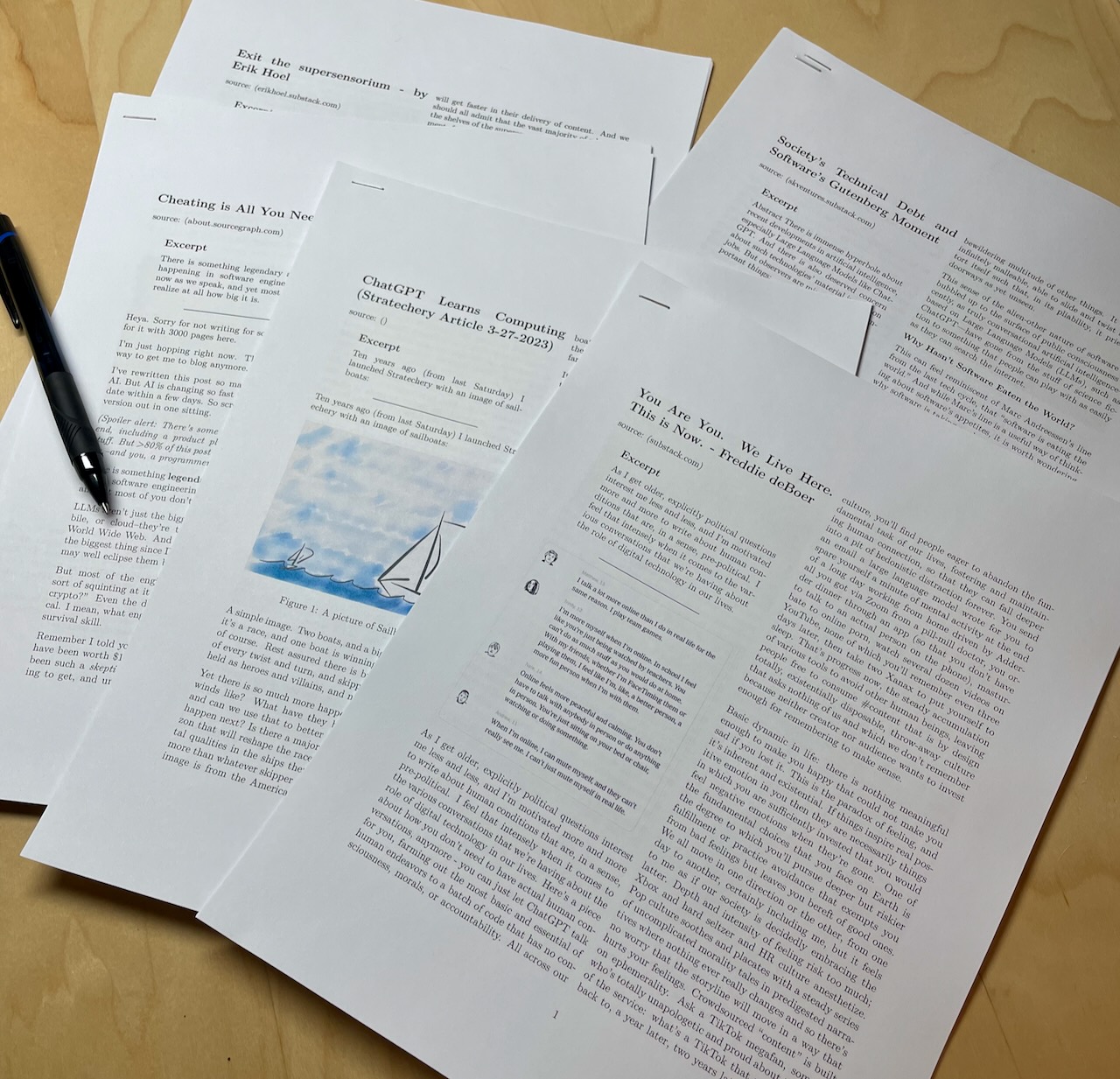
My read-later service is made of paper

My read-later backlog

I’ve tried so many “read-later” services that I can’t remember half of them. They’re all basically the same: visit a website, click a button, and the article is saved to a list somewhere with all the other articles I’ve saved. Some newer services get fancy with recommendations, UI improvements, social integration, etc. but they all just gather a list of articles that I almost never end up reading. But, you know, just in case, right?

I started printing long-form articles that I wanted to read in 2020 and that continues today. It’s the first read-later service that has stuck with me. My process for printing articles works great. I love the concise, two-column format I get from my Pandoc template. The Pandoc->LaTeX->PDF typesetting is so good and makes long-form text super easy to read. That, along with double-sided printing keeps the page count nice and low (it’s less annoying for the forests).

The printed articles are stapled and stacked on my reading desk. When I feel like digging through them, I sit down, grab a pen and highlighter, and slowly and calmly read stuff. It’s low-tech, offline, and comes with zero distractions. The minor friction around collecting articles keeps me from dumping everything into the pile. I only keep what I actually want to read, instead of everything I might maybe (but probably not) get to someday.

It’s a good system.

Permalink #

Wavelength Messenger

This is not a review, but I wanted to jot down some notes after a few days in a new app that I’m enjoying very much: Wavelength Messenger. You might like to read John Gruber’s post for details.

My wife believes that I have some kind of processing disorder that causes me to quickly become overwhelmed by too much simultaneous input. She discovered this after several visits to the local Costco. After a few minutes in a busy Costco, I sort of shut down and become surly. I can only think about leaving. I’m no fun in a Costco.

This disorder is probably why I dislike Discord. A few minutes in a busy Discord server and my eyes sort of glaze over the same way they do in a Costco. I can’t wait to get out of there.

I prefer old-fashioned web forums. Forums are calm. Even busy ones. People can gather around a topic, post threads, and then discuss them, in context, at their leisure. I can find a topic, then easily scan the whole conversation. Discourse does a great job of this. Discord recently added forum-like features, but they feel tacked on and not that different from the main areas.

When I’m visiting a product’s website and see a link to “Community”, I cross my fingers, hoping that the link leads to a Discourse forum and not a Discord server.

Forums, however, can feel a little distant. Impersonal. It’s a challenge to find a good balance between real-time chat and more leisurely forums.

What about Slack? I’ve used Slack since the beginning. Loved it. But it feels heavy. The macOS “app” still uses too much juice and the web app feels janky. Switching between Slack workspaces is cumbersome and it makes me feel too far away from the workspaces I’m not currently in. Slack channels aren’t lightweight enough to use as threads, and Slack’s threads still feel like the place conversations go to die.

Wavelength balances all this nicely. I can see every group I’m in, and which ones have new activity. I can quickly pop in and join the conversation threads I’m interested in. Creating a new thread doesn’t feel like a big deal the way it does in forums. Although so far in a few groups everyone is just using one long thread, so we’ll see how that plays out.

The AI integration feels trendy, but I’ve been surprised at how often I’ve used it. It’s handy having AI right there in my messaging app.

The big thing missing for me is the ability to search messages. I understand that end-to-end encryption creates challenges around searching, but if they can manage to magically move thread history from peer to peer, I bet they can manage search. We’re going to need it.

Wavelength is a good-looking, good-feeling app that is good at group discussions. I like it.

Permalink #

Nick Brandt on using a digital camera – I hated it

I brought a Hasselblad 60 megapixel medium format digital camera to Africa with me. I took photos side by side with my film camera. The digital camera’s images were sharper. They had more detail in both the shadows and the highlights. The digital camera made photographing very, very easy.

And I hated it. … In fact, had I photographed using a digital camera from the beginning, I’m not sure that I would have liked a single photograph that I had ever taken.

Nick Brandt, I am the Walrus

His animal photographs are astonishing. And he uses short (50-100mm equiv. on 35mm film) lenses on film cameras. Amazing.

NICK BRANDT. LION BEFORE STORM SITTING PROFILE, MASAI MARA 2006

Permalink #

More like everyone else

I’m wondering if I should become more like everyone else. Should I post “5 Tips to improve your workflow right now!” articles on Medium? Should I be “super excited” to humblebrag about myself on LinkedIn? Should I fire up my Instagram account and splash gaudy “stories” all over it throughout the day? Should I buy some neon background lights and work on an unnecessary 90-second musical intro to my upstart YouTube channel?

No, I shouldn’t.

Permalink #

Back to Org-roam (from Denote)

Update: I think Org-roam is the right answer for most people, but I could not resist the simplicity and lack of dependencies of Denote, so I am back in Denote as of June, 2023.

Using both Org-roam and Denote for my notes is not sustainable. I had to make a call one way or the other.

I went with Org-roam.

This is a bit disappointing because I prefer the philosophy of Denote. I like that Denote is agnostic about file types (I can mix and match Markdown and Org-mode files, for example). I like that it forces a consistent file naming scheme. I like that it doesn’t depend on Org-mode features or any other complex dependencies. I like that it doesn’t try to do too much, but is easily extensible. Plus, I’m not trying to build some sort of zettelkasten or anything, so simple is preferable.

But, I keep finding things in Org-roam that I “need”. I use aliases all the time. I like to use several tags on a file, but don’t want them all in the file name. I like the full-featured daily notes functions. I like the ability to extract a heading out to a new roam file. Or I can use org-roam-refile to move a heading to another file in the Org-roam directory. I’m sure I could find ways to handle some of these things in Denote, but with Org-roam I get them out of the box.

What I really like in Org-roam, and have come to rely on, is the ability to have individual Org headings become their own independent roam nodes. For a while, I thought this added unnecessary complexity, but it turns out to be super useful. For example, I have a books.org file, with each book as its own heading. (See Book logging in Emacs). Since moving this file into Org-roam, I’ve turned each book’s heading into its own node, making it easier to search for a book or to link between the book and its author note or a concept note. And I can still create summary tables within the books.org file.

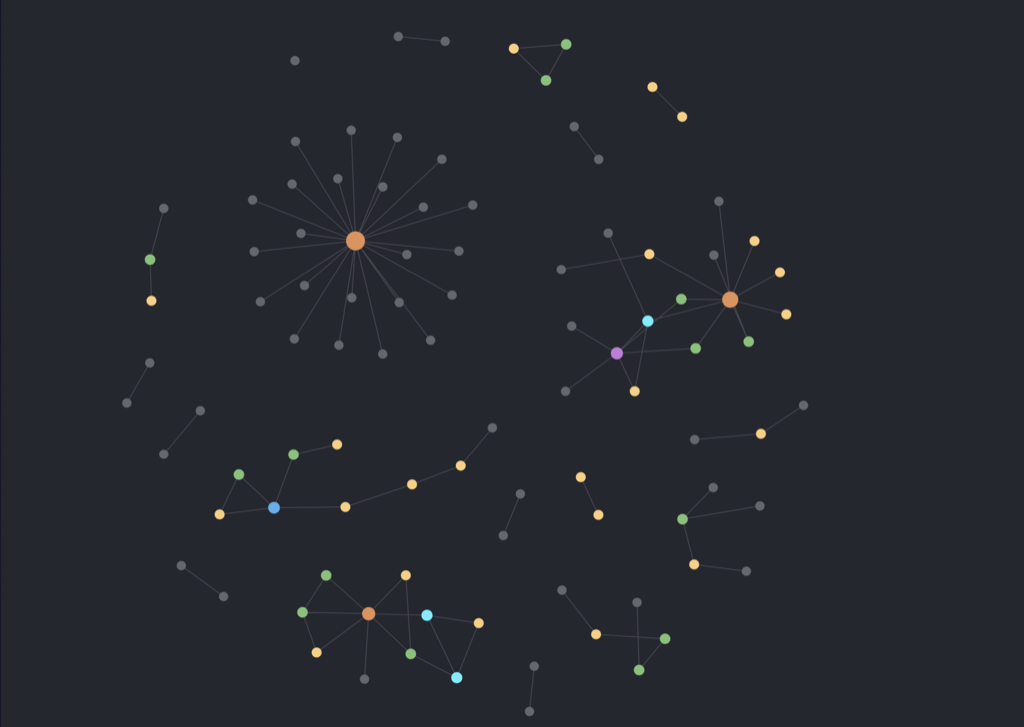
Then there’s the Graph. I make fun of the Graph because it really is mostly useless, but dammit it’s fun to poke around in.

Part of my org-roam graph

Add Org-roam’s larger ecosystem to the above list, and the decision to keep my notes in Org-roam becomes hard to argue with. I’m slowly moving my Denote notes back into Org-roam and fixing links, etc.

I don’t know why I’m so sentimental about Denote. Not using it makes me a little sad. Prot is brilliant and I like the way he thinks. Denote is a terrific, smart, simple Emacs package, but right now Org-roam makes more sense for my notes.

Permalink #

Renumbering my index cards

When I started building a new index card note box, I followed Scott Schepard’s lead and used the Wikipedia Academic Disciplines as the overarching structure. I’ve come to dislike that system. It’s too dependent on hierarchy, and one I don’t really follow. So, this morning, when trying to install a new note about Libertarianism (topical!), I became frustrated and renumbered everything.

I’m now using a simpler, more Luhmann-like card numbering system. (Some would call it “Folgezettel”, but I’ll stick with “numbering system”).

Each new card gets a number, with the first being 1.1. If a subsequent idea plays directly off the first, it gets 1.1a. If it’s on the same general topic, but unrelated to the first, it gets 1.2. The next completely unrelated idea gets 2.1, etc. If I stick to this, I’ll end up with numbers like 134.3a1b and that’s just fine because I know what’s nearby and I always have the index to fall back on.

Bob Doto does a nice job of explaining all this in How to Use Folgezettel in Your Zettelkasten.

Now I don’t need to worry whether “Libertarianism” falls under “Political Science” or “Mythology”. I can just file it somewhere behind my existing thread on, say, “Selfishness”.

Permalink #

Viewing Caddy logs by date in GoAccess

UPDATE: I’ve had trouble getting GoAccess to parse the logs consistently after changing the date format.

I’ve been using GoAccess on the VPS running my static sites for keeping an eye on web server access logs. It works great and requires no tracking scripts. I run a cron job every five minutes to process my site logs and generate an HTML report. This is fine, but GoAccess always processes the entire log file and offers no way to filter the results. Sometimes I only want to see stats for, say, today or for the past week.

To do this, I run GoAccess on only a subset of the log file using the command line directly on the server. The GoAccess man page includes some examples using sed so that’s where I started. The first problem I ran into was that Caddy’s log files use json by default rather than the trusty old common or combined formats. The default log format uses a UNIX timestamp for dates, so the first thing to do was to change the format to iso8601 in Caddy’s configuration, like so…

daily.baty.net {
    log {
        output file /home/jbaty/logs/caddy/daily.baty.net.log
        format json {
            time_format iso8601
        }
    }
}

Now I can parse the logs based on the date using sed:

#!/bin/sh

sed -n '/'$(date '+%Y\/%m\/%d' -d 'today')'/,$ p' logs/caddy/daily.baty.net.log | goaccess -a --unknowns-as-crawlers --ignore-crawlers -

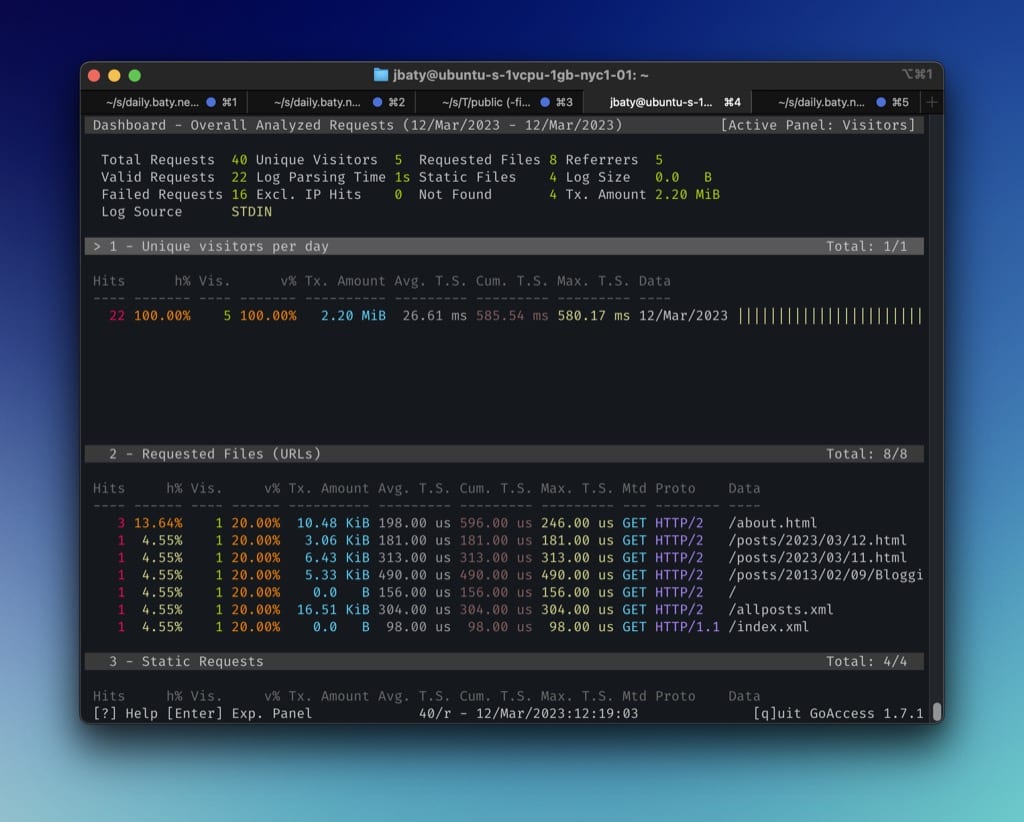
Now when I run ./stats-today on the server, I get something like this:

GoAccess in a terminal on the server

Check me out with my 5 whole visitors so far this morning! 😆

Permalink #

The Spark File

Ten years ago, Steven Johnson wrote The Spark File, in which he describes his process for keeping track of hunches, ideas, etc. in a single text file.

I, of course, thought this was a great idea and immediately started keeping my own spark file. It began in 2012 and I was reasonably consistent with it until 2016. After that, there was a lull, but it picked up again for a short time in 2021, after which I sort of forgot about it.

I ran into the file today and reviewing it has been quite a trip. The short version is that I’ve only done a few of the things I’d written down. This is fine since many of them are things I’m either no longer interested in or were too ambitious anyway. I have, since I last checked, completed a few of them. Crossing them off the list was fun. There are others that are still good ideas and that I may pursue.

Since the file is an org-mode file, I’ve added a capture template to my Emacs config that lets me quickly capture new entries. Now I just need some hunches or ideas to capture.

Permalink #

A fix for backlink display with Org-roam and Doom Emacs

I’ve been tracking an issue with the way backlinks are displayed that affects my use of Org-roam. Someone (hwiorn) finally discovered a workaround when using Doom Emacs: delete the compiled version of org-roam-utils. Like this:

rm .config/emacs/.local/straight/build-*/org-roam/org-roam-utils.elc

Now my links show up correctly. Finally! I’ll probably need to delete the file every time I sync or update but I don’t care as long as there’s a fix. It was driving me nuts.

UPDATE: And a few hours later, it was fixed for good in this commit.

Permalink #

Using jAlbum for photo galleries

The jAlbum UI

I’ve been a Flickr user since 2004 and a SmugMug user for nearly as long. For some reason, I prefer looking at my photos via online galleries rather than, say, my Photos library, and both Flickr and SmugMug have helped me do that.

I’ve also kept standalone static web galleries for the odd side project, such as a memorial to my dog Leeloo. Recently, I’ve been creating more of these, so I started looking for easier or better ways of generating static web galleries from a selection of photos. There are what feels like a thousand options. Everything from giant GUI apps to the nerdiest little command line utilities.

After looking around a bit, I’ve settled on jAlbum. I didn’t expect to like it. After all, it’s from that time (2004) when software was named so that everyone knew what it was written in. And I developed an allergy to Java not long after that. Go figure!

jAlbum is surprisingly robust and capable, while still being simple to use. The defaults are mostly fine, but it lets me tweak the dickens out of it, should I want to.

I’ve only spent the morning with it, but I have created some initial galleries at static.baty.net/photos. I think it already looks fine, and I haven’t even begun to tweak it.

jAlbum has built-in (S)FTP capability for automating the process of getting everything out to my server, but it doesn’t support ssh keys so I can’t use that. I’m instead using rsync via a tiny Makefile, so all I need to do is type make and the changes are deployed.

Permalink #

Leica SL2

The Leica SL2 felt inevitable. After an almost accidental run with the Panasonic S5, which I didn’t enjoy at all, I tried going back to the Fuji system. I’ve always liked Fujifilm cameras and their classic control layout. I purchased a new X-T5 and a few nice lenses late last year, but it didn’t grow on me. The X-T5 is a great camera and I had nothing to complain about. Except it just didn’t give me The Feels. Not the way, say, a Leica does.

I decided that I wasn’t going to be satisfied until I was back with Leica for my digital camera. My heart wanted me to buy another M10-R but we all know how that turns out.

A project I’ve had on the back burner for a couple of years is shooting formal portraits of my extended family. I’d like to get started on that, so I thought I’d move toward a more flexible mirrorless system and decided this was a good time to move to an SL2.

I’ve owned the lower-resolution SL2-S before, and it was fantastic. At the time, I was more interested in digital black and white, so I traded the SL2-S for a Q2 Monochrom. That was fun for a while, but this time I need to be more practical, so I opted for the 47 Megapixel SL2.

The moment I picked up the SL2 I knew I’d done the right thing, and promptly forgot about the price. The SL2 is dense, heavy, solid, and feels perfect in hand. And most importantly, it gives me The Feels.

I no longer have any native Leica L-mount lenses, but I do have a couple of very good Sigma lenses: The 35mm f2.0 DG DN “Contemporary” and the amazing 85mm f1.4 “Art” lens. I also intend to spend a lot of time with my Leica M lenses mounted via the Leica M-Adapter L. The SL2’s viewfinder is second to none and, with focus peaking, makes using manual focus lenses as easy as it gets.

Now it’s up to me to go do something with it.

Obligatory first shot with new camera

Permalink #

Taking notes while reading

Reading notes for

In a recent post, My Antinet and Barthes’ “Camera Lucida”, I wrote about having shelves filled with books that I remember nothing about. Seems like a waste, no?

Writing notes (by hand) while reading new books has completely changed the way I read and I am finding many benefits: More deliberate consumption, better recall, and a physical residue of the things I’ve read.

As I read, I find myself looking for things to “keep”. I write brief keywords, quotes, and short phrases as references on 4×6 index cards. After completing a book, I re-read the notes and, if something triggers further interest, I re-visit the referenced pages and make longer notes on separate cards. Lots of people do something similar, but this is what I do and it’s been a great help.

(I know this is all very “Zettelkasten-ey”, but I’m trying to avoid using trendy, sound-smart words for what’s basically just a box of notes.)

Permalink #