Losing interest in organizing things

Putting everything where it belongs has always been a pleasure for me. "Mise en place" and all that. I find comfort in knowing that a thing is where it should be and that I know where that is.

Recently, though, I've noticed that I dread deciding where that place should be. I've started to avoid my Monday morning routine of reviewing various inboxes and moving their contents into proper folders. The whole process has lost its luster.

I spent a few days recently reorganizing everything using the Johnny Decimal system. This was fun and helpful, but now I don't feel like dealing with it. The JD numbers only seem to get in the way. I'm not using it properly, probably, but any new file without an obvious place to go ends up sitting on my Desktop or wherever while I avoid dealing with it.

It came to a head this morning when I was cleaning out my DEVONthink inboxes. There were maybe 30 files that had nowhere to go. I couldn't decide where to put them. After staring at them for too long, I gave up and came here to whine about it.

I blame HowmTiddlyWiki, and Bear.

To add a note in any of the above apps, I just type the note. Tagging and linking are available, but optional. Bear and TiddlyWiki don't create a new file at all. Howm creates one but I don't have to care where it is or what it's called. I've grown to like this way of working. Bear has taught me to that using tags might be good enough.

With local LLMs getting faster and easier, I suspect that manually organizing files will be come less important. Let technology do it! 😁

I'm tired of organizing things. As someone who has always espoused the meticulous use of folders and consistent file names, I'm starting to feel like dumping everything together with a handful of tags and calling it good.
previouslypreviously

Permalink #

Speed is my enemy

My handwriting isn't pretty. It's not even always legible. I've realized that this is because, when writing by hand in a paper notebook, I start writing one of the letters from later in the word, before finishing the one I'm on. This means I spend half my time compensating for mistakes.

Another problem with speed is that it makes me clumsy. I knock things over and spill things. I believe this is because my brain has already moved on to the next thing before completing what it's currently doing. It's quite frustrating.

When I deliberately try to think and move more slowly, things happen faster. That sounds like a contradiction, but not having to rewrite words or clean up spills makes everything move along at a more consistent pace. And I don't swear as much.

I struggle to slow down, though. If I stop paying attention, the clumsiness returns. Meditation helps. A pattern I've noticed is that the more consistently I meditate, the more my brain is able to align itself with what my body is doing. Sounds weird, but ever since I started paying attention to the way speed affects my abilities, things have improved.

Permalink #

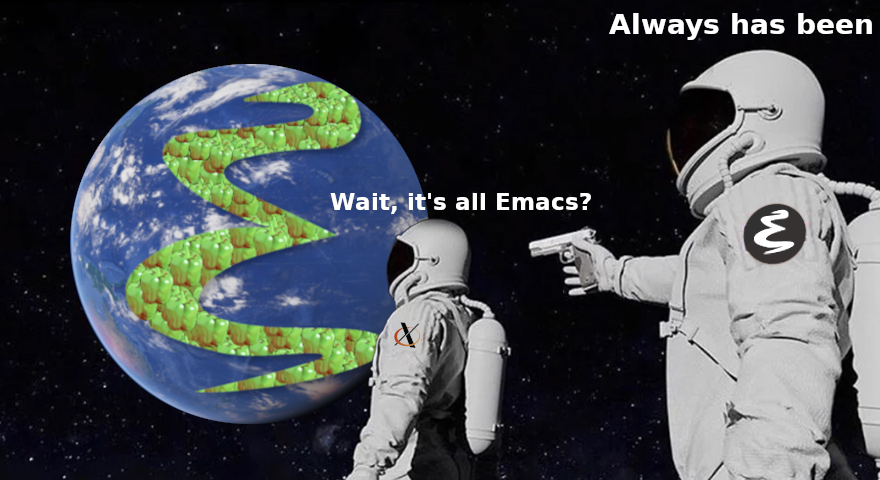
The gravitational pull of Emacs

I want things to be simple and without distraction. I want to avoid futzing all the time. To this end, I often try to move away from using Emacs for everything. Emacs is not simple, no matter how hard I try to force it to be simple.

So I pull out the usual inventory of simple writing and note-taking apps, trying to make them fit. Telling myself that this is better for me.

I spend time actually using all those beautiful and simple apps. I love them, and the whole thing starts out with feelings of excitement and relief from the urge to tweak things in Emacs. Everything seems easier. My pinky is relieved. Futzing is reduced to nearly zero.

However, it's not long before I begin to miss the things I'd spent years building for myself in Emacs. I miss Org-mode. I miss Dired and Magit and Howm and Denote. I miss the ridiculously flexible and powerful export features. I miss using something that feels like it was made just for me. Something free and that I have complete control over.

I soon forget about all the time I'd wasted spent futzing with init.el or writing little lisp functions to do some silly and likely unnecessary thing that I love.

Then I'll find myself needing to open an old .org file. I launch Emacs, and I'm suddenly faced with my familiar, comfortable editor. After getting what I need from that .org file, I open my org-agenda just to see what I might have missed. Then I clean up my ~/Desktop folder quickly using Dired. You know, while I'm there.

It occurs to me that I might have been premature in moving away from Emacs 😆. I can feel it happening again: the return. I create a new org-journal entry, just for the hell of it. These entries usually begin with something like, "Uh oh! What I'm I even doing back here?!" It feels familiar. Feels like home.

One hardly notices the feeling of being sucked back into using Emacs. It just happens. It's like gravity. And you're simply there again.

Permalink #

Reduce & Simplify - Bear app

Bear is one of those apps that either clicks with you or it doesn't. Unless you're me, for whom sometimes it clicks and sometimes doesn't.

I'm trying to follow through on my promise to Reduce & Simplify this year, so for the past week, Bear has been clicking for me.

I first used Bear in 2016 and have dipped into and out of it ever since. The reason for leaving Bear has always been that it's "too simple". The reason I end up back in Bear is because it's "so simple". You see how it is?

For the past few years all of my note taking and most of my writing has been done in Org-mode files using Emacs. What an amazing combination that is. I have many custom functions and configurations that help make using Emacs fast and efficient. I can't even tell you how much time I've spent configuring Emacs exactly to my liking. And that's the problem. Nearly every time I use Emacs, I end up digging into my giant init.el file to make "just one little change". Then suddenly it's two hours later and I'm reading Reddit posts about how someone somewhere did something similar. It's fun, but it's becoming less important to me.

All of the above also applies to Obsidian. The only difference is that it's quicker to get rolling in Obsidian. But also, the influencer-driven community around Obsidian makes finding useful information even more difficult. Why am I wasting time looking for a "better" plugin right now, anyway?

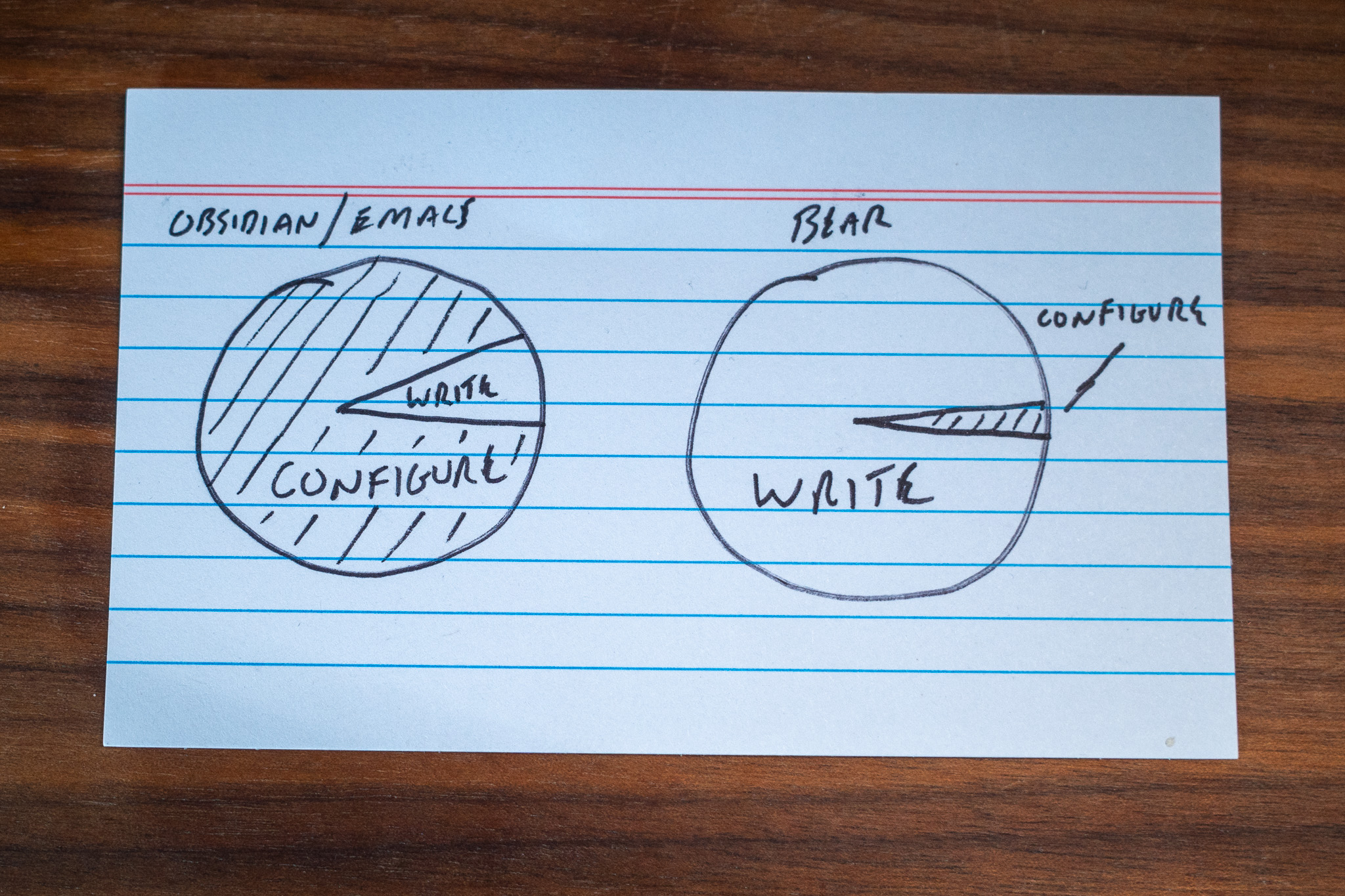
Time spent configuring vs writing in Obsidian or Emacs vs Bear

With Bear, there's not much to do other than write. Sure, it can be tempting to venture off into the weeds of #nested/tag/efficiency, but that gets boring pretty quickly. I admit to adding a few Raycast extensions and a Shortcut or two, but after a couple of days, I feel like I've done everything I need.

Another thing I like about using Bear is the lack of file names. After spending years rearranging my file naming scheme every six months or so, it's liberating to simply not care. Spaces in names? Don't care. Date prefix? Nah. Standardize on lowercase? Doesn't matter. And I don't have to think about where to put anything. How refreshing!

"But is it future-proof?" Well, if Bear goes away tomorrow, my backups are just a bunch of Markdown files that I can continue to use however I choose. Plus, notes can be exported in many formats at any time. That's future-proof enough for me.

Using Bear feels great right now. It's beautiful to look at, pleasant to use, simple, and it syncs everywhere with no additional dependencies. I'm spending most of my time in Bear writing notes rather than playing with Bear. Will I become frustrated by Bear's constraints? Maybe, but right now I'm Reducing & Simplifying and that feels good.

Permalink #

Small company blogging tools and the Lindy effect

There are times I don't feel like blogging the hard way[1]. When that happens, I look to simple, hosted, CMS-based blogging tools.

Recently, I've been experimenting with Pika and Scribbles. I like both of them. They are both simple, clean, easy, and inexpensive. Choosing either of them for a blog would be fine.

There is one thing that concerns me a little, and that is the hobby nature of these tools. I don't mean to be dismissive by calling them "hobbies", but I can't help but feel that these kinds of tools are always at risk of being abandoned when their authors' attention shifts to something new.

This is one reason I no longer use any of Dave Winer's stuff, no matter how clever. They tend to just go away.

One exception I know of is Blot.im. I've been using Blot on and off since 2017. David still updates it regularly and still answers emails quickly whenever there's an issue.

The Lindy effect applies here, and is worth thinking about when considering new tools.

I'm happy to support these efforts. I subscribe to Blot and have paid for a lifetime subscription to Scribbles. I'm still evaluating Pika. The decision about whether to actually commit to them for my blog is more difficult.


  1. By "hard" I mean having to do everything myself, like with Kirby, Hugo, Tinderbox, etc. ↩︎

Permalink #

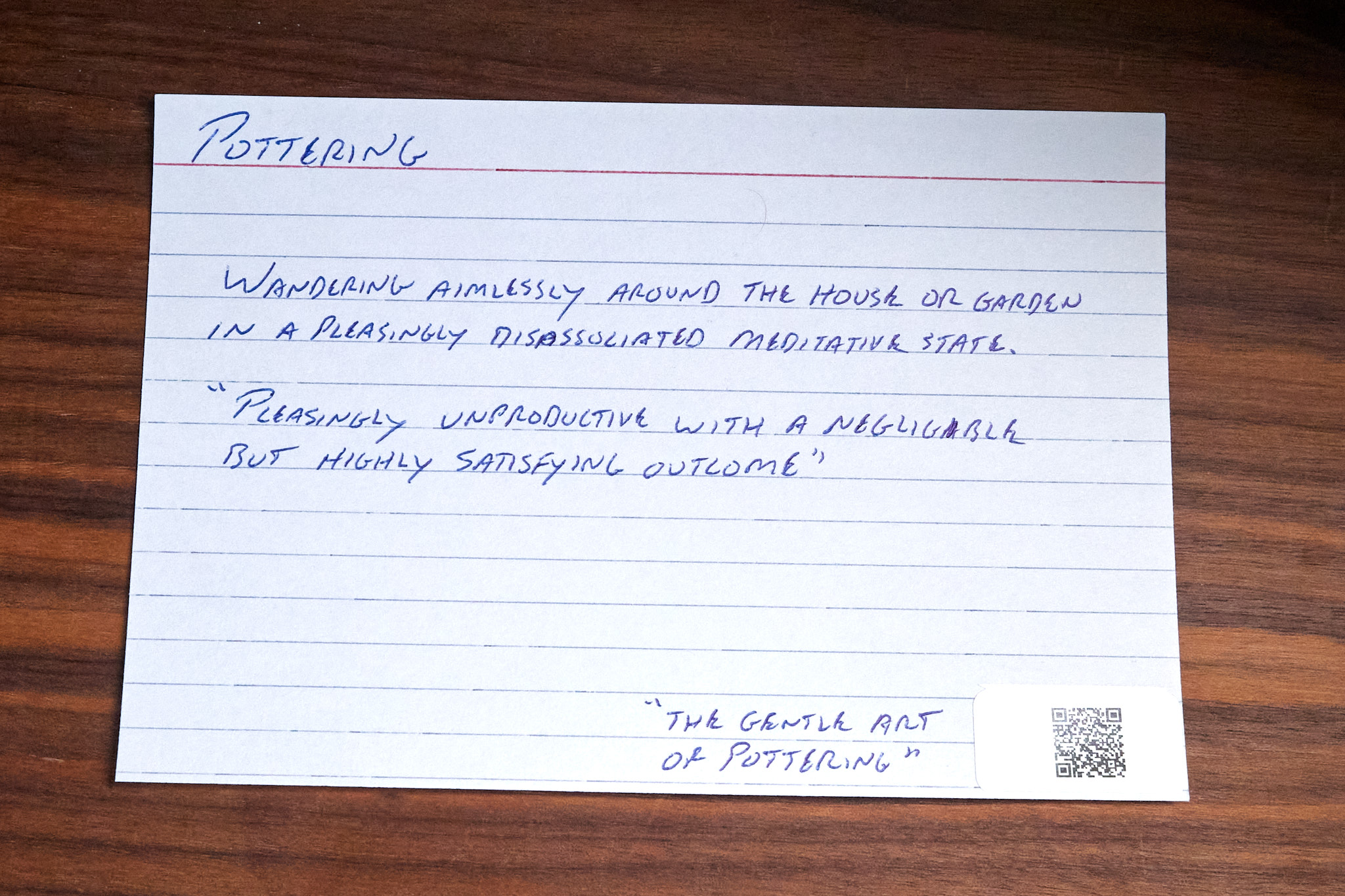
QR codes and index cards?

When I write a quote or note on an index card, I try to record some version of a reference. Most often this is just a title, author, and date of the article or book. When I need to revisit the source, I then need to look it up based on what I'd written on the card. This is fine for physical books, but I had an idea today that could make it easier for digital sources.

What if I put a QR code pointing to the source right on the index card?[1]

I have a little Niimbot label printer that can print QR codes. I just paste the URL, and it generates the QR code automatically. What I don't love about it is that I have to get out my phone to make the labels and the app is pretty awful. And trying to run the iOS app on macOS is an exercise in frustration[2].

Here's my first run at this:

The QR code could contain anything, really. Not only URLs. I could encode a link into an Obsidian vault, or the path to an Org-mode file, etc.

I'm not sure yet if this is a terrible idea or not, but I feel like it's worth a try.


  1. Maybe everyone is already doing this, but I've not seen it mentioned. ↩︎

  2. I'd love to hear recommendations for better label printers. ↩︎

Permalink #

I've already stopped using Hey email

After a time away from Hey email, I impulse subscribed again. And once again, after a short time, I already don't want to use it. I have reasons.

When Hey (hey.com) email was first launched, I signed up immediately. It was a fresh take on email and it felt nice. Hey either resonates with you or it doesn't. With me, it did. I paid for a year or two, and used it (on and off) for a long time. I never fully adopted my jbaty@hey.com email address because, well, I know me. Also, I already have an email address.

I still think Hey is a good service. Its opinionated way of dealing with email is clever and useful. However, I can't get over the fact that it doesn't use normal IMAP. This means there's no way into my email other than using the Hey web interface or iOS app. It's fine, but makes me feel trapped. Email is one of the few remaining things we have that doesn't lock us in.

Linking to emails is something I do all the time. Links to Hey emails are easy to make, since they're just web URLs, but I don't trust using them in my notes because once again, I know me, and those links will be dead once I, inevitably, go back to using "normal" email.

There's something about the web UI of Hey that introduces more friction than I like. It's fast enough, but it just feels a teeny bit janky. I can't explain it, but it wears on me.

A smaller, but irritating aspect of using Hey is that one of the guys who runs the place can't seem to stop saying stupid shit in public. I try to allow people plenty of leeway when it comes to differing opinions, but his keeps getting worse and the smug, know-it-all-ness of it bugs me.

And honestly, I don't get that much email these days, so a fancy workflow for processing it is overkill.

So, I've stopped forwarding my email to Hey and am back in my usual Fastmail->Apple Mail combination. If I get bored, I can always install the wonderful Mailmate or something like it to play with.

Permalink #

Today's software installations

So far today, (as of 9:57 am) I have installed three apps that I had deliberately avoided installing on the new Mac Mini.

MailMate because I just quit Hey but still wanted something different to play with. I've used MailMate on and off since sometime in 2013 I think. It's a powerful, flexible, text/Markdown-first email app.

TheBrain because I'm still looking for the "Everything" app, and in my experience, TheBrain has been the best at that. If I'd never stopped using it, I'd be able to find every single thing and everything associated with that thing.

Bike Outliner because sometimes I just want a quick outline without all the fuss of Tinderbox or Org-mode. Bike is nice for that.

Permalink #

Howm reminds me of TiddlyWiki

Something I've always liked about TiddlyWiki is that I'm never forced to decide where something goes or what it's named. I can simply click on the new tiddler button, type something, and hit save. Links, tags, or other organization can be applied later, but none are required.

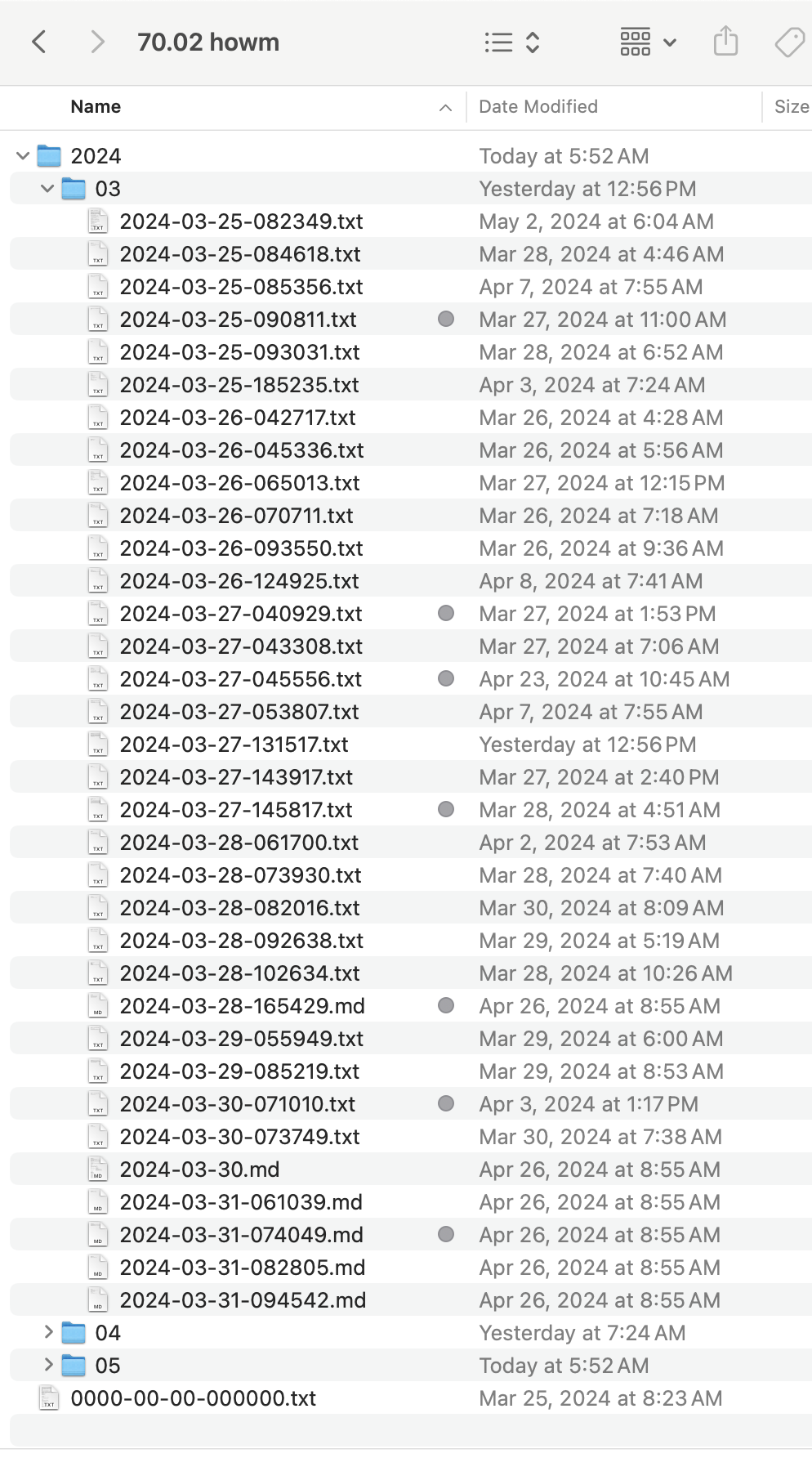
The Howm Emacs package works similarly. By default, Howm[1] notes are organized in YYYY/MM/ folders and file names are automatically created based on the current time, e.g. 2024-05-07-130712.txt. I don't have to think about them.

It's nice to just make a new note and not care where it goes. I sometimes get twitchy about not having useful file names. "What about accessing your notes outside Howm?" First, I never do that. Second, there's grep, Spotlight, or any other text editor that can search a folder full of plain text files. This is not something I need worry about. In fact, it's slightly better than with TiddlyWiki, since to find something in TiddlyWiki, I need a web browser to open the wiki and search. There's only one useful way in. Of course that's never a problem, but still.

This is fine:

I continue to be surprised by how quickly Howm has become an important part of my workflow. I should write about how the combination of Howm and Denote fit into my process.


  1. I've decided to write it as "Howm" with an initial capital. Howm is an acronym, but I've never seen it capitalized as "HOWM". I don't like it all lowercase, since it feels like it should be treated as a proper noun, so I'm going with "Howm". ↩︎

Permalink #

A Nope page

In the spirit of /Now and /Uses and /Hello pages, I've created a /Nope page.

It's for keeping track of things I don't like or want to do. It's a work in progress, but it'll probably see more updates than my now page 😄

Permalink #

But what if something something?!...

In a post from Andreas:

Well, of course it’s great, even fantastic - for Adobe. They can lure you in with low prices, then gradually make the subscription more expensive, and then move the features you use to the “premium” tier where you have to pay even more. Not to mention that they can remove features on a whim if they feel like it, or charge you even more if you want to keep them. And if you want to keep access to your files, you have to be subscribed until the end of time - “nice pictures you have there! It’d be a shame if you couldn’t open them because you decided to opt out of our subscription model, wouldn’t it?”

I dislike subscriptions. I rage-quit everything Adobe a few years ago in a huff about subscriptions and, well, I don't love Adobe. However, I'm once again paying a subscription to Lightroom Classic and Photoshop.

Why? First, because the product is, overall, more appropriate for me than the alternatives. And second, in seven years of subscribing to the Adobe "Photography" plan, none of the things Andreas mentioned have happened. The price is the same (I'd happily pay double). They've only ever added features (I don't remember a single feature being removed. Has there been any?) If I cancel my subscription, I still have 100% access to my files (I just can't make additional edits).

I'm not trying to single out Andreas. His post just reminded me that these "What if...?!" doomsday scenarios have guided way too many of my decisions. What if [SOME APP] stops being developed? What if Apple behaves even more badly? What if some "proprietary" (usually sqlite, so not really) database becomes corrupted? What if I can't read [FILETYPE] in 50 years?

Of course these things can happen, but how often do they? Basically never, has been my personal experience. And if they do happen, there's almost always a reasonable way out.

Why suffer using something we don't love, on a just-in-case, instead of something we do love and find immediately more useful, because "what if!?"

Previous

Permalink #

Adding when I should be removing

I love software. I love learning what software can do. I love setting up workflows using all the fun software I've learned about. The problem is that this leads to chaos and complexity. Every time.

You're probably wondering what made me think of this. Well, yesterday I was exhausted from fighting with Obsidian and Emacs, so I installed Bear. You see what I mean? I spent an hour this morning importing stuff from Obsidian and cleaning up tags, etc. Bear is so nice and simple and absolutely does not lend itself to tweaking.

Problem solved! Not really.

What about daily notes? What about templates? What about complex exports? Why is folding so cumbersome? Where are the backlinks displayed again?

Sigh. I really appreciate Bear, but can I live in it? Probably not. I love simplicity, but can't abide constraints. I'm screwed, I guess.

Permalink #

Re-calculation

I still keep an actual calculator on my desk, and use it regularly. I find it easier and more "stable" than using either a calculator app or even the built-in calculator in Raycast.

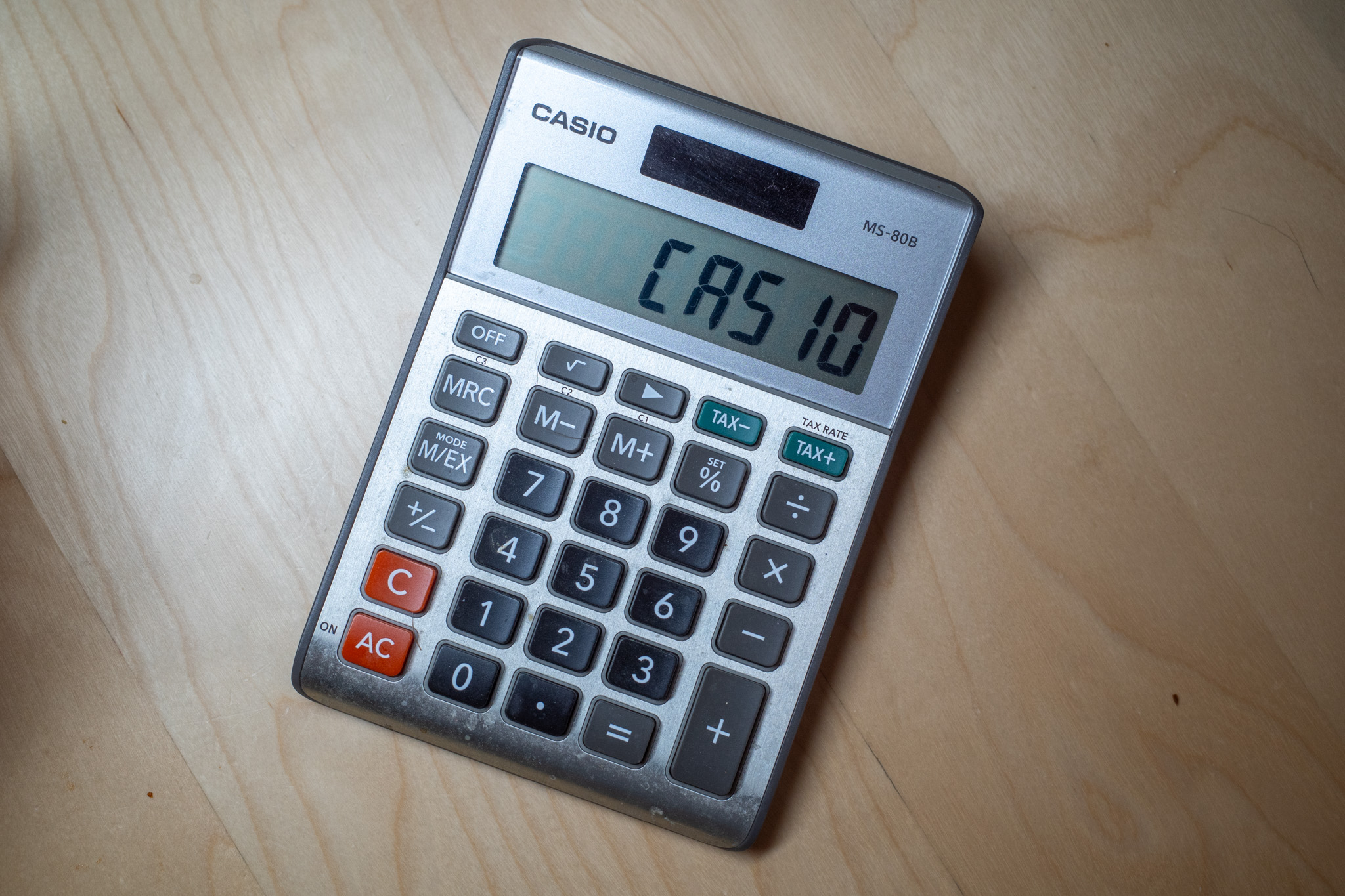
Generic Casio MS-80B calculator

I bought the Casio shown above years ago because it had a large screen and doesn't use batteries. It's fine, but there are a couple of things about it that bother me.

First, there's no "On" button. Ok, there is, but it's buried under the AC button. Bugs me.

The On button issue is bad enough, but that's not why I hate the Casio. I hate the Casio because when I turn it off, the screen reads "CASIO" for a few seconds before actually turning off. It's like watching a little ad each time. I hate it, so I bought a new calculator.

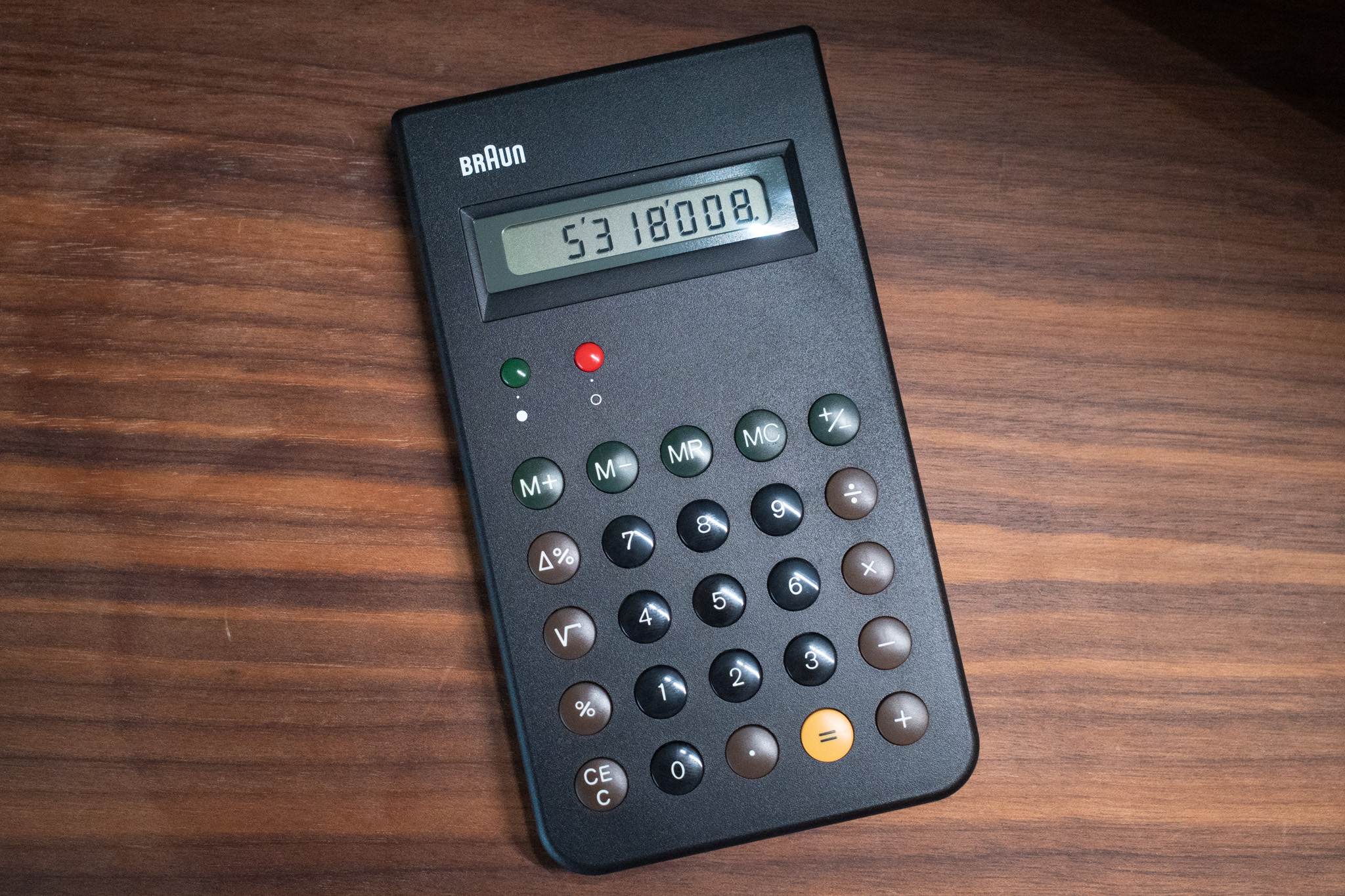
Reissued Braun ET66 calculator

This is the re-issued version of the iconic, Dieter Rams designed Braun ET66 (1987). I recently watched the Dieter Rams documentary, "Rams" (2018), which reminded me of the Braun, so I thought this model would be a fine choice.

I like it. It's simple, clear, does what I need, and looks good doing it. And it doesn't shout its own name every time I turn it off. Much better.

Permalink #

Using the Apple Extended Keyboard II

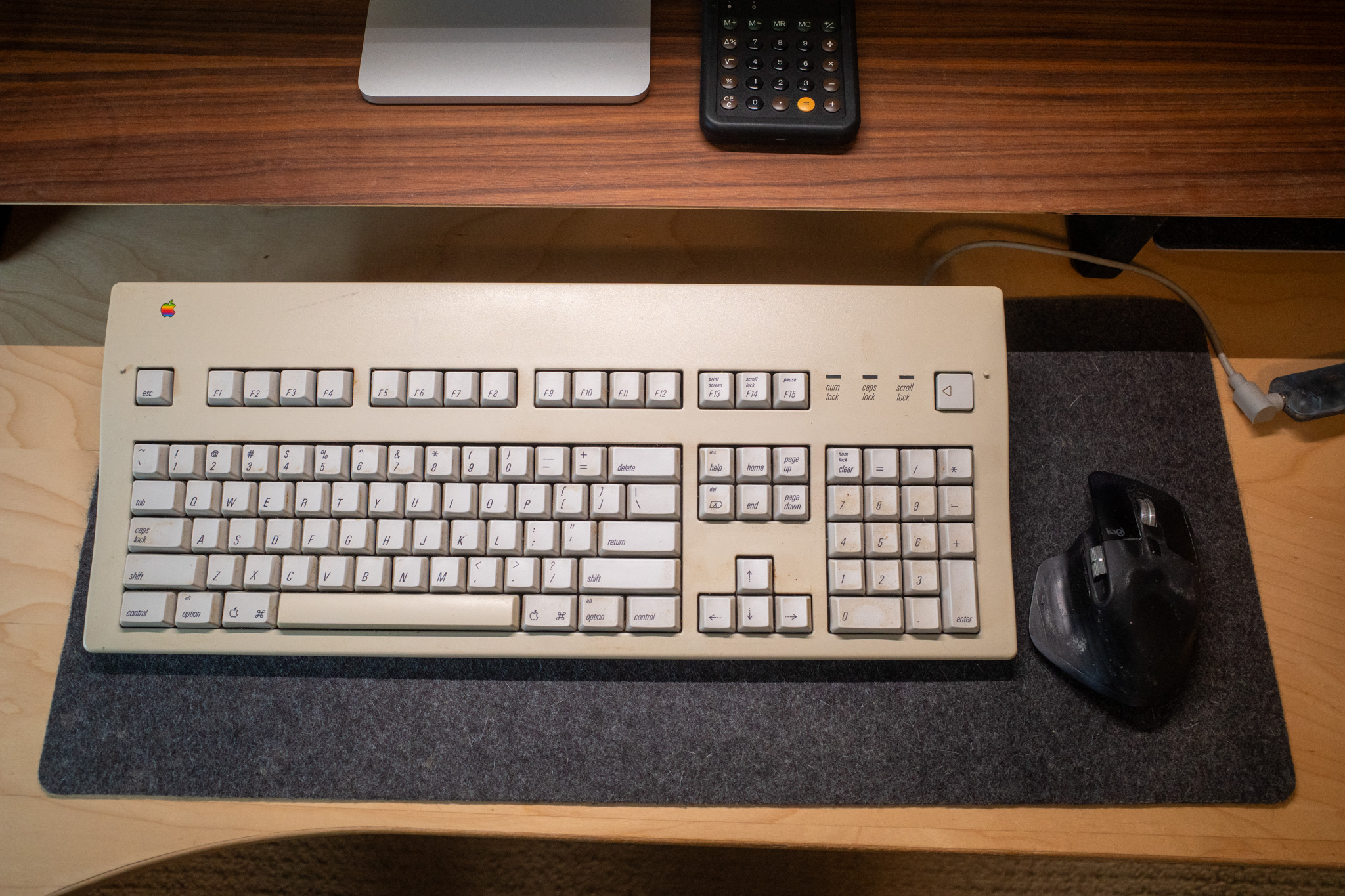
Look what I found in the garage:

Apple Extended Keyboard II

It's my old Apple Extended Keyboard II from 1990 or 91. I last used this one in 2015.

The AEKII uses an ADB port, so I had to dig out my ADB->USB-A adapter (save everything!). I'm typing this post on the keyboard right now. The Alps switches are as great as I remember, and might be my all-time favorite switches.

Beyond the great switches and nostalgia, using the keyboard leaves a bit to be desired. First off, it's enormous. It takes nearly all of my felt deskpad and leaves barely enough room for a mouse. And speaking of the mouse, the size of the keyboard means that the mouse is over 12 inches away from my right hand. Reaching for it is a whole thing.

Another quirk is that the little home row nubbins are on the D and K keys. On newer Apple keyboards, they are on the F and J keys. I can't tell you how many times I've had to delete a bunch of gibberish and reorient my hands while typing this.

I could get used to the size, but the AEKII's Caps Lock key can't be mapped to Control because it physically locks down when pressed. It thinks it's a manual typewriter, I guess. This is a deal-breaker.

Even though it'll probably end up back in the box soon, it's fun using a 34-year-old keyboard that still works and is, in many ways, better than anything made today.

Permalink #

Lightroom (Classic)...again

I switched from using Lightroom Classic (LrC) to Capture One Pro (C1) "for good" back in 2021. It wasn't because of Adobe's subscription model, or because I had some vague aversion to Adobe, the company. It was because I felt like I was getting better images, faster, with C1.

I kept a few notes on Lightroom Classic vs Capture One but haven't updated it in a while, so here are a few notes about why I have moved back to Lightroom Classic.

C1 has become laggy for me. I'm working on either a MacBook Pro M1 Max or Mini M2 Pro. Nothing should be slow on these machines, but whenever I move a slider in C1, I have to wait a couple of seconds while it catches up. This gets pretty annoying.

C1 never seems to improve its cataloging features, which have always felt a bit lackluster. I like C1's "sessions", but then I need some other app for cataloging. I'm working on using less software, not more, so cataloging is important.

Aside from specific issues, the thing that has put me off C1 is that over the past couple years, Capture One (the company) has made some moves that have affected how I feel about C1, (the app).

Capture One now basically forces me to pay for a subscription, and it's expensive. I know I said that subscriptions weren't the reason I switched, but that doesn't mean I like subscriptions. I don't.

More importantly, they've become increasingly focused on professional, in-studio customers. That's great for pros, but I'm just a guy who likes to take pictures. I'm paying a lot of money for software that is becoming less relevant to me.

The latest beta update of C1 introduced a "Studio" version and includes things like Client viewers and "Live" for Studio. These are not just less useful to me, they are useless to me. I started wondering if I'd be better served by Adobe. That was a surprise.

So I forked over my $10 for the Photography Plan subscription and installed Lightroom Classic and Photoshop (still one of the best deals going, regardless of how one feels about subscriptions). I resisted the temptation to install the new Lightroom, because I know how that ends.

I started by importing everything from 2020 through today. Since I'd used LrC for years, I was immediately comfortable. I made the few changes that LrC allows to the UI and settings, imported my old presets, set up my export templates, and was off and running.

It was nice to have nearly-instant response while spotting film scans again. It's good to have a catalog that feels robust. LrC feels tighter than C1 somehow. And the community is so big. Almost too big, honestly. It can be overwhelming. Adobe's huge ecosystem is valuable. I've never been great in Photoshop, but I'm better there than in one of the "other guys" like Affinity. And if I don't know how to do something, a dozen YouTube videos showing me how are within arm's reach.

I'll miss some things about C1, certainly. I'll miss the wildly-customizable UI. I'll miss that hitting "Auto" is often all I need. I'll miss the fancier exports. I'll miss the culling features during imports. And if I ever do get in a studio, I'll miss the flawless tethering.

If Capture One ever decides to cater to amateurs like me as well as pros, I'll take another look, but for now, I'm in Lightroom Classic. I feel a little dirty about it, though.

Originally posted on Scribbles: https://scribbles.baty.net/post/lightroom-classic-again

Permalink #

Using the reMarkable 2 as Read-Later device

I know, I know, the reMarkable 2 tablet is designed as a digital replacement for writing on paper. It's not necessarily meant as a document reader. But that's what I've been using it for.

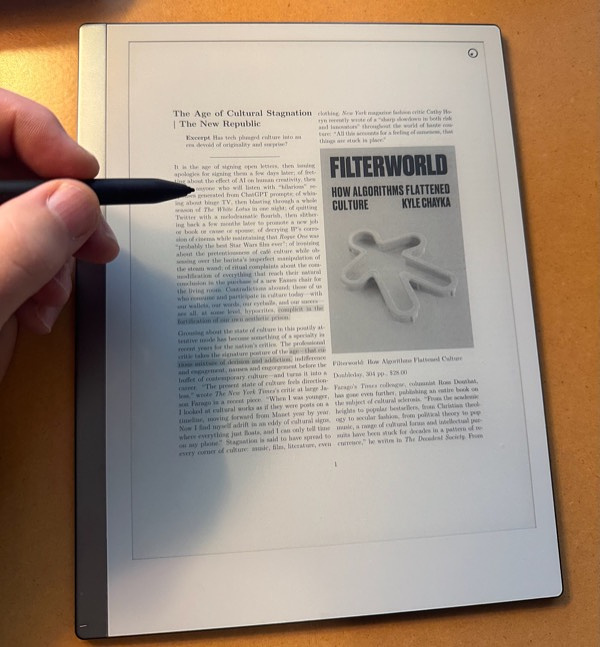
Reading PDF on reMarkable 2

For years now I've saved web articles as Markdown files, converted them to PDF, and printed them for reading later. See My read-later service is made of paper.

I wanted to see how reading PDFs felt on the reMarkable, so I copied a few of my saved article PDFs to it. It turns out that I liked it very much. Highlighting text with the stylus works great, and I can even choose the color of the highlights, which don't display on the device, but they do on the actual PDF.

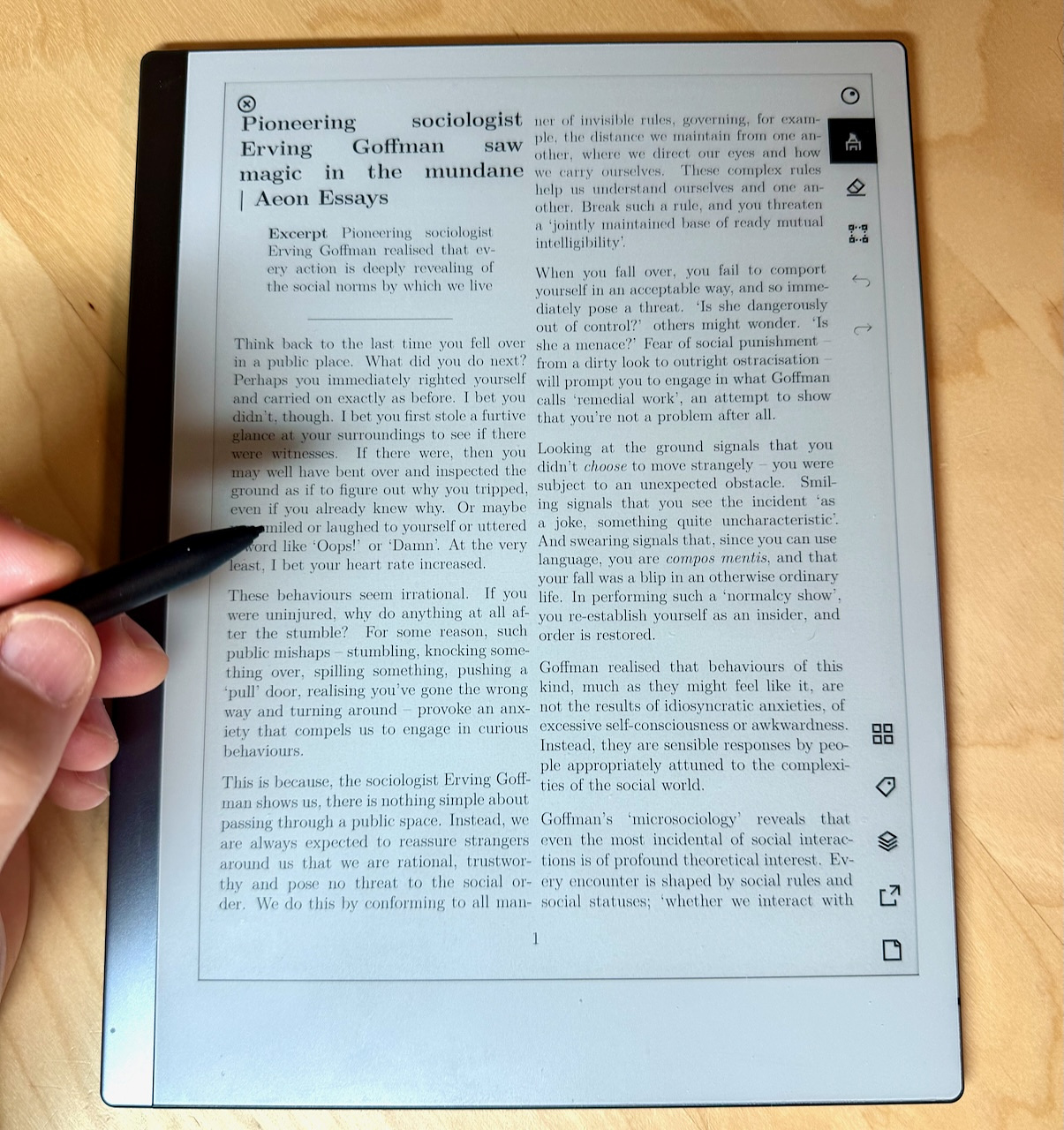
My only complaint was that the text was too small. To fix this, I made a new Pandoc template so that the font was larger, and the margins were smaller. I included some extra room on the right, so that the reMarkable toolbar doesn't cover the text. The script outputs the PDF directly to the Dropbox folder I have synced with the tablet. Here's how it looks with the updated template.

A PDF using my updated Pandoc template

Nice, eh?

I create these by converting articles to Markdown using the Markdownload plugin. From there, I open the file in BBEdit and run a shell script which runs Pandoc to generate the PDF. Both the script and Pandoc template can be found here if you're interested. Note that they would need to be tweaked for your environment. This can easily be done via command line or just a shell script, but I've had it configured via BBEdit for so long that it's habit.

Permalink #

Emacs Howm package for notes

howm is an Emacs package for taking notes. It was recommended to me recently, so I thought I'd take a look. The project page says "howm: Write fragmentarily and read collectively." Worth a shot, right?

I haven't seen too many people talking about howm. The best introductions I've found are from Leah Neukirchen and Andrei Sukhovskii.

I installed it via use-package with the following

;; howm package config

(use-package howm :ensure t
  :config
  (setq howm-directory "~/Documents/howm/")
  (setq howm-home-directory "~/Documents/howm/")
  (setq howm-keyword-file (expand-file-name ".howm-keys" howm-home-directory))
  (setq howm-history-file (expand-file-name ".howm-history" howm-home-directory))
  (setq howm-view-use-grep t))
;;  (setq howm-view-grep-command "/opt/homebrew/bin/rg"))

;; Fix for help bindings
(define-key howm-menu-mode-map "\C-h" nil)
(define-key riffle-summary-mode-map "\C-h" nil)
(define-key howm-view-contents-mode-map "\C-h" nil)

;; Sensible buffer names
(add-hook 'howm-mode-hook 'howm-mode-set-buffer-name)
(add-hook 'after-save-hook 'howm-mode-set-buffer-name)

I couldn't get the rg settings to work, so I'm still using grep. It's fast enough for this test.

If you're interested in getting started with howm, you should read the articles linked above. Here's what I found interesting.

  • Major mode doesn't matter. Howm works with everything from plain text files to Org-mode.
  • It's date-centric. Most actions prioritize temporal nearness and files are named with just a date string.
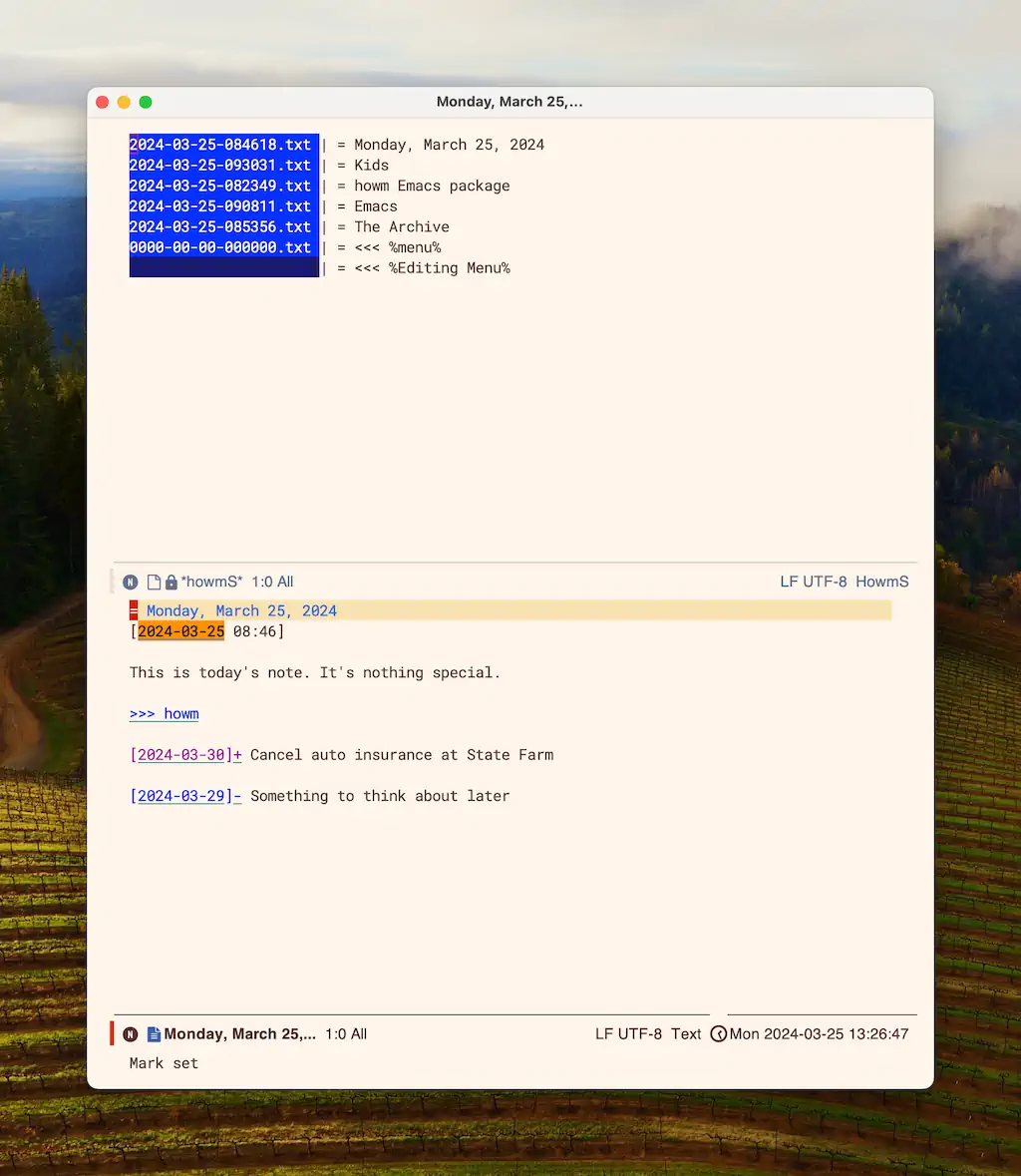
  • There are some clever built-in todo/scheduling features. Just put in dates like [2024-03-25]+ and howm figures out how and when to show it.
  • Linking and backlinking are simple. Put >>> some phrase anywhere and it turns into a link which searches for that phrase when clicked. Put <<< term in a note and every other occurrance of that term will be underlined and linked to that note.
  • howm hates evil-mode. If I were to try getting anywhere with howm, I'd need to figure out my own collection of custom bindings in evil-mode because by default they don't get along at all.

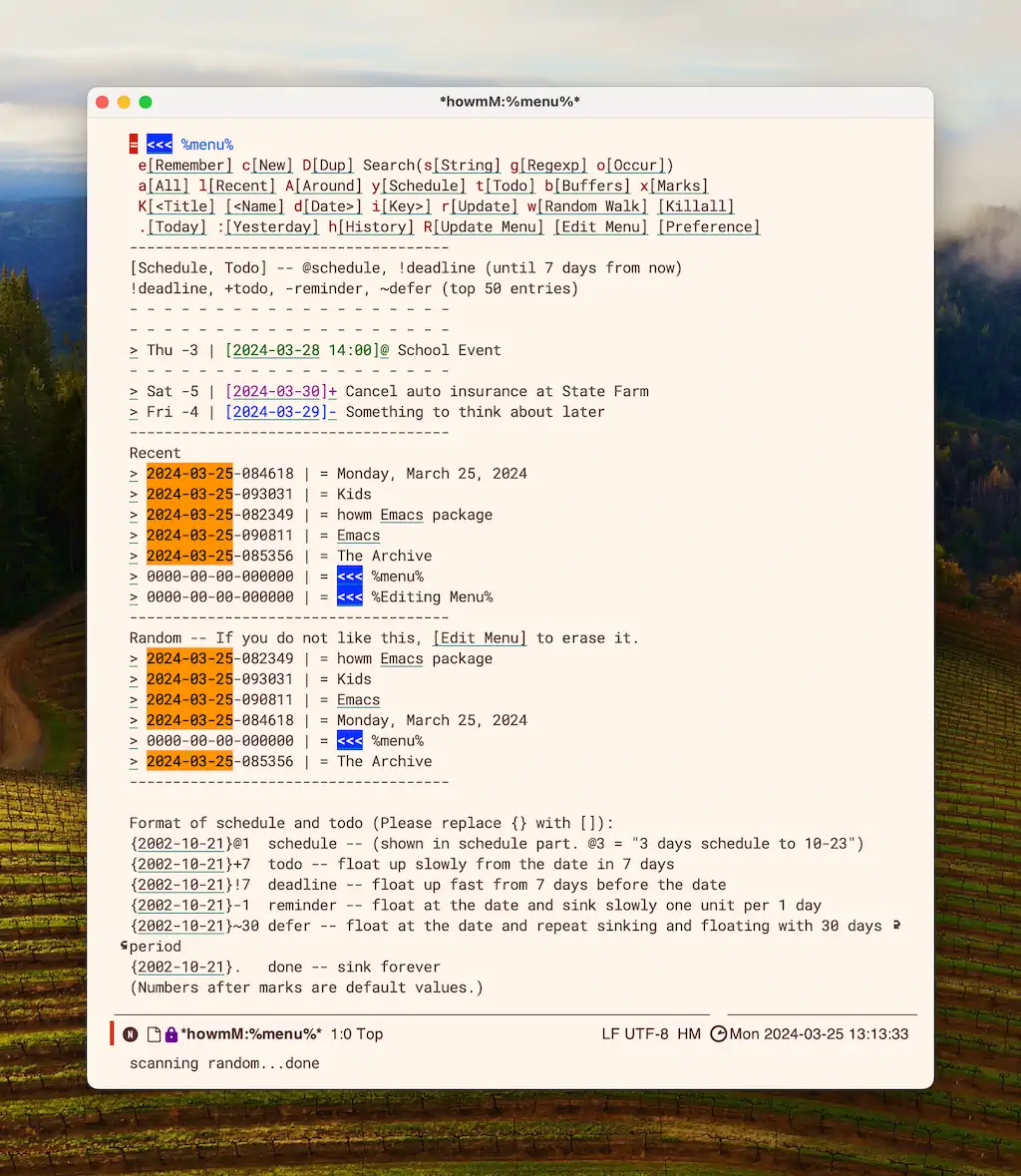
I created a handful of test files, and here's how howm looks so far.

The howm menu. Functional, but not pretty

And here it is browsing some notes.

The howm search and preview/edit windows

Howm is neat, but I don't expect to move my notes into it just yet. I find Denote to be nearly perfect for note taking, so I'm all set. I do think a combination of howm in plain text files and Hyperbole to add some juice would be a nice combination.

Permalink #

OWC miniStack STX and the Mac Mini

When I ordered the M2 Mac Mini I opted for the smaller 512GB internal SSD knowing that, since the Mini would be always-on, I could hang as much storage off it as I wanted.

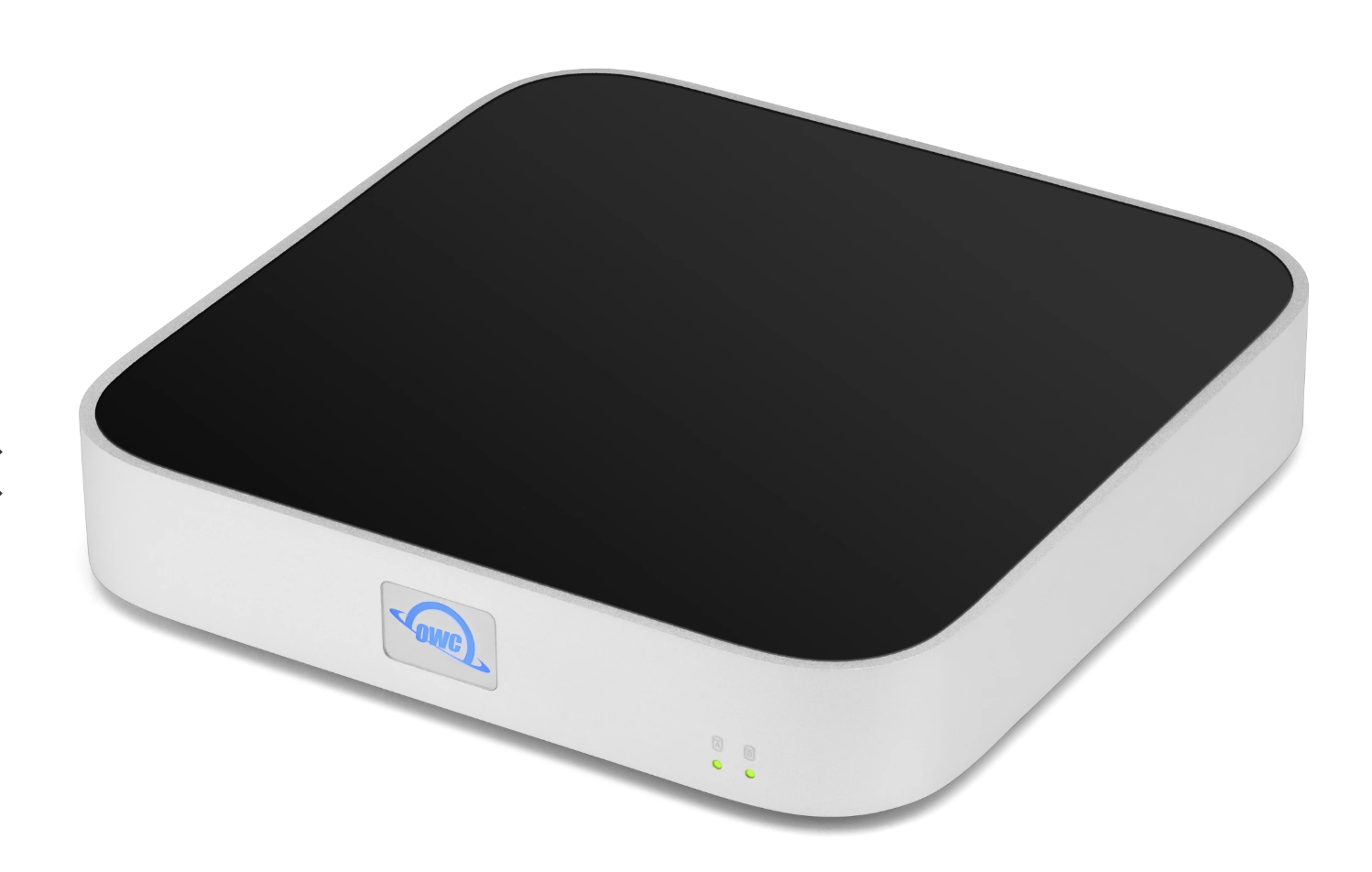
A hodgepodge of external drives scattered over my desk is not the prettiest setup, though. I wanted something cleaner. Something nicer-looking. I went with an OWC miniStack STX.

The miniStack can be ordered pre-configured with a variety of storage options, but I figured I'd save a few bucks and set it up myself. I ordered a 2TB Gen 4 M.2 NVMe stick and a Seagate IronWolf 8TB HD. It took about 10 minutes to install both drives into the miniStack and I was ready to go.

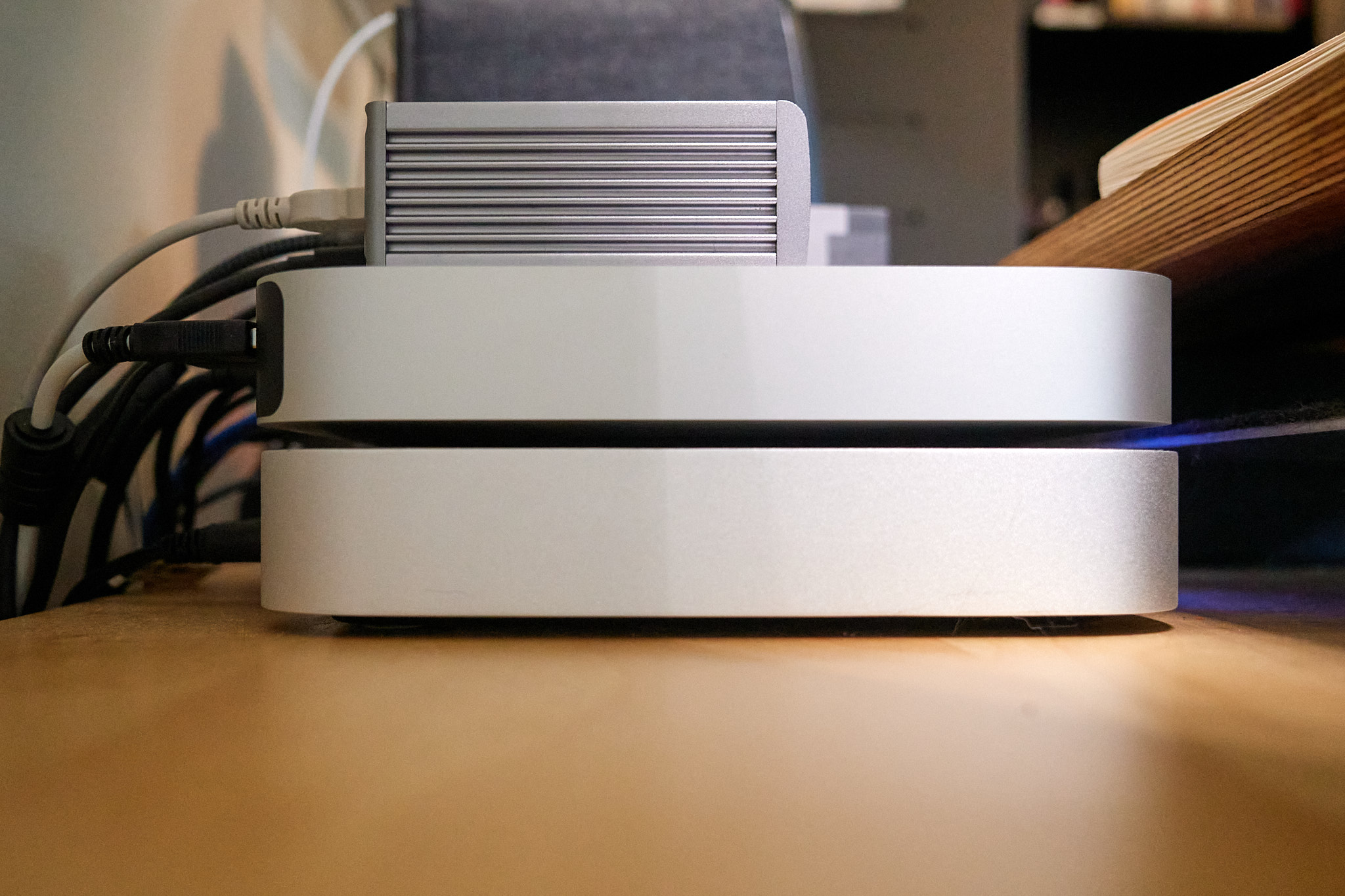
The whole point of the thing is that it is the exact dimensions of a Mac Mini. It sits underneath the Mini and so takes up zero additional desk space. This is way better than normal external drives.

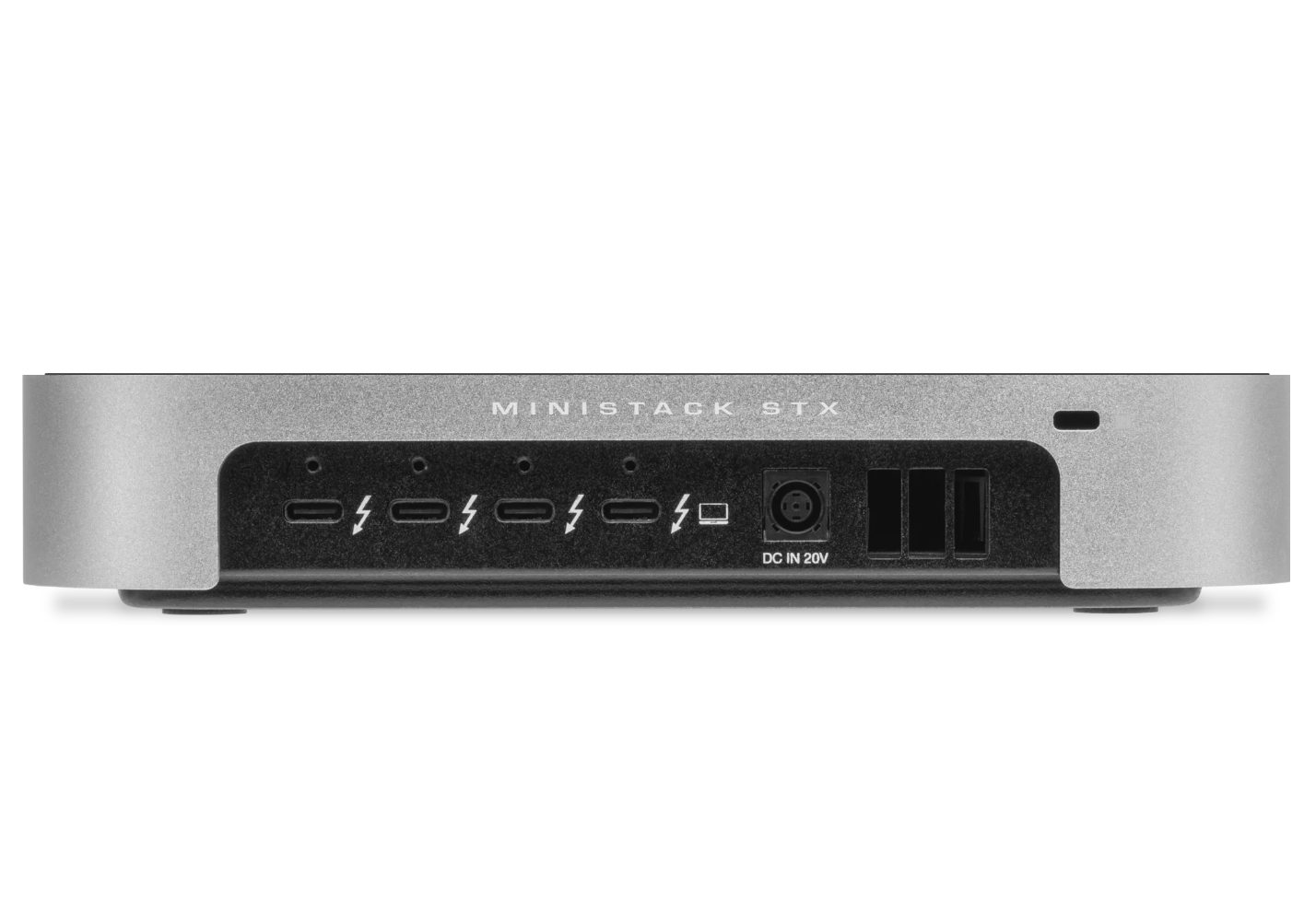
An important bonus with the miniStack is that it adds three Thunderbolt 4 ports (actually four ports, but one is used by the Mini->miniStack cable).

There's a small catch. The PCI bus only uses one channel so top transfer speeds are limited to around 750MB/s. I don't know anything about NVMe drives or PCIe buses so I'm just taking their word for it, but my disk speed test showed around 790MB/s. That's plenty for my purposes.

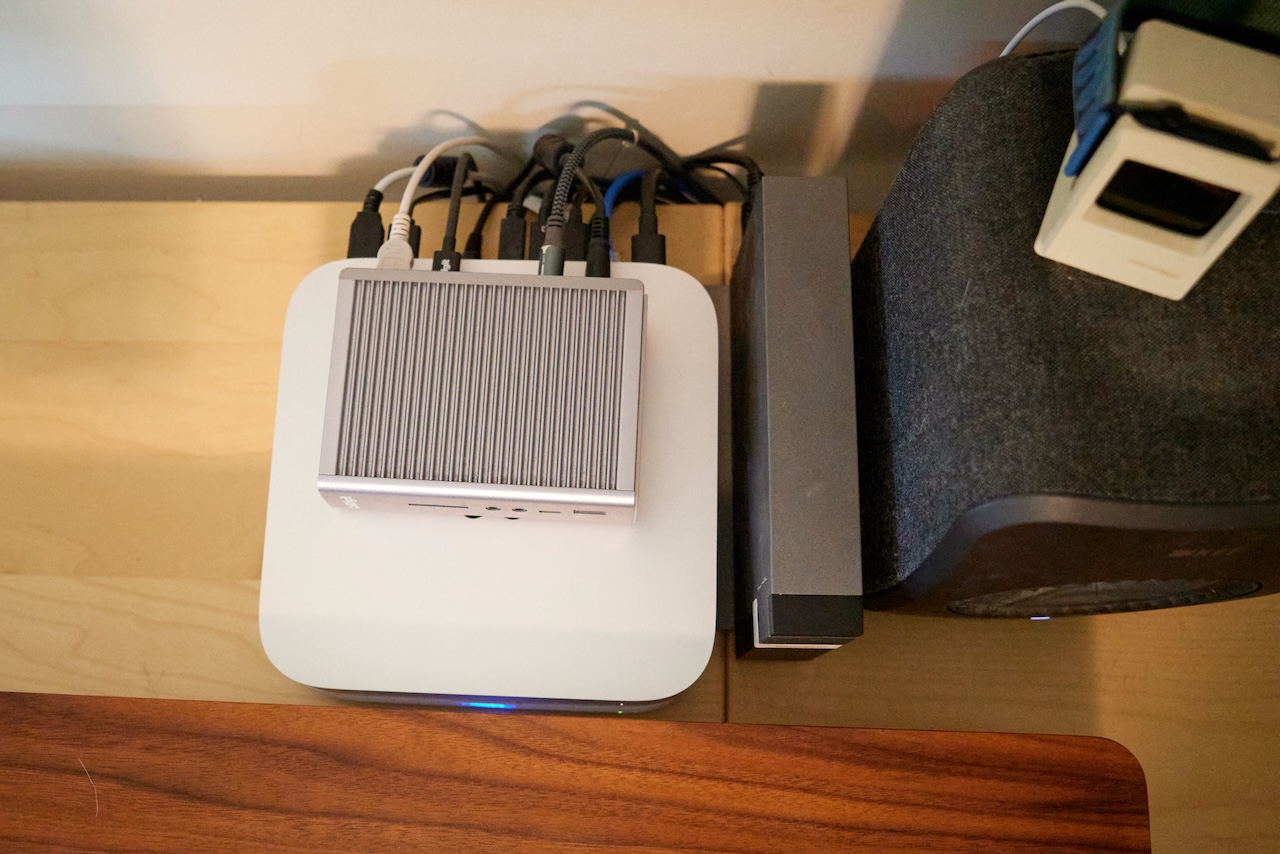
I still need the CalDigit hub for the SD slot, Optical audio, and extra USB-A ports. Here's what the stack looks like:

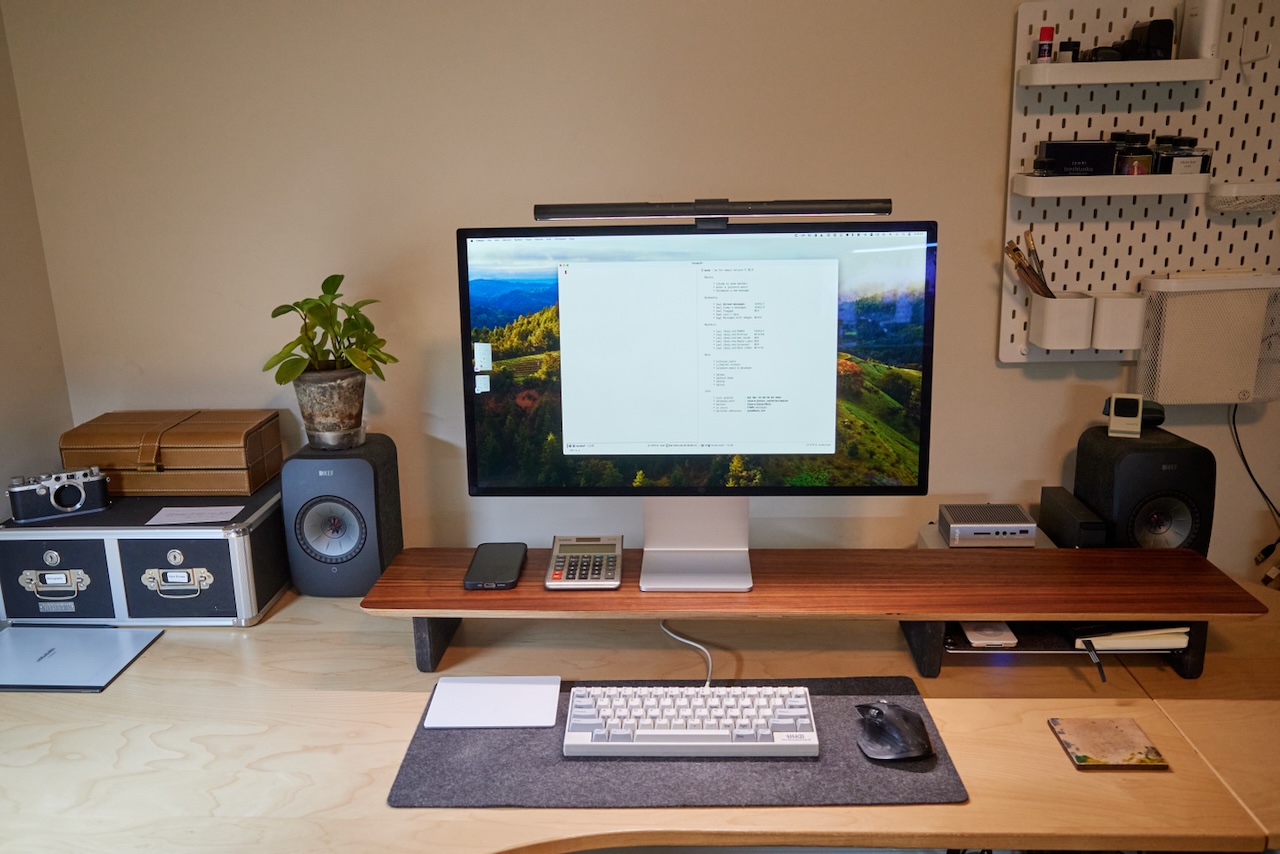
Setting all this up gave me an opportunity to tidy up the rest of my desk. I think it looks great.

So far I've not heard any noticeable fan noise, so that's good. I do hear the HDD grinding away but that's probably due to both Spotlight and BackBlaze doing their things.

The 2TB SSD will be used for working files and recent photos. The big HDD will contain the rest of my media and photo archives, along with anything else I want near-to-hand but don't need fast-transfer access to. That leaves a 1TB SSD (not shown) hanging off the back for Time Machine and the vertical 8TB HDD for nightly backups using Carbon Copy Cloner.

It's a nice upgrade.

Permalink #

What if I stopped worrying about [THING]?

My life would be simpler if I could convince myself to stop worrying about things like[1]:

  • How should I rename photos during import?
  • What if the app goes away?
  • How will I find this later?
  • Are my notes are in the right app or format?
  • What if I switch to Linux?
  • Are file names consistent everywhere?
  • Kebab case or Camel case?
  • Has anyone at the company done anything problematic recently?
  • What will people think of me if I start/stop using this app?
  • Will this be readable in 100 years?

Almost none of these are truly important, even though they all seem very important at the time.


  1. This is a very incomplete list ↩︎

Permalink #

I canceled my Fujifilm X100VI order

I tried, albeit half-heartedly, for 18 months to grab a Fujifilm X100V at a "normal" price. The X100 series are awesome cameras. I still have an original X100, and had an X100T for a while. The original X100 is just so very slow that I don't often grab it. When the new X100VI was announced, knowing they'd probably be in short supply soon, I pre-ordered one at both Adorama and B&H.

After missing out on the first batch of cameras, it was clear that I was in for a long wait. This gave me time to think about cameras.

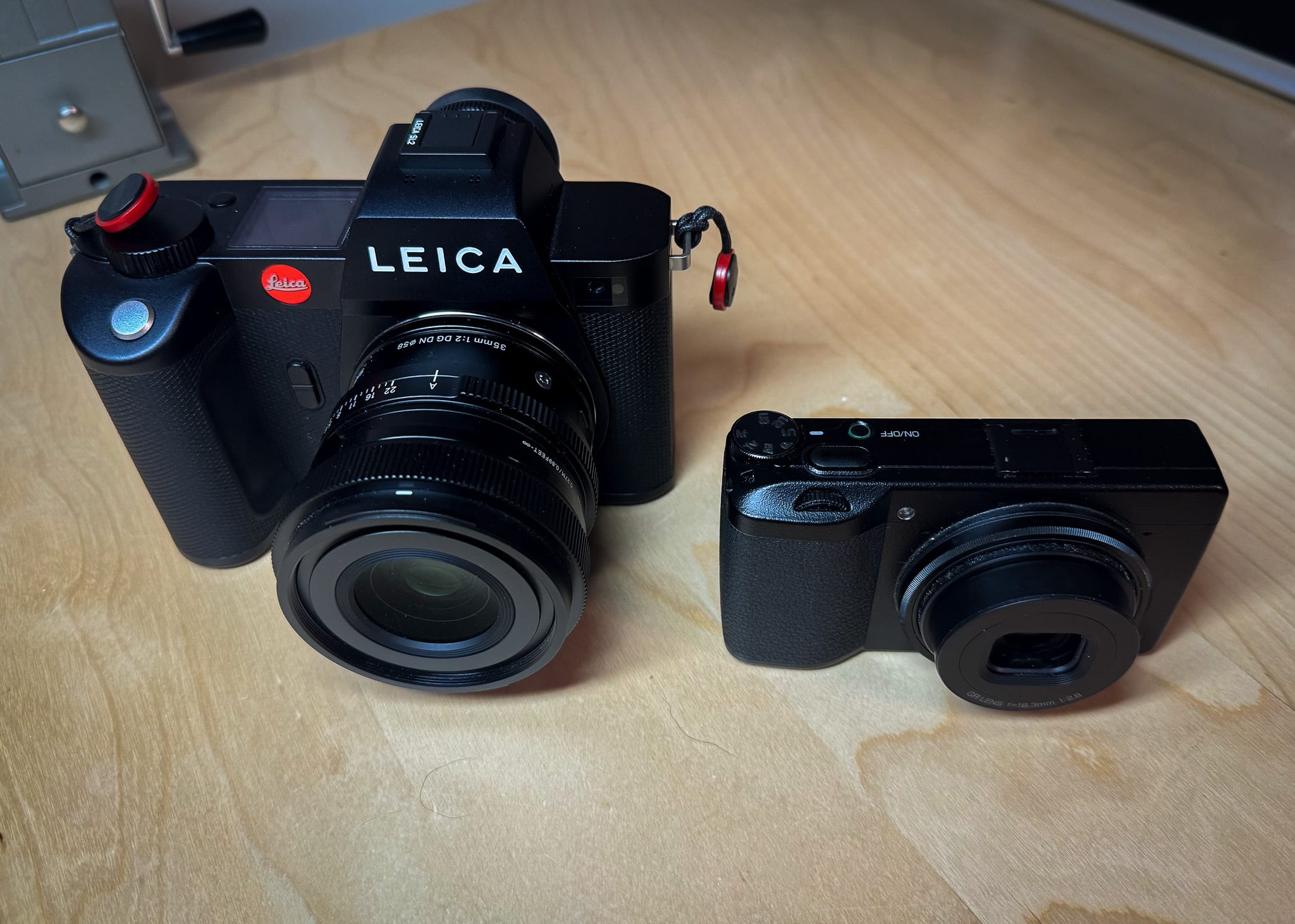
I don't need a new digital camera right now. I'm barely using the ones I have, which are two very nice cameras. See for yourself...

The little GRIII is great for carrying everywhere and I love the files I get from it.

The SL2 is for when I'm being "serious" about photographing something.

Where would the X100VI fit? I suppose it would probably replace the GRIII, but the more I though about it, the clearer it became that I didn't need it, so I canceled my orders.

I would love the built-in flash, optical viewfinder, and 35mm FoV, but until I start actually making photos again, I don't need a new digital camera.

Permalink #